Published on 6/23/2026
Oil and gold prices fell on Tuesday, while the dollar held steady near its highest levels in a year, with traders focusing on a gradual return of crude flows through the Strait of Hormuz, and increasing bets of a US interest rate hike this year.
At the time of writing these lines, Brent crude fell by 1.43% to $76.79 per barrel, and West Texas Intermediate crude fell by 1.41% to $72.82, continuing yesterday’s losses on Monday, which exceeded 3% after America granted Iran an exemption from sanctions for a period of 60 days following initial talks.
Read also
list of 4 itemsend of list
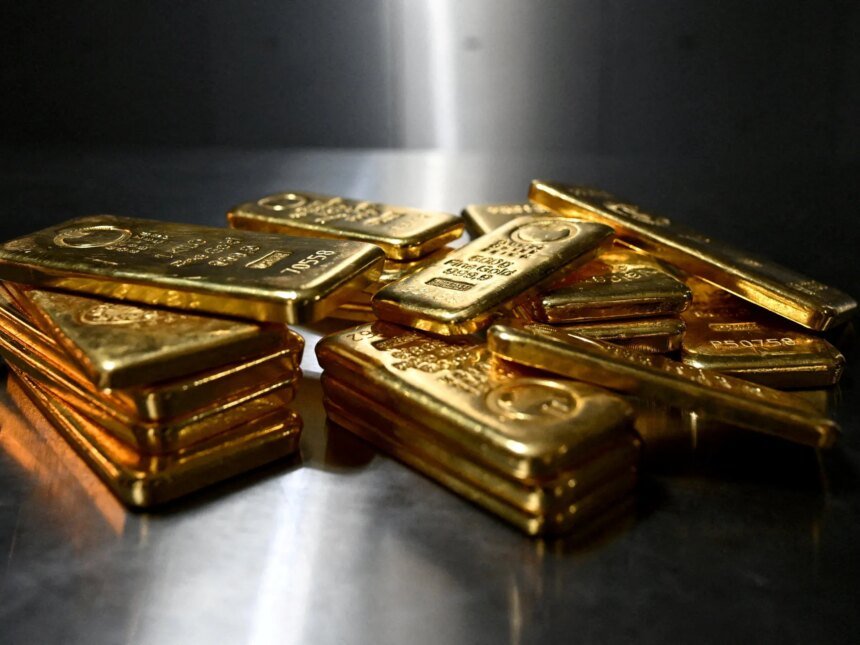
Gold fell by 1.78% to $4,116.83 per ounce, silver fell by 4.31% to $62.25 per ounce, while platinum fell by 2.71% to $1,626.90, and palladium fell by 3.34% to $1,228.50, with pressure from the strength of the dollar and expectations of tightening US monetary policy.
In the currency market, the dollar index rose to 101.049 points, the euro moved at $1.14289, and the British pound at $1.32348, while the Australian dollar reached $0.69556, the New Zealand dollar reached $0.56882, and the yen traded near 161.42 against the dollar, close to levels that raise concerns for the Japanese authorities.
Hormuz flows
According to Reuters, oil prices continued to decline amid indications of progress in the return of crude flows through the Strait of Hormuz after the US-Iran talks, while the market is still monitoring the stability of navigation in one of the most important global oil corridors.
Ship tracking data showed that two crude oil tankers carrying slightly less than two million barrels sailed through the Strait of Hormuz yesterday, Monday, in an indication of a recovery in traffic after flows declined on Sunday due to concerns about traffic through the Strait.

The agency quoted a note by ING Bank analysts that the gradual increase in oil flows through the Strait of Hormuz is still affecting the market, while the head of the research department at Sparta Commodities, Neil Crosby, said that the increase in transit operations over the past days will be considered by the market to be an indicator of an improvement in actual oil, contracts, and diplomatic progress.
The developments came after the beginning of a week in which the calm seemed threatened, as US President Donald Trump threatened to resume the war if Iran closed the Strait of Hormuz, before indicators of talks and the resumption of some flows pushed prices down.
Chief market analyst at KCM Trade, Tim Waterer, said that a dose of doubt still prevails in the market due to the lack of trust between Washington and Tehran, considering that the return to pre-war oil levels may be delayed and does not appear immediate.
Analysts polled by Reuters expect US crude oil inventories to decline last week, along with distillate and gasoline inventories, as the market monitors the impact of the return of Iranian barrels and the potential for increased supply.
US Department of Energy data showed yesterday, Monday, that crude oil stocks in the Strategic Reserve fell to 331.2 million barrels, the lowest level since June 1983, with supplies shrinking following the outbreak of the Israeli-American war on Iran.
gold
Gold lost some of its luster with the consolidation of the dollar and the increasing expectations of a US interest rate hike, as the rise of the US currency and the rise in bond yields reduce the attractiveness of the precious metal, which does not generate a return.
US Vice President J.D. Vance said that talks with Iranian officials in Switzerland laid a good foundation for a final agreement, despite Iran’s denial of starting discussions on its nuclear program, which eased some of the demand for safe havens.
Chicago Fed President Austin Goolsbee said that, with the labor market stabilizing, he is focused on seeing whether high inflation will remain there or decline as the impact of higher tariffs fades and if the conflict in the Middle East is resolved.
According to the CME Group’s Fed Watch tool, traders see an 88% probability of a rate hike in December, compared to 61% before the Federal Reserve meeting last week.
Investors are awaiting US personal consumption spending data, the Federal Reserve’s preferred measure of inflation, due later this week for additional signals on the path of monetary policy.

Dollar and yen
The dollar held firm as US Treasury bond yields remained high, as the two-year bond yield, the most sensitive to interest expectations, hovered near 4.21% at the time of writing, after approaching the highest level in 16 months.
Reuters quoted foreign exchange analyst at OCBC, Sim Moh Siong, as saying that the dollar is stabilizing with the support of rising yields and expectations of monetary tightening in the Federal Reserve policy, with increased volatility due to limited guidance issued by the central bank.
The yen remained near the lowest level in decades, as exceeding the level of 161.96 against the dollar would push it to the weakest level since 1986, at a time when a source told Reuters that Japanese Finance Minister Satsuki Katayama held an online meeting with US Treasury Secretary Scott Besent amid fears of sharp fluctuations in currencies.
As for the pound sterling, it remained relatively stable after the resignation of British Prime Minister Keir Starmer, which paves the way for an orderly transfer of power, while the euro remained near its lowest level in 3 months after European Central Bank President Christine Lagarde reduced inflation fears in the second quarter.