Published on 6/23/2026
|
Last update: 14:30 (Mecca time)
French newspapers unanimously considered the current heat wave an exceptional event that reveals that France has entered a new phase of climate extremes, and that what was considered an exception has become a recurring reality.
It also agreed that the country is recording unprecedented numbers, whether in the number of areas covered by the red and orange alert or in night and day temperatures, with warnings that the 2026 wave may rival or exceed the 2003 and 2019 waves in terms of intensity and breadth.
Read also
list of 2 itemsend of list
Most of these newspapers believe that the crisis is no longer just a passing health challenge, but rather a test of the ability of the state and society to adapt to climate change.
These newspapers pointed out the severe suffering in schools and the fact that more than 1,352 schools and high schools were forced to close due to classrooms turning into “thermal boilers.”
She concluded that the “step-by-step” crisis management policy or immediate solutions such as purchasing portable air conditioners before exams are no longer effective in the face of structural climate change.
Le Monde was the only one to publish an editorial with a sharp political nature, in which it focused on the necessity of changing the prevailing intellectual model and bringing the issue into the heart of the upcoming electoral battle.
She strongly criticized the far-right and right-wing forces for rejecting environmental measures and considering them “punitive policies,” and also criticized the left for being distracted by personal conflicts.
In this regard, the newspaper borrowed the famous warning of former President Jacques Chirac, saying: “Our house is burning, and we are still looking elsewhere… The political world continues not to consider combating global warming an absolute priority.”
Lacroix focused on the documentation aspect, comparing the current wave to the major historical waves of France in 2003 and 2019.
It presented an analysis of national thermal indicators, through which it explained how the danger of the 2003 wave, to which the death of 15,000 people was attributed, lay in the “suffocating nights” in which the temperature did not drop below 25 degrees, which was repeated in the current wave, as it recorded nearly 25 degrees at night in Tours and Poitiers.
It quoted the director of the French Meteorological Authority, Sophie Voirin, as saying that the 2026 wave will be “similar to the waves of July 2019 and August 2003 in terms of heat intensity,” with a new record being set, represented by the inclusion of 89 French departments in the red or orange warning, which is the largest since the establishment of the heat warning system.
The Media Part website moved away from numbers and policies to document the human experience of citizens, through the testimonies of more than 25 people from various parts of the country, and one of them summed up the feeling of many by saying: “They are leaving us to simmer,” while the newspaper concluded that millions of French people are facing a record heat wave in a country that is “unprepared for the fiery years ahead,” whether inside homes, workplaces, or means of transportation.
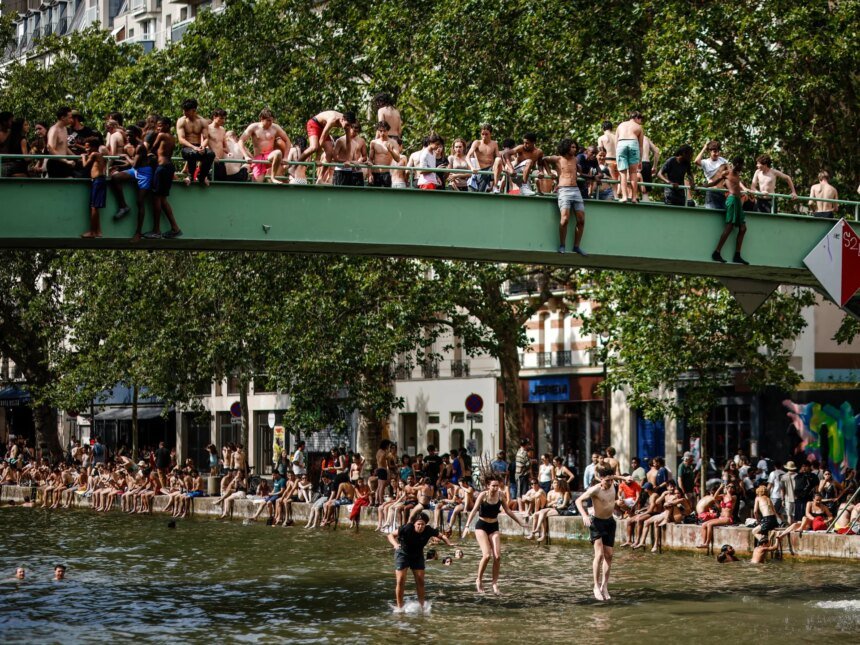
Le Parisien was interested in drawing a field picture of daily life under the heat, moving between bakers, workers, teachers, farmers, and city dwellers.
A teacher in the city of Lyon was quoted as saying: “The children are exhausted… some of them are constantly bleeding from the nose,” while a construction worker said that work has become impossible as surfaces approach temperatures that cannot be touched, while a farmer summed up the climate change by saying: “We are harvesting wheat 10 days earlier than we did a decade ago… This is scary.”
The newspaper also highlighted the increase in drowning incidents and the pressure on ambulance services, in a scene that reflects the expansion of the effects of heat on various aspects of life.

Le Figaro focused on schools, considering that the heat wave revealed the fragility of the educational infrastructure. She pointed out that more than 1,350 schools and colleges were closed due to high temperatures, stressing that about 80% of school buildings need thermal rehabilitation.
Despite the government’s launch of extensive financing programs, the newspaper quoted local officials warning of a decline in government aid, which threatens to delay modernization projects whose cost may reach about 80 billion euros.
Health effects
From a scientific angle, Le Point addressed the health effects of the heat wave, and explained how the body is unable to maintain its normal temperature as the outside temperature approaches 40 degrees Celsius, warning that exceeding this limit may lead to serious disorders in the body’s systems.
In another interview with doctor and researcher Marine Akkawi, she shed light on a less discussed aspect, which is mental health, stressing that “extreme heat also threatens our psychological health.” The results of her research revealed a significant increase in psychological emergencies, and an increased risk of dementia, psychotic disorders, and acute stress, as well as a statistical relationship between rising temperatures and increasing rates of suicide and violent behavior, calling for the integration of mental health into plans to confront heat waves.
While Le Point explains how the body and mind collapse biologically below 40 degrees, and Le Parisien and Media Part depict how this collapse translates into daily suffering for citizens and workers on the street, Le Monde, Le Nouvel Ops, and Le Figaro converge on one point: France faces a new climate that neither its infrastructure nor its political budgets were designed to withstand, and the government is still managing the crisis with a “first aid” mentality rather than radical planning.
Source: Le Parisien + Le Point + Le Figaro + Le Monde