Gaza – The war in the Gaza Strip did not limit itself to annihilating stones and people, but its fire spread to devour the “financial safety net” that protects what remains of its exhausted economy. Today, the insurance sector in Gaza finds itself trapped between unprecedented material destruction that has affected thousands of facilities, cars, and factories, and inevitable bankruptcy that threatens to liquidate companies after their losses reached astronomical numbers that the most powerful financial institutions are unable to bear.
The tragedy begins from the ground, where major investments and industries that lasted for years turned into rubble in moments. The CEO of Sharab Trading and Glass Manufacturing Company, Iyad Sharab, narrates with emotion the magnitude of the shock and loss that his company, which was considered one of the pillars of this sector in Gaza, suffered.
Read also
list of 4 itemsend of list
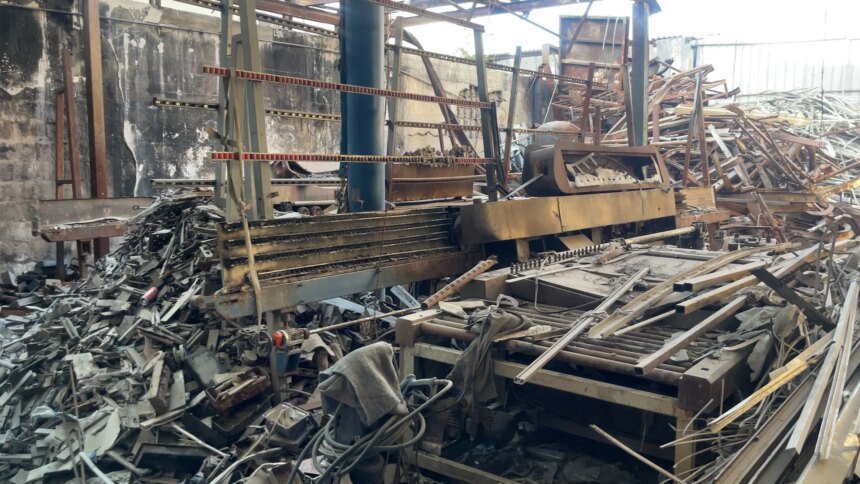
In December 2023, Israeli aircraft struck the company’s glass factory, leaving behind complete destruction of the building and fires that destroyed modern machinery and a large portion of the goods and warehouses, causing the complete crushing of the company’s assets and industrial history.
Shurrab expresses the reality of frustration that the merchants are experiencing, saying, “The war destroyed the factory, machinery, and goods, causing a huge loss and comprehensive destruction of the company’s assets.” He adds, “Because of these losses that befell most companies in Gaza, I do not think that anyone will resort to insurance again. People are suffering from a severe decline in income, and there is a constant fear of renewed destruction at any moment, especially after everyone realized that insurance companies do not cover war damages.”
Clinical death
The crisis of confidence between the affected people and companies does not stop at the limits of the terms of “insurance policies,” but rather extends beyond them to the absence of a reference to protect their rights, as Sharab says.
He continues, “There is no longer any confidence in the insurance sector now, and the main reason is the lack of a clear and binding law that forces the parties to pay and compensate in such catastrophic circumstances.”
Shurrab sent a cry for help to the international community and concerned authorities, calling for immediate intervention to save what remained of his company and other industrial facilities in Gaza and revive them to ensure the continued rotation of the local economy, which is threatened with complete collapse and clinical death.

The insurance sector is considered one of the most important pillars of the non-banking financial sector in Palestine, as its contribution amounted to about 2.3% of the gross domestic product of the Palestinian economy a few months before the genocidal war on Gaza, as analyst and economic expert Ahmed Abu Qamar said.
Abu Qamar added, “During the months preceding the genocidal war in 2023, the sector was experiencing a remarkable recovery, as the total written insurance premiums amounted to about $400 million, a number that reflects the amount of trust and mutual dependence that existed between the economic system and insurance companies to protect investments. However, this sharp rise in numbers collapsed with the start of the war, as this huge financial portfolio turned from a source of safety into an unbearable legal and financial burden.”
Abu Qamar believes that the absence of a binding legal environment and new living priorities after the war led to the state of “forced abstinence” that the market is witnessing today, as the search for sustenance takes precedence over any idea of securing establishments that may disappear in a second.
Abu Qamar points out that the vehicle insurance sector accounts for the largest share in the insurance market at about 68% according to data for the year 2023, and with the destruction of hundreds of thousands of vehicles in the Gaza Strip as a result of the bombing, this high percentage has turned from a major source of income for companies into a huge financial burden amid compensation claims that exceed the human capacity to absorb, according to his description.
Losses reach 98%
The losses that befell the insurance sector were not just a temporary decline in financial indicators, but rather a systematic crushing of companies’ assets and investments.
As for the Gaza Strip, this sector suffered a large share of destruction, like other economic sectors, as headquarters, field assets, and installations were targeted, as well as the vehicles sector.
According to data from the Ministry of Transport and Communications, more than 65% of the vehicles in the Gaza Strip were completely destroyed as a result of the ongoing war, according to Abu Qamar.
Economic analyst Abu Qamar says that the percentage of losses at insurance companies in the Gaza Strip has reached an unprecedented level of 98%.
A major financial dilemma
For his part, President of the Palestinian Federation of Insurance Companies, Anwar Al-Shanti, revealed shocking numbers that reflect the almost complete contraction of financial operations in the sector.
He told Al Jazeera Net that the insurance companies that are members of the federation (numbering 10 companies) declined in their work in the Gaza Strip in an unprecedented way, as the size of their insurance portfolio fell to only 0.5% (half a percent) of its total general insurance portfolio.
On the legal and financial level, the President of the Federation confirmed that the usual insurance coverages do not automatically cover the risks of wars and political unrest. However, there are exceptions that put companies in front of a major financial dilemma.
He says, “Some major companies and institutions had a special addendum called the Political Risks Addendum added to the policies. Based on this documented clause, Palestinian insurance companies will bear direct damages and compensation resulting from the war, valued at between 30 and 40 million dollars.”
But Al-Shanti stressed that the biggest loser in this aggression is the Palestinian citizen who sacrificed everything he owned.