
Global stock markets shuddered on Tuesday, recording steep declines driven by tech companies.
The firms at the forefront of artificial intelligence and chip making had previously pushed markets to record highs, giving them an outsized impact on market indexes. A sell-off in these shares that started in the United States on Monday reverberated around the world, with Asian markets hit particularly hard.
Some of the biggest U.S. tech companies, including Alphabet and Amazon, continued to fall in premarket trading on Tuesday, on top of losses the day before. The stock of SpaceX also continued to slide: After jumping in its first few days of trading, Elon Musk’s rocket-and-A.I. company has shed more than 20 percent of its value in the past three trading sessions, although it remains above its initial public offering price.
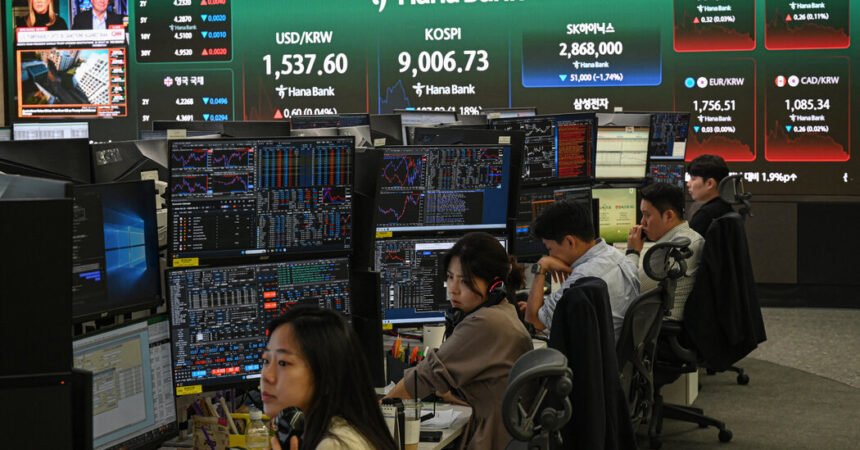
The sharpest decline in Asia took place in South Korea, the world’s best-performing stock market since the start of 2025. The country’s benchmark Kospi index fell 10 percent, at one point triggering a 20-minute trading halt by the exchange operator.
The surge in South Korea’s stock market over the past year was mainly fueled by the country’s two largest memory chip makers — Samsung Electronics and SK Hynix — whose semiconductors are critical to A.I. systems. As their shares have skyrocketed, retail investors have piled into the market, driving large and unpredictable swings in the market. Shares of both companies plunged more than 12 percent on Tuesday.
Alexander Redman, chief equity strategist at the brokerage CLSA, said in the past, such a big one-day drop would cause panic, but now it’s treated as a regular feature of the market.
“It’s unnerving that you’re seeing this kind of volatility,” Mr. Redman said, speaking to reporters at the company’s investor conference in Seoul. “It just feels very, very frothy.”
He said it is hard to say whether this means South Korean shares will bounce back soon or if it is “the beginning of the end.”
In Japan, stocks fell 3.6 percent, while markets in Taiwan and Hong Kong were down more than 1 percent.
Futures for the S&P 500 fell 1.5 percent, suggesting that U.S. stocks will extend the global rout when trading begins in New York. Futures for the tech-heavy Nasdaq were trading 2.5 percent lower.
In Europe, the Stoxx 600, an index that tracks the region’s largest companies, fell by 1 percent. Semiconductor companies, including STMicroelectronics of Switzerland, Infineon of Germany and ASML of the Netherlands, posted sharp declines.