Despite successive statements heralding the holding of negotiations between Iran and America yesterday, Sunday, in Switzerland, in a positive atmosphere, confirming progress on some files, the terms of the memorandum of understanding signed between the two countries emerge to remind us that the road ahead is still long and complicated before agreeing on its thorny provisions.
The document digitally signed by US President Donald Trump and Iranian President Masoud Pezeshkian on June 18 represents a formula for agreeing to follow the path of agreement, according to observers. It does not establish a final plan for the settlement, but rather draws broad and phased guidelines to get the two parties out of the state of non-peace and non-war through political channels, after the war that broke out at the end of last February.
Détente and complex negotiations
The memorandum of understanding signed between Washington and Tehran represented a breakthrough, as it was announced while the Middle East was on the verge of falling again into a costly, brutal war. The 14-item Islamabad agreement was an opportunity for calm that revived hope for an end to the conflict.
The statements of officials in both countries reflected this breakthrough, and also reflected caution stemming from both parties’ awareness of the complexities associated with implementing the terms of the memorandum, as Iranian Deputy Foreign Minister Saeed Khatibzadeh described the memorandum of understanding signed with America as representing an “unprecedented document,” stressing that it is the result of many rounds of talks.
Khatibzadeh said in an interview with Al Jazeera that the subsequent phase of signing the memorandum will witness intense negotiations aimed at achieving permanent stability in the region, but he linked this to a basic condition, which is the commitment of all parties to what was stated in the texts of the memorandum. As for J.D. Vance, US Vice President, he described the memorandum as “a general document of one and a half pages,” a description that implies an acknowledgment of the thorny stage that follows this initial understanding, and the files that must be resolved.

Thorny files
Article thirteen of the memorandum stipulates the completion of five basic points or the resumption of their implementation before the start of negotiations, including issues related to the Strait of Hormuz, the blockade, frozen Iranian funds, and ending the war on various fronts, including Lebanon, according to the Iranian Deputy Foreign Minister.
Strait of Hormuz
Regarding the Strait of Hormuz, the memorandum of understanding stipulates that the strait will be opened, and that Iran will guarantee safe and free passage for commercial ships for a period of 60 days, and that operations to immediately begin dismantling and removing sea mines within 30 days.
However, the Iranian side revealed its intention to adopt a new mechanism to manage the Strait after the expiry of the deadline (60 days), as Tehran is holding a dialogue with the Sultanate of Oman to determine future maritime services in coordination with the bordering countries, in accordance with international law.
In return, the United States is committed to lifting its naval blockade imposed on Iranian ports immediately, and to end completely within 30 days. Iranian reports have confirmed the resumption of the movement of oil tankers towards the country’s ports, bypassing the previous blockade lines.
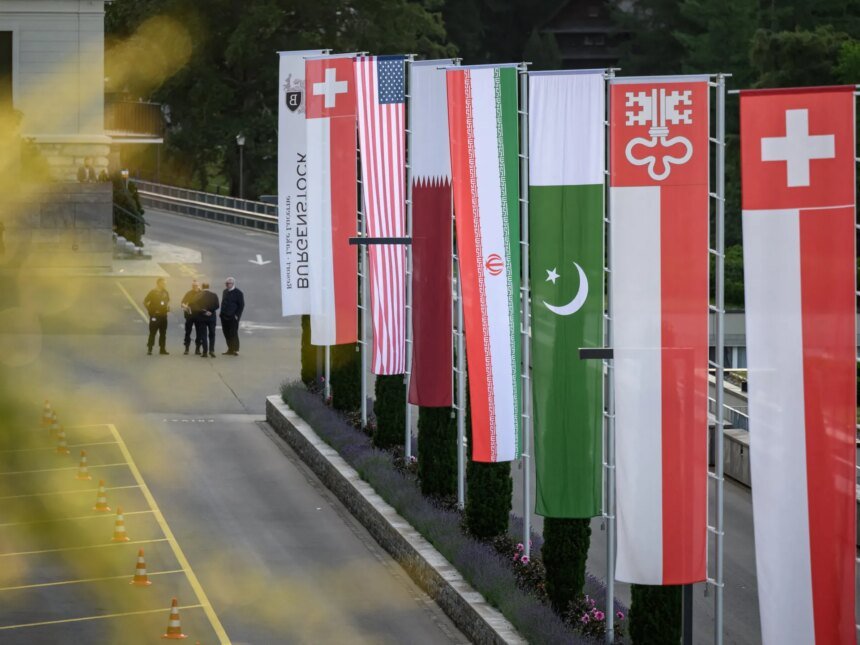
A Qatari-Pakistani statement regarding the outcomes of the Bürgenstock Resort talks in Switzerland indicated the establishment of a communication channel between the parties – during the period stipulated in the fifth paragraph of the memorandum of understanding – with the aim of avoiding accidents and misunderstandings, and ensuring the safe passage of commercial ships through the Strait of Hormuz.
Oil and frozen money
Tehran considers the lifting of sanctions to be the cornerstone of any lasting stability. Under the memorandum (Article 10), the US Treasury pledges to issue immediate exemptions allowing the export of Iranian oil, petrochemical products, and all banking and insurance transactions related to them, which Iranian negotiators confirmed has begun to be implemented with the recent crossing of millions of barrels of oil into international markets.
As for the frozen assets, the document stipulates that all of them can be used and payments made to any beneficiary determined by the Central Bank of Iran. Regarding the “$300 billion fund” allocated for the reconstruction and development of Iran in cooperation with regional partners, Tehran explains that the idea represents, in essence, “an Iranian demand to pay fines due to war losses,” but its detailed mechanisms have not yet been decided and are still subject to discussions by technical committees.
Lebanon file
The first clause of the memorandum stipulates an end to the war on all fronts, and mentioned Lebanon by name, indicating the need to pledge to guarantee Lebanon’s sovereignty and territorial integrity. This clause constitutes an obstacle to the agreement of the parties due to Israeli intransigence, as the Israeli government refuses to withdraw from the areas it occupies in southern Lebanon.
The aforementioned joint Qatari-Pakistani statement stated that with regard to Lebanon, the two parties agreed to establish a working group to avoid escalation, which includes the two parties and the Lebanese Republic, facilitated by mediators, to ensure commitment to stop military operations in the country, as stipulated in the memorandum of understanding.
According to the statement, the technical talks are scheduled to continue throughout the remainder of the week at the Bürgenstock Resort, to discuss all relevant issues.
Iranian Foreign Minister Abbas Araqchi said yesterday that the mediation efforts succeeded in making progress towards ending the war, considering that the first real test of Washington’s seriousness lies in the extent of the success of the “Joint Technical Working Group in preventing friction and escalation in Lebanon.”
The nuclear file
Highly enriched uranium represents the most fragile point in the agreement; In the memorandum, Tehran pledged not to seek to possess or develop nuclear weapons, and a methodology was agreed upon that requires “reducing the level of uranium enrichment at the same site and under the supervision of the International Atomic Energy Agency to settle the status of the current stockpile.”
Until the final agreement is concluded, the parties maintain the “status quo”; Tehran is not taking any new nuclear action, and Washington is not imposing new sanctions or strengthening its forces in the region.
But the irony lies in the fact that the American side is focusing openly and strictly on the mechanisms of “monitoring, verification and inspection of facilities,” while officials in Tehran tend to avoid nuclear details in their statements, linking any nuclear concession to the end of all American and unilateral sanctions according to a clear timetable.
Israeli anger
The Iranian-American agreement was met with widespread official and popular Israeli anger and criticism, as critics considered it to reflect a “major strategic failure,” at a time when Washington responded to the criticism, with US Vice President J.D. Vance calling on Israel to “wake up and face reality.”
The Financial Times quoted an unnamed former senior Israeli official as saying that “the nuclear file was dealt with only in words,” without clear Iranian commitments to give up its stock of highly enriched uranium.
The official added that the agreement represents a “strategic disaster,” noting that “the situation today is worse than it was before the war, especially since Israel is no longer moving in full coordination with the United States as was the case previously.”
According to the report, the agreement may allow Iran to obtain US exemptions that allow it to sell oil and access its frozen assets, while the Iranian regime remains in power.
Parties in Washington and Tehran have accused Israel of seeking to thwart the agreement, and Khatibzadeh accused Israeli Prime Minister Benjamin Netanyahu of seeking to disrupt any path that leads to stability in the region, saying that, in his opinion, there is a recurring pattern of thwarting peace opportunities through military escalation.
The Iranian official said that Iran believes that the United States and Israel were partners in the war, and that Washington bears the responsibility of ensuring Israel’s compliance with any agreement.
Red lines
Diplomacy between the two countries is driven by emerging deterrence calculations, not based on mutual trust. For Iran, accepting negotiations with Trump came as a result of a “balance of power” imposed by the equations on the ground. Tehran’s red lines are to prevent the United States from achieving political gains through negotiation that it was unable to impose militarily, and to ensure the complete and unconditional lifting of sanctions.
On the other hand, Washington’s red lines – as repeatedly announced in the statements of American officials in the hierarchy of power – are to prevent Iran from possessing a nuclear weapon, and to protect international waterways.
Another priority is related to Trump’s desire to limit his country’s military role in the Middle East. However, this desire is governed by intense internal pressures; Trump was quick to reassure his critics that the memorandum was not a final document, directing a direct threat to Iran: “If they do not commit to proper behavior, we will immediately return to dropping bombs on their heads.”
Despite the criticism and thorny issues, it appears, from statements released after the negotiations that took place in Switzerland yesterday, that the two parties are continuing on the path to reducing the escalation and resolving the conflict at the negotiating table.