Published on 6/22/2026
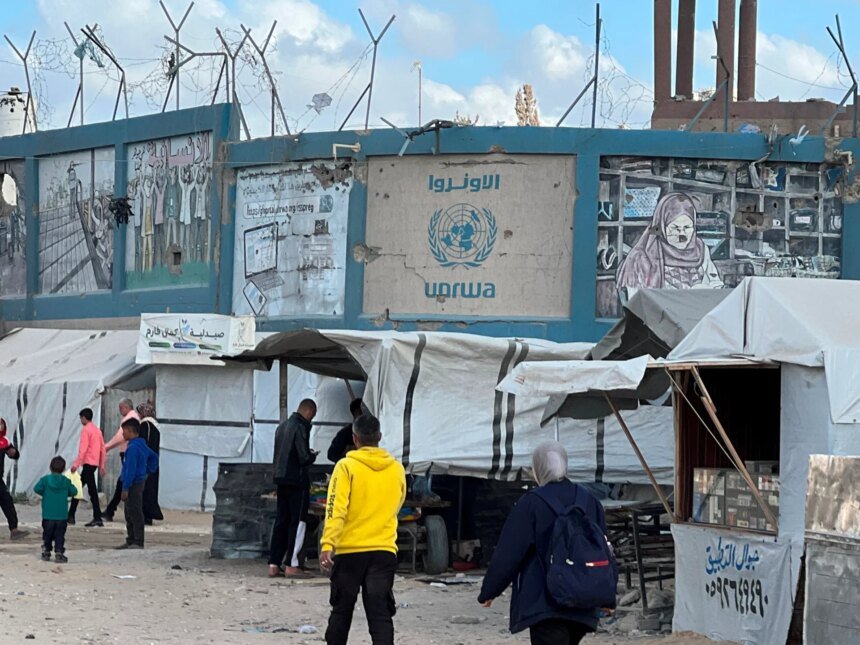
While he was waiting for the start of his weekly leave last Thursday evening, Rabih Al-Tanani, an employee at the United Nations Relief and Works Agency for Palestine Refugees (UNRWA) in the Gaza Strip, was surprised by an e-mail message from the administration of the United Nations organization, informing him that he would be fired from his job immediately “in the interests of the agency.”
The shocking message turned vacation anticipation into a nightmare. Al-Tanani alone supports three families, and it quickly becomes clear that he is not alone, but rather one of 70 employees in Gaza who were dismissed by the agency that evening all at once, in response to what they said were Israeli allegations, and without conducting any investigation.
After receiving the letter, Al-Tanani expressed his astonishment, saying, “It was shocking and extremely unfair news, because we have no connection to any party, neither politically nor militarily.”

Harsh consequences
Al-Tanani spoke to Al-Jazeera about the harsh consequences of the decision on his life and the lives of his colleagues, considering that the decision is unfair against the 70 employees. For him, “the matter is very severe because I am the breadwinner for three families: my family, my sister’s family in our house, and my father’s family.”
In his response to the accusations directed at him, Al-Tanani said, “I am an Arabic language teacher. I teach the language and the Holy Qur’an, nothing more and nothing less. If teaching Arabic and the Qur’an is the suspicion and the main reason for dismissal, then what a beautiful suspicion it is. I am a completely neutral person and am not partisan.”
Al-Tanani criticized the decision-making mechanism and its immediate implementation, and said that the injustice lies in two parts: The first was to dismiss him and his colleagues directly, without any notification or prior notice, and the second was what he said was a contradiction in the agency’s statement itself, as they stated that they did not have evidence to prove the validity of these allegations, and yet they made the immediate dismissal.
Al-Tanani concluded his speech with a cry in which he wondered about the fate of those affected: “There are 70 families who have been displaced. Where will they eat and where will they drink now?”
Absence of incriminating evidence
In the same context, Mohammed Shweidah, school director at UNRWA and secretary of the staff union, recounts the details of the decision to dismiss him from his job after a career spanning 26 years.
Shweideh told Al Jazeera that he was surprised on Thursday by the arrival of his dismissal letter from the Commissioner-General, followed by a general letter he addressed to all employees stating that the services of 70 employees had been terminated with Israeli allegations indicating “their work within armed agencies.”
Shweideh points out a dangerous legal and historical paradox by saying, “For the first time in the history of international and international organizations, the evidence of acquittal is the same as the accusation. Acting Commissioner-General Christian Saunders publicly admitted that he asked Israel to provide him with evidence to support its claims, and that it did not provide any evidence, and despite that, he dismissed us under the pretext of (the interest of the institution).”

Legitimizing the targeting of employees
Shweideh believes that this position legitimizes Israel’s targeting of workers, and he considers that the dangerous thing in these decisions is that the Commissioner confirms that Israel has the right to target anyone within UNRWA. As for the occupation, Gaza and the entire Palestinian people are automatically accused, and even the Secretary-General of the United Nations and the foreign employees were not spared from their accusations once they disagreed.
The secretary of the union criticizes the dismissal mechanism and the absence of the role of the legal department, as he stated that the agency did not conduct an investigation with any individual, but rather the commissioner relied on a clause that gives him absolute power to dismiss any employee, a law that the agency’s employees union demanded to be abolished.
For his part, Mustafa Al-Ghoul, head of the Employees Union in Gaza, describes the scenes of the decision and its consequences, saying, “They informed us of the dismissal of the 70 employees based on Israeli allegations of belonging to Palestinian parties, specifically the Hamas movement, and we asked the Commissioner-General to listen to them and investigate them, to no avail.”
He added to Al Jazeera, “We have not heard, in any earthly law or heavenly religion, of an employee being thrown on the side of the road without investigation, and what is happening in an international institution affiliated with the United Nations is a dangerous phenomenon and an illegal decision.”
Al-Ghoul criticizes the pretext of “protecting the institution” that the administration used to approve the dismissal, recalling that the previous commissioner (Philippe Lazzarini) dismissed 15 employees during the last period under the pretext of “protecting UNRWA,” without achieving any benefit. On the contrary, Israel prevented him from entering Gaza, expelled all foreign employees, and refuses to bring any aid into the agency.