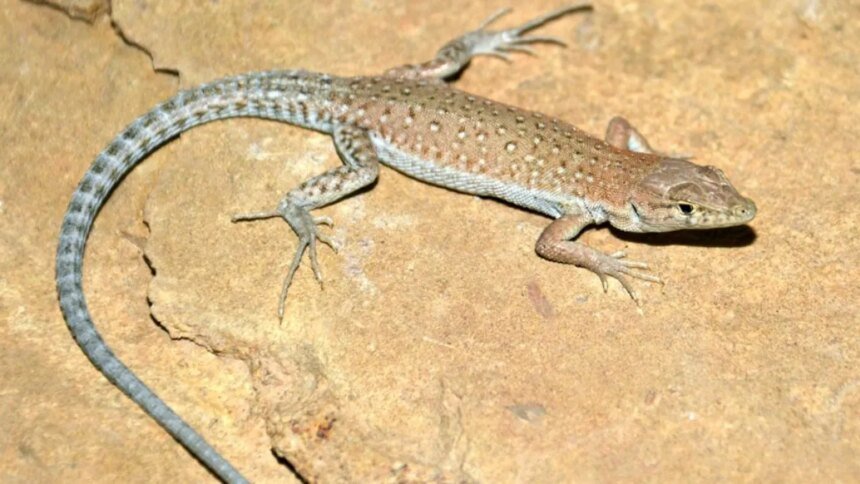
If you ask herpetologists in Syria about the most famous reptiles in the local environment, their answer will be the lizard, which belongs to the “Messalina” family, and is scientifically known by the name “Messalina guttulata,” meaning the desert lizard spotted with small spots.
This name remained popular among them for decades, until a study conducted by an international research team and published in the journal Zootaxa was able to prove that this lizard, which lives in a volcanic area in southern Syria within Harrat al-Sham in the Syrian desert, belongs to the species Messalina cryptica, which was discovered by the same team in 2025.

From Egypt was the beginning
The beginning of the story of this exciting discovery goes back to the efforts made by herpetologists, using genetic analysis, in order to rearrange the “Messalina” family tree. They discovered that what was considered a single species called “Messalina gutulata” is in fact several independent species.
It was believed that the “Messalina guttulata” lizard was widespread in the Sinai region of Egypt and large parts of the Arabian Peninsula and the Levant, but recent studies conducted during the past eight years have shown that this species is limited to the areas located west of the Suez Canal, and that some of the lizards that were wrongly classified as this species in fact belong to species known as “Messalina Bahaa al-Dini,” which is a name honoring the Egyptian herpetologist Muhammad Bahaa al-Din, and “Messalina austra arabica.” And Messalina Arnoldi.
In 2025, the research team that published the new study described a new species called “Messalina cryptica,” which means “hidden” or “hidden,” because this species remained hidden inside another species due to the strong similarity between them.
Dubravka Vilenska, from the Department of Zoology at the Faculty of Science at Charles University in the Czech capital, Prague, and the researcher participating in the study, told Al Jazeera Net that the morphological differences within the group that was known as “Messalina gutulata” are relatively subtle, and therefore fall within what is called “hidden diversity,” that is, species that appear very similar morphologically, but are genetically different, and “Messalina Austro Arabica” may be an exception, as it is generally smaller in size than other species in the group. However, it does not This trait can only be relied upon when comparing adults, because juveniles are naturally smaller.”
She adds, “On the other hand, the genetic differences within the group are quite clear at the mitochondrial and nuclear levels, which led us in 2025 to discover a new species called Messalina cryptica. This encouraged us to re-examine a group kept in the Prague Museum since the 1990s, which was collected from a volcanic area in southern Syria within Harrat al-Sham.”
Return to Syria Samples
These samples were known as “Messalina gutulata”, and the researchers conducted a re-examination of them using morphological characteristics (length, head size, number of scales, etc.), and DNA from several different genes. The main result was that all the Syrian samples that were able to be genetically analyzed belong to the species “Messalina cryptica” and not to “Messalina gutulata”. This means that the first confirmed record of this species was found in Syria before it was discovered in 2025.
Dubravka says, “To confirm the results, we compared the genetic sequences of the Syrian lizards with samples of the Messalina cryptoca species collected from Jordan. We found that the Syrian samples showed great genetic similarity to their counterparts in Jordan, which is a natural matter and a logical development due to the geographical expansion and direct environmental contact between the two countries, which made the newly discovered species appear so far more homogeneous and genetically stable compared to its relatives, without strong evidence of current internal divisions.”
However, the researcher confirms that the vast areas of the nature of the spread of these lizards in Syria still hide many secrets, as scientists are eagerly looking forward to determining the full scope of their spread and monitoring the extent of their intersection with other close species in the region, which will give science a deeper understanding of the evolutionary and biogeographic history of these desert creatures.
Although Syrian lizards tend to be slightly longer, with relatively larger and deeper heads, and black or dark in color, Dubravka and her colleagues had an explanation for these differences in their study, as they said that the morphological differences in length and head fall within the natural limits of variation within a single species, while the color is most likely an environmental adaptation to the black volcanic rocks in the Harrat al-Sham region.
Waiting for more surprises
Dubravka believes that there are new species of lizards of the “Messalina” genus that have not been discovered in the Levant region, and she says, “Lizards of this genus belong to creatures with hidden diversity that deceive the eye with their apparent similarity, which makes the hypothesis of finding species with unique genetic specifications that prompts us to classify them as a stand-alone species that remains strong at all times.”
This proposition, which Dubravka refers to, is supported by the scientific breakthrough witnessed in the past eight years alone, represented by the discovery and description of three completely new species, all of which were classified as “Messalina gutulata,” in addition to a previous study conducted in Syria on a close group that led to the promotion of one of the subspecies from the rank of “subspecies” to become an independent species in its own right, called “Messalina brevirostris,” which conclusively proves that the true diversity of these reptiles in the region is still underestimated.
Regarding the geographical distribution of these reptiles in the region, she indicated that the recently discovered “Messalina cryptoca” species in southern Syria lives in a geographical area very close to another species recorded by research in Jordan, which is “Messalina Bahaa al-Dini,” which opens the door to the extended possibility of the presence of this latter species within the Syrian borders as well, while confirmed scientific records so far do not contain any observation of any individual from this group in Lebanese territory.
Dubravka concluded from this scene to the basic conclusion that scientific resolution requires conducting broader field surveys, and expanding the circle of collecting samples from various parts of the region, to reach a comprehensive genetic map that accurately determines the true geographical distribution and the complete biodiversity of these lizards in the Levant.