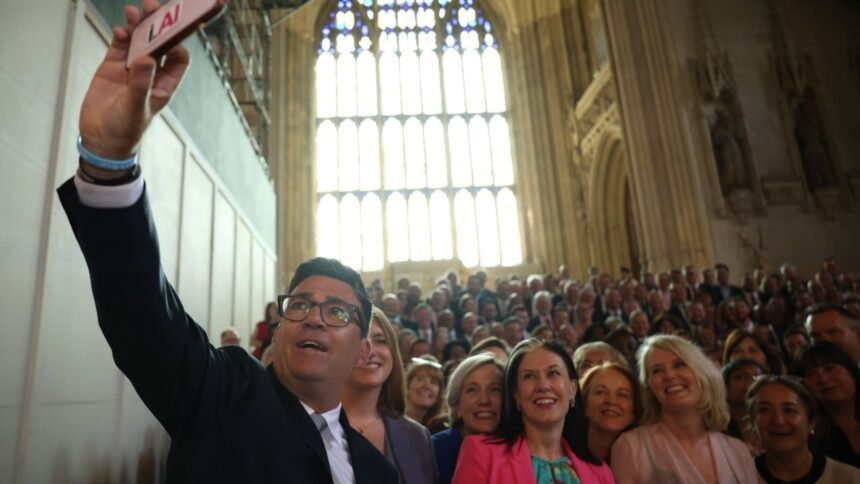
LONDON, ENGLAND – JUNE 22: Andy Burnham, Labour MP for Makerfield, takes a “Selfie” with the Parliamentary Labour Party after his swearing-in at the Houses of Parliament on June 22, 2026 in London, England. Last week Andy Burnham won 54% of the vote in the Makerfield by-election, paving his way to return to Westminster as an MP and challenger to Prime Minister Keir Starmer’s leadership. (Photo by Dan Kitwood/Getty Images)
Dan Kitwood | Getty Images News | Getty Images
U.K. Prime Minister Keir Starmer announced Monday he’d step down, opening the door for Britain’s seventh leader in 10 years.
The process to succeed him as Labour Party leader and prime minister will see a successor take the helm by September 1 at the latest, and with a new administration comes a new set of economic and fiscal policies for markets to digest.
Here is what investors should know while the U.K. searches for its next leader.
First up, the frontrunner.
Who is Andy Burnham?
Andy Burnham is the favorite to succeed Starmer. The mayor of Greater Manchester won a seat in Britain’s parliament in a special election last week, making him eligible for the leadership.
On Monday morning, former health secretary Wes Streeting, who had been a potential rival for the premiership, endorsed Burnham, boosting the chances that he will run unopposed, which would significantly shorten the process.
Burnham left parliament in 2017 to become Manchester mayor, after serving in previous Labour governments and challenging for the party leadership in 2015.
ASHTON-UNDER-LYNE, MANCHESTER – APRIL 13: Britain’s Prime Minister Keir Starmer meets school children at a breakfast club with Manchester Mayor Andy Burnham, during a visit to a primary school on April 13, 2026 in Ashton-under-Lyne, Greater Manchester, north-west England. During the visit to the breakfast club, the Prime Minister is speaking about the government’s policies aimed at providing support for families. (Photo by Paul Ellis – WPA Pool/Getty Images)
Wpa Pool | Getty Images News | Getty Images
The prominence the mayoralty gave him, and his separation from the intrigues of parliament, earned Burnham the nickname the “king of the north.”
He is viewed by onlookers as being to the left of Starmer, and previous comments around fiscal spending had unsettled investors.
“We’ve got to get beyond this thing of being in hock to the bond market,” he said in an interview last September, which sparked a sell-off in U.K. government bonds, with traders even then regarding him as a potential future prime minister.
He later walked back the statement. “I have never said you can just ignore the bond markets,” he told ITV News in May.
Writing for CNBC in May, Ian King recalled interviewing Burnham – and broke down his “Manchesterism” style of economic management.
Why gilt markets are watching the transition
Freeing government spending from the constraints of the bond market may prove harder than Burnham anticipated, particularly as the U.K.’s fiscal picture continues to worsen.
Yields of U.K. bonds, known as gilts, have spiked at signs that the government may spend more. If Burnham becomes prime minister, he will inherit the same cash-strapped administration, limiting his capacity for major outlays.
Yield movements may instead focus on the manner of Starmer’s departure, rather than the policies of the successor, April LaRusse, head of investment specialists at Insight Investment, wrote in a note.
“More recently, the gilt market seems to be expecting a more pragmatic approach to changes in government policy,” she said.
“We expect the market focus will now be on who may be chosen for key cabinet positions, with the gilt market most interested in the Chancellor and the potential timing of the next Budget.”
What Starmer’s exit could mean for sterling

how GBP/USD has fared over 5 years.
The British pound is unlikely to be moved by Burnham’s move towards 10 Downing Street because it was “well anticipated and largely priced,” according to Convera.
“A clearly defined transition would likely be seen as orderly,” Antonio Ruggiero, FX strategist at Convera, wrote in a note.
“The downside risk lies in a more chaotic path. If no timetable emerges and attention shifts toward a leadership challenge that could force his departure, heavier pressure on sterling could reappear.”
Monetary policy is sterling’s primary concern, with markets anticipating the Bank of England could hold rates for the rest of the year.
Who will be the next chancellor?
Part of how bond markets and sterling react to the new prime minister will be their choice of finance minister, known in the U.K. as the chancellor. Current chancellor Rachel Reeves may represent a low-risk option by signalling continuity, but she will reportedly be replaced.
Media reports in recent days have named Streeting, the former health secretary, and Ed Miliband, the energy secretary who led the party from 2010 to 2015, as potential candidates.
LONDON, ENGLAND – MARCH 26, 2025: (L-R) Secretary of State for Environment, Food and Rural Affairs, Steve Reed, Secretary of State for Energy Security and Net Zero, Ed Miliband and Secretary of State for Health and Social Care, Wes Streeting, depart from 10 Downing Street after attending a weekly cabinet meeting in London, England. (Photo by Peter Nicholls/Getty Images)
Peter Nicholls | Getty Images News | Getty Images
“Fixed income investors will be quick to judge a new chancellor on whether they are a cautious or adventurous type of person,” Dan Coatsworth, head of markets at AJ Bell, said in a note.
“Bond markets want a cautious type, and someone determined to balance the books. They wouldn’t want someone ratcheting up the spending without enough thought to whether the country can afford it.
“Equity investors will be hoping for a more pro-business chancellor than Reeves, as she has presided over considerable cost pressures on UK industries over the past two years.”
Why U.K. growth remains a challenge
A change in leadership does not automatically translate to a change in the country’s economic fortunes.
The International Monetary Fund warned in April that the U.K. could see the biggest hit to growth from the Iran war of any major economy and is forecasting growth of just 0.8% in 2026, down from the 1.3% it forecast at the beginning of the year.
“The Prime Minister might be changing, but the issues the UK economy faces remain the same,” Indriatti van Hien, Janus Henderson Smaller Companies fund manager, wrote after Starmer announced he would go.
“The next Prime Minister faces the unenviable challenge of reviving economic growth while walking a fiscal tightrope. Energy policy and welfare reform need to be addressed to reduce the UK gilt yield premia, unlock funds for growth and ultimately attract capital flows back into the UK.”