
Published on 6/17/2026
|
Last update: 16:43 (Mecca time)
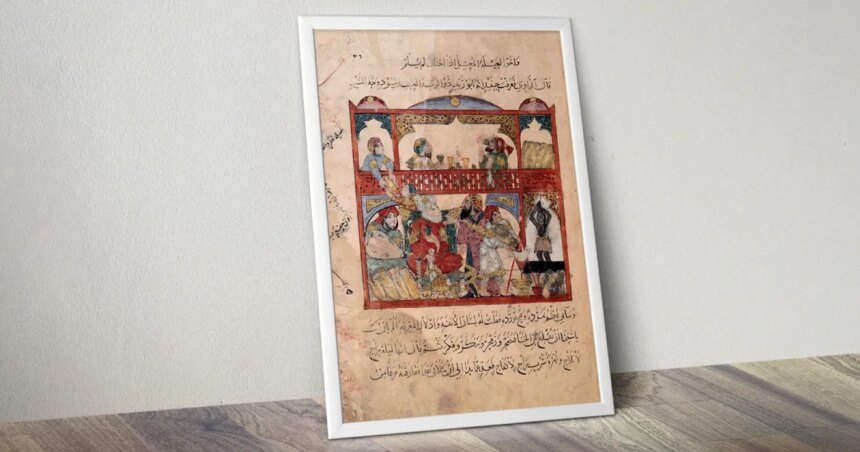
At the beginning of the sixth century AH, young men from Shativa, Badajoz, and other cities of Andalusia were riding by sea to Basra, to sit in the circle of a sheikh who would dictate to them fifty stories about an eloquent swindler named Abu Zayd al-Suruji. These stories were the talk of councils and the subject of competition, and they were collected in “Maqamat al-Hariri.”
The book did not stop with the people of Andalusia. Maqama (the art of recited narration that reached its peak at the hands of Abu Muhammad al-Qasim al-Hariri) crossed the borders of Arabic itself, and from its eloquent impostors an invisible thread extended to the tramps of Spanish literature and the stories of the clever.
Read also
list of 2 itemsend of list
The residence was not the only addition to this journey; In the same century, other works of Arabic literature were making their way to Europe, to the point that some researchers said that Dante Alighieri looked at them before writing his Divine Comedy, a claim that is still subject to debate and debate, but it is certain that the maqamat organized by the great Arab writer Abu Muhammad al-Qasim al-Hariri were inspired by the creation of many writers.
Dr. Ihsan Abbas mentions the names of 21 people among the Andalusian writers, all of whom wrote maqamat, depending on their ability, including Ibn Shahid, Ibn Sharaf al-Qayrawani, al-Saraqusti, and al-Wahrani, and some sources identified them with 24 maqamat writers, who varied between descriptive and critical maqamat, as well as the kudiyya maqamat.
But how did Hariri’s shrines reach Andalusia at that time? To begin with, Ibn Bassam Al-Shantarini (d. 542 AH), the author of Al-Dhakhira in The Virtues of the People of the Peninsula, is unique in speaking briefly about it. He says that the Maqamat of Al-Hamdhani reached Andalusia at the end of the fourth century AH, and that the minister and writer Abu Al-Mughirah Abd Al-Wahhab bin Hazm (d. 437 AH), – a cousin of the well-known Imam Ibn Hazm, and there was a quarrel between them – tried to imitate them, and so did Abu Amer bin Shahid Al-Andalusi (d. 426 AH), and it seems that Ibn Shahid took from Al-Hamdhani’s Satanic Resurrection an idea upon which he built the message of Disciples and Whirlwinds, this is what Dr. Shawqi Dhaif points out.
We find a large number of sources and biographies mentioning the names of people who traveled to Iraq to hear Al-Hariri’s maqamat, whether directly from its author or from some of his companions Al-Khalas and his students. Among these sources are Al-Fath bin Khaqan (d. 529 AH) in Qala’id Al-Uqyan, Ibn Khair Al-Ishbili (d. 575 AH) in the Index, and Ibn Al-Abar (d. 658 AH) in Al-Takmelah, as it mentioned that Ahmad bin Khalaf Al-Shatibi, and Aba Al-Qasim bin Jahur, Al-Hasan bin Ali Al-Batalyusi, and Abu Al-Hajjaj Al-Qadha’i attended – since 505 AH – Al-Hariri’s councils in Basra. The Andalusian pioneers transmitted Al-Hariri’s maqamat to a generation of writers. Ibn Jahur transmitted it to Muhammad bin Khalid al-Tamimi, Muhammad bin Abdullah al-Lubli, and Muhammad bin Muhammad al-Batalyusi, while al-Qadha’i narrated it to Ibn Khair, who in turn transmitted it through his author to many.
Abu al-Qasim Muhammad bin Abd al-Ghafour al-Kala’i al-Ishbili, the author of Ahkam Sina’ al-Kalam, a contemporary of al-Shantrini. However, he did not mention any of the maqamat of the Andalusians, while he mentioned al-Hamdhani and praised him, and was even fanatical about him. He said, “The virtues of Abi al-Fadl are not infinite or neglected, and a group of writers opposed him in these maqamat, with what this book has refrained from mentioning.”
As for Al-Qahir Muhammad bin Yusuf Al-Saraqusti Al-Andalusi (d. 538 AH), he composed 50 maqamat known as the obligatory maqamat, because he adhered to his prose and organization in what was not obligatory in the manner of Al-Ma’arri. The hero of these maqamats was Ibn Habib Al-Sadoosi, and their narrator was Al-Sa’ib bin Tammam, with the presence of a secondary narrator called Al-Mundhir bin Hammam. The marine element is strongly present in them, as the topics of these shrines revolve around sailors, the horrors of the sea, the ports and what happens in them, and this reminds us in some way of Hanna Minna’s novels, in which the sea is present to a large extent. We said earlier that Al-Hariri’s shrines neglected the geographical sequence, and the same thing we observe with Al-Saraqusti.
It is also noted that Al-Saraqusti did not name his maqamat with the names of cities, such as Al-Baghdadiya, Damascus, Al-San’aniyah, etc., so he used a name different from what we are accustomed to in the books of maqamat. Half of his maqamat do not have titles but rather numbers, and for the other half there are titles for some of them, including the triangular maqamat, the studded maqamat, and the tanned maqamat. Another objection to Al-Saraqusti is that he adhered to the topics of the Maqamat of Al-Hamdhani and Al-Hariri, and did not confirm anything of the culture of his country and surroundings. Here we remember that when the companion Ibn Abbad looked at the unique contract – by Ibn Abd Rabbuh Al-Andalusi – he recited the Almighty’s saying, “These are our goods returned to us,” and the reason for this is that Ibn Abbad requested the book for a while, and he thought that it included news from Andalusia. And its literature, so it is the news and literature of the East.
It has been reported that Ibn Sharaf was delusional about the number of Maqamat al-Hamdhani, and this is forgivable due to the proximity of the era and the lack of the book’s arrival, but news was received from communities in the diaspora, and Ibn Sharaf included Maqamat whose narration was entrusted to Abu Rayyan al-Salt ibn al-Sakan, and Yehuda ibn Shlomo al-Harizi (d. after 602 AH) translated al-Hariri’s Maqamat into Hebrew, in the first half of the thirteenth century AD, after he traveled to the East and recognized their importance, and was keen to transmit them almost entirely. The literalist except for the Qur’anic verses, which he replaced with Biblical texts, then imitated Al-Hariri’s Maqamat. He wrote 50 maqamat, which he called Sefer Tahkamoni, meaning the Book of Wisdom. Its narrator was named Heman Ha-Azrachi, and its hero was Ha-Kini.
Yaqoub bin Eleazar, another Jew from Toledo, was a contemporary of Hariri. He translated Kalila and Dimna into Hebrew, then wrote a number of maqamat in the same manner as Hariri, and called the book Peaceful. In 1264, under the direction of Alfonso Al-Ma’arri and his message!
The Maqamat of the Jews of Andalusia represented the link between Arabic literature and its Spanish counterpart. Many similarities were observed between the Arabic Maqamat and the stories of the Spanish villains, and Hariri’s touches are clear in some of the stories of the vagabonds in Spanish literature. Likewise, the German poet Friedrich Rickert translated Hariri’s Maqamat into his mother tongue, and it was also translated into English and French.
The shrines flourished in Andalusia after the Berber or Cordoban strife, which led to the division of the country into rival states, and the emergence of class disparity in society, followed by the emergence of a class of destitute and distressed people. Due to the lack of space to mention all the Andalusian Maqamat here, we refer the honorable reader to a book entitled The Andalusian Maqamat from the Fifth Century to the Ninth Century AH, by Dr. Sharif Alawneh, in which he presents brief translations of more than 25 Andalusian Maqamat writers, then reviews examples of their works followed by a brief analysis. Ibn Mahrez Al-Wahrani – who lived in the sixth century AH – wrote a book entitled Al-Wahrani’s Sleeps, His Maqamat, and His Letters, and it contains the great dream in which he imitated Al-Ma’arri’s actions in the Epistle of Forgiveness, and the book includes a number of Al-Wahrani’s letters as well.

Echoes of the Arab residence in other nations
The Persians tried to imitate Al-Hariri’s maqamat, but they did not achieve his perfection. The Persian maqamat was distinguished by not relying on a single narrator, unlike the maqamat of Al-Hamdhani and Al-Hariri. According to them, the author has the uppermost word, or in modern novelist expression, the author and the narrator are identical, and their positions are not linked to one hero, as the author talks about several heroes.
In the year 551 AH, Judge Hamid al-Din Abu Bakr bin Omar al-Balkhi wrote 23 maqamat, in the style of al-Hamdhani’s maqamat, and explicitly stated that he was one of al-Badi’s students. In each of Judge Hamid’s maqamat, a new hero appears, even if the topic does not change from what Al-Hamdhani and Hariri drew; Kadiah. The Maqamat of Judge Hamid were transmitted to Eastern Jewish and Christian circles and were translated and imitated in the Hebrew and Syriac languages. None of the Persians wrote the Maqama as Al-Humaydi did, and some of them did not repeat his attempt, and the reasons for this require further research and study.