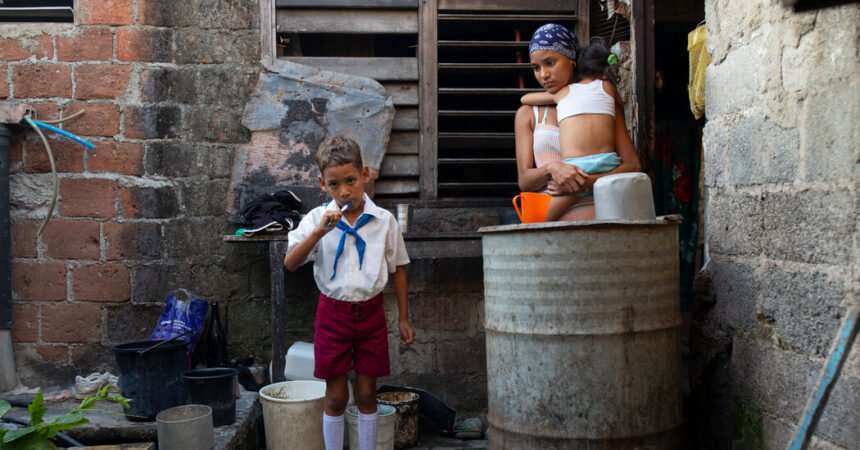
Axisa and Aron Alfonso, 6- and 7-year-old siblings in western Cuba, are luckier than most of their classmates: Their father takes them on their one-mile commute to school on horseback.
The children and teachers who live farther away rely on a spluttering, yellow Soviet-era school bus that no longer shows up. Teachers often do not make it to class, so the Alfonso family and their horse, Chocolate, turn around and go home.
A U.S. oil blockade has set off an increasingly agonizing energy crisis that has brought transportation largely to a standstill. Fewer cars and buses are on the streets, and, as a result, fewer students and teachers are in school.
“My children rarely go to school. They go, but the teachers don’t come,” said Sergio Alfonso Vásquez, 33, a farmer and the father of Axisa and Arona. “I’m afraid because they aren’t learning anything.”
To save energy, the Cuban government in February cut school to half-days and resorted to Covid-era remote learning for college students.
Then Cuba decided to end the school year two weeks early and scrapped college entrance exams for high school seniors after acknowledging that sleepless nights without electricity and a lack of school meals were exhausting students and teachers alike.
The Cuban government’s measures are the latest blows to the country’s once vaunted public education system, which had long been a signature triumph of the country’s socialist revolution.
Schools were already reeling from Hurricane Melissa last fall, which damaged hundreds of buildings; a mass departure of teachers in recent years; and shortages of textbooks, uniforms and even pencils and paper.
The extreme gasoline shortage finally brought the strained system to a stop.
The Trump administration’s pressure campaign, including an executive order that prohibited countries from delivering oil to Cuba, is aimed at forcing Cuba’s government into making political and economic changes.
But experts say the damage to the educational system is a striking example of the negative consequences of U.S. measures on regular Cubans and that, in the case of schools, amounts to a serious long-term threat.
“Education in Cuba is at risk due to the current energy crisis,” Anne Lemaistre, the regional director of UNESCO, the United Nations education organization, said on Instagram. “It jeopardizes the future of an entire generation.”
All 240 of Cuba’s boarding schools had to close this semester, Ms. Lemaistre, who is based in Havana, told The New York Times.
The Cuban government did not respond to requests for comment, but government officials have publicly discussed the schools crisis.
“After a night without electricity, getting a kid to school, figuring out how to engage him, and the class itself, is a challenge,” Naima Ariatne Trujillo Barreto, Cuba’s minister of education, said in February on state television. “And for the teachers, who also suffer just as much, without electricity or with the problem of whether or not they have water at home, concentrating on giving classes has been quite a challenge.”
Even before the Trump administration started imposing stricter measures against the Cuban government, the country had already been in a steep economic decline for several years.
The Cuban government said the school system was facing a shortage of roughly 26,000 teachers, many of whom had quit for better-paying jobs in the private sector.
In Camagüey, a city in eastern Cuba, nearly 1,000 teachers had left the country for good in recent years, state-run media reported.
After the Covid-19 pandemic, the country experienced a record-breaking exodus. More than a million people, including thousands of teachers who earned an average of $11 a month, left the country.
President Trump cut off international fuel deliveries in January and introduced a new package of aggressive economic measures aimed at starving the Cuban government of cash.
The Trump administration argues that the United States is not to blame for Cuba’s energy crunch, but instead faults Cuban officials for not investing enough in infrastructure while diverting “energy resources to line their own pockets.”
The State Department, in a statement, questioned why the Cuban regime claims it has no fuel for schools, while Interior Ministry officials who quash protests have enough gas to carry out their operations.
Remote learning for college students, one of the austerity measures adopted by the Cuban government, has proved all but impossible. Blackouts stretch over 20 hours a day, and most students and teachers cannot pay for enough data on their phones to support remote classes.
Instead, professors have sent lessons using WhatsApp voice notes.
Leonard Gómez León, a third-year law student at the University of Havana, described the semester as “hellish.”
“The power outages have been constant, the lack of internet connection, and so on, and it’s truly terrifying to see how badly we students are doing,” he said. “I feel like this is almost a lost semester.”
Mr. Gómez, 21, is the vice president of the University Student Federation of Cuba, a state-run organization that has traditionally toed the government line. But he helped organize a protest in March outside the university, demanding the semester be canceled until in-person classes could resume.
The vice minister of education, Modesto Ricardo Gómez, told the protesting students that the Trump administration was “massacring an entire society.”
The collapse of education is a stark contrast to the gains the that country made after Fidel Castro toppled a U.S.-aligned dictator and seized power in 1959.
He made education a priority at a time when the illiteracy rate was higher than 20 percent and mobilized 250,000 students and teachers to teach adults to read, particularly in the countryside.
Illiteracy was all but eradicated. The island’s universal, free university system steadily expanded over the decades, churning out doctors and engineers.
But the government, which has a near monopoly on such professions, has for decades paid minuscule salaries, undercutting economic incentives to study or teach. And the quality of Cuba’s education has deteriorated since the fall of the Soviet Union, the country’s main benefactor, which led to budget shortfalls.
Katrin Hansing, an anthropologist at the City University of New York’s Baruch College who has written extensively about Cuba, said the education system is now “a shell of its former self.”
University education in particular, she said, is largely on pause.
“What is happening online is very poor in quality,” she said. “There’s only one, or two, or less, hours of electricity a day, and people in that time are trying to do everything to survive from washing to cooking.”
Alejandro Paradero Almenarios, 20, had enrolled at the University of Guantánamo, hoping to become a biology teacher, but dropped out in January, five months into his freshman year. He decided the effort was not worth it given the paltry wages he would earn teaching high school, the equivalent of $7 a month.
“I was studying and studying for nothing,” he said.
He now works full time making charcoal, which people now rely on to prepare meals because cooking gas is unavailable.
Raúl Cabrera Oliva, 18, was in his last year at a vocational high school in Artemisa, west of Havana, that specialized in veterinary medicine.
With few transportation options for most students, the school closed.
“No transportation, no school,” Mr. Cabrera said.
The government’s push to reduce school hours to half a day caused another set of problems. By the time parents and children, many of whom hitchhiked, arrived at school, there was no time for parents to go home and then return in time for dismissal.
Mothers killed time waiting outside.
Yaymaris Rodríguez López said she would leave her house in a village in western Cuba every morning at 7 a.m. with her two sons, ages 12 and 4, and stood on the side of the road, hoping someone would drive by offering a ride to her children’s school.
Sometimes, 10 a.m. came and went, and they would still be waiting.
“What am I going to do? I have to take them to school,” Ms. Rodríguez said. “They can’t grow up to be dumb.”