Published on 6/20/2026
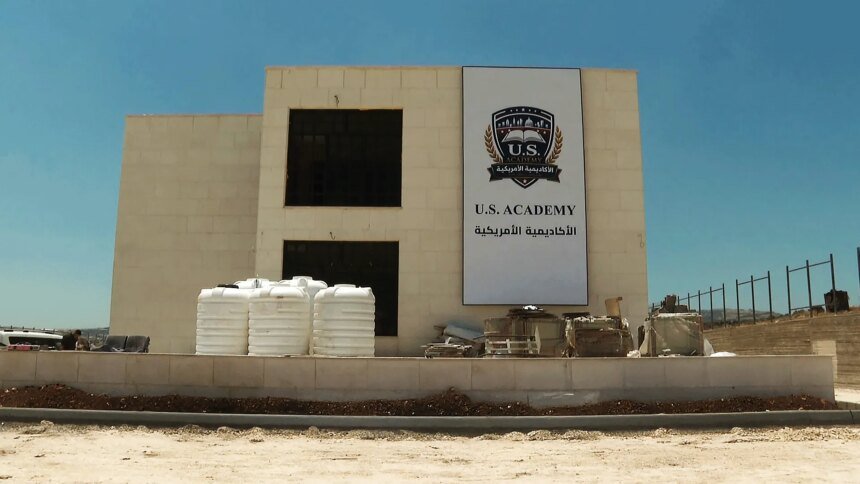
On the outskirts of the village of Deir Dibwan, east of Ramallah, the scene was supposed to be completely different. A modern school with educational and investment ambitions, which includes playgrounds and sports facilities, and opens its doors to Palestinian and American students who wish to learn and live in their homeland. But the project, which cost the Palestinian-American investor Abdel Jawad $5 million, found himself besieged by a settlement tent, repeated attacks, and thefts that affected building materials and school contents.
The report prepared by Al Jazeera’s correspondent from Ramallah, Tharwat Shaqra, indicates that Abdel Jawad did not expect his educational dream to turn into a daily battle to protect the place. Despite his residence in the American state of California, he was forced to return to the West Bank after the escalation of attacks on the project, to reconsider his calculations and change the school’s plan. Instead of making it an open space for students, he began to think about raising the walls and tightening protection measures.
Abdel Jawad said that the project now needs a fence and guards working day and night to be able to maintain it, noting that the school, which was supposed to include a playground, a swimming pool, and educational facilities, changed its features due to what he described as settler attacks and the theft of materials used in construction.
He explained that his goal with the investment was to support education and provide a suitable environment for students, especially Palestinian Americans whose families return to the region for the purpose of learning and getting to know the country, but he pointed out that the situation changed after the start of settler attacks, which, according to him, led to the displacement of residents who were residing in the region.
Abdel Jawad says that the land he owns is 16 dunums, but he is no longer able to access only about 10 dunums, due to restrictions and attacks that prevented him from accessing the rest of the area.
He added that the school may turn into a place resembling a prison due to protection measures, but he stressed that the goal will remain linked to education and maintaining presence on the ground.
The school issue does not appear to be an isolated case, as Palestinian lawyers say that the property of expatriate Palestinians has become a frequent target of attacks in areas north of Ramallah.
Targeting circle
Lawyer Yasser Alqam, from the town of Turmus Ayya, follows hundreds of cases related to complaints about the seizure of lands belonging to Palestinians residing in the United States of America, and confirms that many of these files reached the American authorities without tangible results.
Alqam said that the number of complaints cannot be counted, as they are dozens and perhaps hundreds of cases that were submitted to the embassy and the US State Department, but the owners did not see, according to him, any response that would put an end to what they are exposed to.
In Turmus Ayya itself, fears of attacks prompted a Palestinian expatriate to leave his life in the United States and return to his village. Zaher, who was living in the state of Georgia, decided to return after escalating tensions and the attacks approaching the home of his daughter and grandchildren.
Zaher says that he returned with the aim of staying with his daughter, protecting her, and standing with her, explaining that his family was living in the United States, but circumstances forced him to return and stay near his family.
Between a school project that was not completed as planned, lands whose owners face difficulty in accessing them, and families returning from exile for fear of their children, the stories of expatriate Palestinians in the villages of Ramallah paint a picture of another battle revolving around land, ownership, and existence.
Even those who hold foreign nationalities and have lived far from Palestine for years find themselves facing a new reality when their property returns to being targeted. While hundreds of complaints remain pending, the owners of these lands continue to try to protect what remains of their connection to their homeland.