West Bekaa- On the banks of Lake Qaraoun, where the waters of the Litani embrace the green slopes of Western Bekaa, it stands vacant as one of the towns that experienced the cruelty of war and the burden of waiting. A town that has combined Lebanon’s diversity and contradictions for decades; It is adjacent to churches and mosques, and the roads of the Bekaa and the south meet, while its markets and fields pumped life into the entire region.
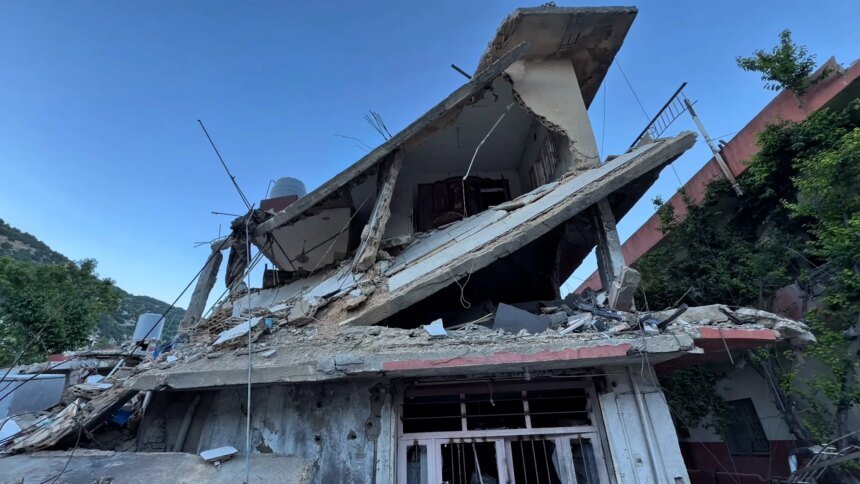
Today, the town of Mashghara looks different. Between the cracked buildings, perforated facades, and traces of rubble that still spread in more than one neighborhood, residents are trying to restore the details of their daily lives, and return to places that no longer completely resemble what they left behind on the day of displacement.

When Hajj Fatima Hammoud returned to the town after long months of forced absence, she did not need anyone to show her the way. She knew the alleys and lanes by heart, and knew the locations of the trees that she had planted with her own hands in front of her house decades ago, but as soon as she arrived, she stood silent for a long time. The scene before her did not resemble the image she had kept in her memory throughout the months of displacement.
The features of the place have changed. The houses that were once full of life have disappeared behind the piles of rubble, and some of them have nothing left but slanting walls that resist falling, and among the scattered stones, family photos are still hanging on parts of the walls, while the remains of possessions and clothes that their owners left behind and are gone forever are scattered.

In this particular neighborhood, one of the most painful events in the town’s memory occurred. A number of residents were killed in an Israeli raid that resulted in one of the largest massacres that Mashghara witnessed during the war, turning the neighborhood that was bustling with the voices of neighbors into a space burdened with absence.
Life after return
Around Hajja Fatima’s house, traces of war appear in every direction: buildings razed to the ground, shops that have lost their facades, and roads that still bear the scars of the raids that tore the place apart. Although some movement has returned to the town, the war is still present in small details. In the closed windows, in the abandoned houses, and in the names that were absent from the daily scene.
Hajja Fatima recalls the scene of return with clear bitterness, saying to Al Jazeera Net: “We were only dreaming of returning. We were not thinking about how we would live after that.”

She is unable to hold back her tears as she wanders through the ruins of the neighborhood to which she returned, stopping at every corner, as if searching for a part of a memory that survived the destruction. She says that the scene was much harsher than what her imagination had depicted during the months of displacement, and that returning brought back to her all at once the faces of the loved ones she lost in the war.
Hajja Fatima recalls the names of neighbors and relatives who have passed away, one by one, as if she were reading them from a memory book. For her, every name is a story, and every face is part of the daily life that brought together the people of the neighborhood on social and religious occasions and family evenings.
She confirms that what the residents lost is not measured only by the extent of the destruction that befell the buildings. During the war, the neighborhood lost about 12 of its residents, a loss she describes as greater than any number or statistic. She adds that homes can be rebuilt no matter how great the damage, but those who left will not return.

In front of her damaged house, she points to the cracked walls and demolished rooms, then remains silent for a few moments before saying that what happened to the house remains less painful than what happened to the people. The neighborhoods that were once full of families changed their features, and entire buildings disappeared from the scene, while many families found themselves homeless and without certainty about the future.
However, Hajja Fatima still clings to hope. Despite the weight of loss and destruction, she believes that what helps the people to persevere is their adherence to each other, their insistence on remaining in their land, and preserving the memory of those who have passed away.
In today’s Mashghara, the return does not seem like the end of the story as much as it is the beginning of a long journey to restore what the war destroyed. Among the rubble and cracked houses, residents are trying to restore their lives piece by piece, while the memory remains a witness to a past time, to people who have disappeared, and to a town still searching for its image among the rubble of war.

Back burdened
In the center of town, Hussein Sarhan stands over the rubble of his relatives’ homes and shops that were bustling with life before the war. Today, there is nothing but scattered stones and iron. He passes through the rubble slowly, as if he is trying to reconstruct the place in his memory: the crowded alleys, the open shops, and the adjacent houses that were filled with the sounds of families.
Sarhan told Al Jazeera Net that the town was almost empty at the time of the targeting, which limited the size of human losses despite the density of construction, but he explains that the nature of the adjacent houses contributed to expanding the scope of the destruction, so that not a single neighborhood remained immune from the impact.
When the people returned, silence was the first thing that greeted them. Many found themselves facing uninhabitable homes, and their livelihoods were scattered overnight. Some of them took refuge with their relatives, and others took refuge in houses opened by the townspeople living outside, in an attempt to contain the shock.
Despite the extent of the devastation, another form of life emerges within the rubble, as Sarhan talks about quick solidarity initiatives, in which the townspeople and expatriates opened their uninhabited homes to receive the affected families, as a temporary space to breathe.
In the end, it appears empty, as its people describe it: a town burdened with destruction, but not emptied of its people. Its residents are still there, among the rubble and memory, trying to recover the features of a life that was not completely erased, but it is no longer what it was either.
The toll of destruction
The town of Mashghara was subjected to a series of Israeli raids, estimated by the town’s residents at approximately 40 to 50 raids, which resulted in extensive material damage to homes and residential buildings. The losses included the complete destruction of about 60 homes, and between 200 and 300 homes were partially damaged, in addition to damage to the infrastructure.
There were also casualties among civilians, including martyrs and wounded, which increased the scale of humanitarian losses. The effects of destruction are still evident in the town’s neighborhoods and roads, as residents continue to feel the extent of the radical change caused by the raids in the town’s urban and life landscape.