Tracey Emin’s exhibition at Tate Modern offers hope
Published at 05.00

In London at the faeces-stained waters of the river Thames in front of the Tate Modern art gallery, a bronze lump over two meters high stands on its bare knees with its butt in the air. Its face and arms look like raw beef, as if someone pounded its flesh after plunging to the earth.
It is Tracey Emins sculpture “I followed you to the end” and I stand at eye level with its abdomen and think of what Emin has said in numerous interviews over the years, how she sees the whole body as a self-portrait.
How the underbelly is as important as the face to capture the inner life.
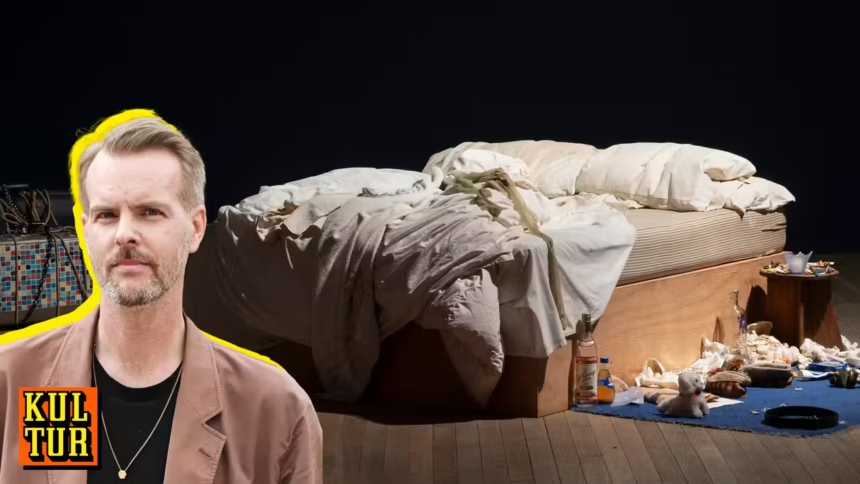
In hers maybe most famous work “My bed” from 1998, which consisted of her own bed, it was a self-portrait where only a memory of an actual body appeared, a woman has cried, supped and fucked but we only get to see the unbedded aftermath of it.
Tracey Emin belongs to the generation of British artists born in the early 60s who in the second half of the 90s were lumped together under the epithet Young British Artists (YBA’s). Where other artist giants such as Damien Hirst from the same “cohort” breaks up sharks into component parts has Emin worked more on dismembering his own body – an antiseptic artistry vs one that bleeds.
In “A second life”, the major retrospective of her artistry that opened earlier this spring at Tate Modern (running through August 31), it becomes clear that her singular pulse still beats hard.
A noticeable difference in comparison to other tourist-dense exhibition destinations I’ve been to over the years, the incredibly attentive and almost devout atmosphere from the other visitors.
Fascinated, I stand and watch about forty people of all ages stand like packed herrings in front of a 30-year-old film in which a young Emin talks about an abortion.
The halls are painted in a dull blue color and take on the role of one Victorian mortuary. But instead of a singular dead body, you are chased by a bewitching Emin who has metaphysically dismembered herself on a curated autopsy table through the exhibition’s eleven rooms.

Already in the exhibition beginning, Emin’s voice from an early video work leaks through the walls and the words “Slut, slut, slut!” bleeds into the other art.
It is art where phantom pains are allowed to take physical expression and put on a pedestal.
In a world over-exploited with performance demands, Emin feels safe as the cicerone of the non-profitable bodies.
It is room for people who grind their way in the world more than they walk.
Thank you Emin for that.
“Everybody knew he’d broken into girls before” she writes in the text work “Exploration of the soul” from 1994 about a rape she was subjected to as a teenager.
“He has broken into girls before” is a sentence that so well describes something indescribable, something that will forever disturb the peace of everyday life afterwards, I get tears in my eyes for the part of myself that is forever disturbed because of my life’s own burglars.
In the painting “Rape” from 2018, the body is in complete disintegration, there is nothing for the viewer to grab hold of, the water leads the way through the paint that runs down and smudges the remains of what once might have been a human on the canvas.
Emin is as much a word artist as a visual artist and has an ability to call things by their right names, the simple impact of the word “rape” straight up and down.
In the painting “I never asked to fall in love, you made me feel like this” from 2018, a coagulated black hole is visible below a reclining figure that appears to exist in a sanatorium in purgatory.
She paints in the cheapest color acrylic, a color that, unlike oil, has historically been looked down upon precisely because of its availability.
Overall, there is a welcome and an opportunity in Emin’s choice of material throughout her career. With acrylic paint, felt fabric, pen and paper, she opens up for others who bleed through life to build their own safe spaces.
In 2020, Emin was affected of cancer and was forced, among other things, to have her uterus removed and perform a ostomy surgery.
In a narrow passage located in the middle of the exhibition halls, there are white display tables made for medical pamphlets, but instead of an easy-to-read brochure about cancer, there are close-ups of Emin with bloody bandages, urine bags and a stoma that glows red.
It may sound absurd, but that bright red stoma stump acts a bit like a portal into the strongest part of the exhibition, the paintings she made after the cancer diagnosis where the color red dominates in almost every image.
The paralyzing effect of an invasive disease forces her to take urgent artistic action, and the paintings she painted after the cancer shine in a way that makes even the previously less invasive works rise higher in the context.
“Get out from living inside of me” that she embroidered in 2008 on a hospital blanket that makes me itch just by its mere sight.

As effectively as possible is Tracey’s second life in the final mausoleum-like portrait chamber where a death mask she had cast off her face at the age of 39 (a perfect age to pre-empt her death) sits enthroned in the center of the hall surrounded by bleeding giant portraits on the walls.
Faceless bodies float around me on the paintings on the walls around the middle-aged mask. Among other things, she has written “Not as old as my broken fucked up vagina” in crying capitals on the board “Last of my kind” and a guy in middle school age stands there and reads every word as if it were an altar board.
He feels like a manifestation of a patriarchal future I don’t really believe in at all, but it feels hopeful in the moment and I am moved to tears again.
On the last one the wall a black-clad apparition watching over a Tracey with her hands between her legs on a kitchen table in the painting “I watched Myself die and come alive”.
Death tends to keep track of itself, so it’s important to keep track of your life as long as you have something left.
“Art can be really mean to me, but then it comes back to me when I least expect it, lifts me up and takes me with it”.
Tobias Dunér-Axelsson is a freelance art critic.