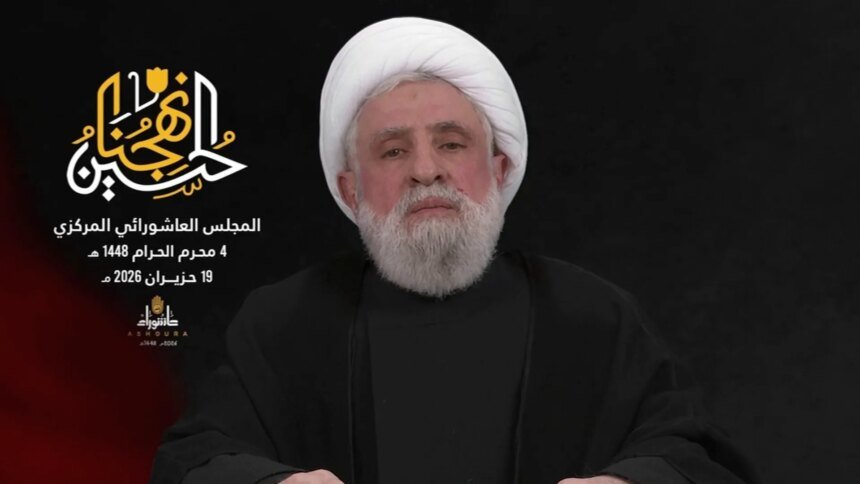
Hezbollah Secretary-General Naim Qassem said today, Friday, that Lebanon is going through the most dangerous stages of its history, and that the American-Israeli plan aims to completely end the Lebanese resistance.
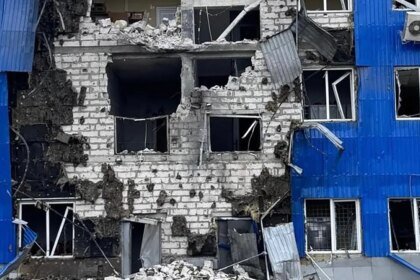
He added in a video speech that the Israeli war on Lebanon, which he described as criminal, did not observe any controls in killing civilians and children and destroying buildings, and wanted to bring the resistance to its knees by a prior decision.
He continued that there was no return to what was before March 2, and pledged to remove Israeli forces from all the areas they occupied in Lebanon.
He pointed out that “the (Israeli) enemy and America backed away from the agreement of November 27, 2024, after the fall of Syria (Bashar al-Assad’s regime), because they believed that the balance of power had changed, so they refused to continue proceeding according to what was in practice.”
Plan to end resistance
He accused Washington and Tel Aviv of having drawn up a 12-point plan to end the resistance in Lebanon, saying that the party had also drawn up a 12-point plan to thwart this plan, stressing that the project to end Hezbollah and stabilize the occupation had failed.
Qassem stated that the American-Israeli plan “is based on exploiting the Lebanese government to overthrow the resistance in violation of the constitution and with all heinous acts, regardless of the result, and the political authority was required to provide political cover,” stressing that “all sea, land and air crossings were closed to prevent supplies from reaching the resistance.”
He said that the United States and Israel prevented reconstruction in order to keep people displaced and displaced until the resistance environment turned against them, and they imposed a severe financial blockade “so that the resistance would not be able to rise.”
He also said that they had “spread sedition until the Lebanese army turned against the resistance,” and added that the army’s awareness and objective circumstances prevented this from happening. He also accused Washington and Tel Aviv of having tried to persuade Syria to intervene in Lebanon to use pincers against Hezbollah, but it did not respond to them.
Spreading strife
Sheikh Naeem Qassem said in his speech that America and Israel “worked to revive the Sunni-Shiite strife under the title of protecting the position of the prime minister, but rational people did not pass this strife,” adding that “the poison sprayers did not lead us to the Shiite-Christian strife.”
He added, “They wanted to strike the Sunnis with the Shiites and strike the army with the resistance, and then those who considered themselves ideologues of the powerful Lebanese state would emerge to invest in the situation,” noting that some reports that reached the party confirmed that the Americans “when they blamed these people for not doing anything, the answer was that they could not do anything.”
He continued, “The plan was based on the presence of international cover and from some Arab countries to pressure to achieve Israel’s interests under different headings and forms,” saying that “all the intelligence services in the world are working against us and exploiting all their capabilities to besiege us.”
He stressed that America “is leading this plan with all its details in all directions and using all available capabilities. We know and follow the scenes of everything, and we deal with matters that require confrontation, sometimes politics, and sometimes media.”

The right to defence
Hezbollah Secretary-General Qassem said that the resistance relied on its right to defend and liberate the land, and reconsidered the military structure and method of management after the battle of “Uli al-Bas” in a way that suits the possible new battle.
He added that the resistance “modified its methods of fighting, developed a doctrine that takes advantage of the experience and existing circumstances based on hit and run and instability, and developed weapons and marches with the minds of its people.”
Qassem said that the Lebanese resistance believed in confronting the enemy, and directed its weapons at him so that he would leave Lebanon without leaving a trace, and that it “cooperated with those who carry its vision in confronting the one enemy,” and maintained its unity with the “Amal” movement.
He stressed that the resistance adopted ambiguity and silence and continues to do so so that the enemy does not know what it is planning. It took a Karbala decision that is still in effect. It was patient where it needed to be and fought where it needed to, and its patience was fighting for 15 months.

Israel will withdraw
Qassem stressed that “there is no return to what was before March 2,” and that the project to end Hezbollah has failed, and that the Israeli is begging for the smallest gains and that he will leave the land no matter what he does.
He continued, “Hezbollah’s project in Lebanon is based on following the path of Hussein, resisting injustice, and adhering to freedom,” considering that “every step the party takes to confront foreign guardianship, Israeli occupation, and cultural and moral subordination represents a form of victory.”
He also said in his speech, “Since we do these things under this title, we are victorious in all our lives because we are on the right path, and when the enemy confronts us with weapons, we confront him with weapons, and when he confronts us with soft war, we confront him with the same, and when he tries to impose something on us, we refuse and raise our voice with the tools of confrontation available to us.”
He added, “We do not fear death, and we fight for the sake of God in defense of our principles and our lives, so that we can protect our integrity and our choice. The weapon of death that they threaten us with is not a weapon that scares us, even if there are none of us left.”
He continued, “The enemy is defeated because he did not defeat our rules, our souls, our convictions, or our steadfastness, and because we are present in the arena and bear all the difficulties and punishments,” and that victory “does not need a narrative that confirms it.”
He explained that the huge losses incurred by the resistance in its war are not a defeat because they are “much less than surrender,” pointing out that about 4,000 men, children and women “were slaughtered in Sabra and Shatila, and we did not surrender.”
He pointed out that the resistance “achieves achievements through its steadfastness,” and that talk about the destruction of homes and people’s capabilities during the war “is nothing but an attempt to incite people to resist,” saying, “You will not reach a result because those who march under the banner of Hussein will not respond to Yazid’s group.”
He continued, “Stop asking about the form of victory, and go discuss other political issues because you will not reach a result with us,” stressing that what happened was “clear Israeli aggression,” and that those who reject the war “are those who refuse to do what they must.”
He stressed that the resistance “is not required to win according to the projects of others, but rather according to the tasks specified by Sharia law, and victory is to prevent the enemy from achieving its goals, so do not pay attention to those who see everything as a defeat.”

cease-fire
Israel and Hezbollah agreed to a ceasefire as of four o’clock local time today, Friday, but the Israeli raids continued, after four Israeli soldiers were killed during battles in southern Lebanon.
Reuters quoted an American official, who refused to reveal his identity, confirming that the two sides had agreed to a ceasefire, saying, “We learned that after the exchange of fire earlier today, Israel and Hezbollah entered into a ceasefire.”
In turn, Axios quoted an American official as confirming that Israel and Hezbollah had agreed to a ceasefire with American-Qatari mediation after talks with Israel and Iran.