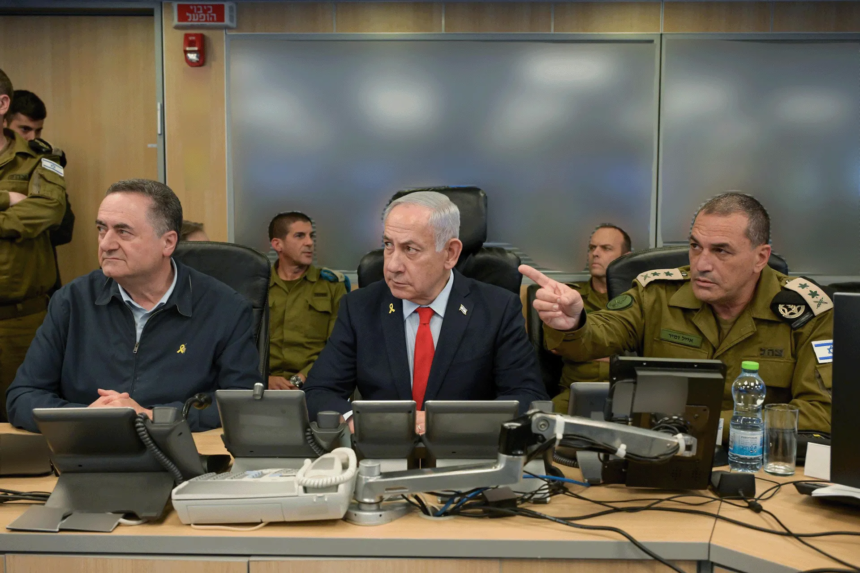
On June 18 and 19, 2026, Israel’s northern front entered the most complex juncture in its history. Tel Aviv woke up to a “disaster” that struck the 52nd Armored Battalion (401st Brigade) in the Ali Taher Heights and the outskirts of Nabatieh, resulting in 4 deaths, including the battalion commander, Lieutenant Colonel Dor Gedaliah Ben Simon, and the injury of the deputy commander of the 36th Division and senior officers.
This military bleeding coincided with the signing of a historic memorandum of understanding between Washington and Tehran (Wednesday, June 17), which tied the hand of Prime Minister Benjamin Netanyahu, and placed him in a double “pincer” between the defeat of the field and the strategic international restrictions.
Read also
list of 2 itemsend of list
Illusions of swearing
The first cracks emerged in the collapse of trust between Tel Aviv and the Trump administration, as journalist Eli Leon revealed in Maariv newspaper – citing US Vice President J.D. Vance’s podcast – the details of a stormy call between Trump and Netanyahu following Israeli raids, and he quoted Trump as saying angrily: “He completely lacks wisdom. Why did Netanyahu carry out that attack? I was very angry.” Rather, he described him as “a very difficult man,” directing a strategic insult: “He should be grateful to us, because if Iran had nuclear weapons, Israel would not last even two hours.”
For his part, J.D. Vance redrawn the boundaries of the relationship with excessive pragmatism, explaining: “We are the superpower in the world. Accordingly, we are the largest partner, and they are the smaller partner. This is how things go,” setting up an American veto against the right-wing’s ambitions to destroy the Iranian regime: “Is turning Iran into a ‘Persian Libya’ in the interest of the United States? Absolutely not.”

The harshest political reading came from analyst Amos Harel in Haaretz newspaper, where he considered the agreement an American surrender and the culmination of Israeli failure. He wrote: “From an Israeli point of view, the memorandum of understanding is a very bad document. It is like an American surrender agreement… By its nature, it culminates the October 7 war as a strategic loss… Trump has retreated and withdrawn from the Gulf region.”
Harel explained that Trump portrayed Netanyahu as a secondary partner, and gave provocative, sarcastic advice: “There is no need to shoot down buildings over every drone that falls in the desert.” The most dangerous is the “unification of arenas” clause, which explicitly stipulates a ceasefire in Lebanon and recognition of its territorial integrity, which implicitly imposes the withdrawal of the 12-brigade forces and turns them into a politically isolated burden.
Connect squares and oil weapon
The Israeli elite monitored the interdependence imposed by Tehran between the Gulf and southern Lebanon. In an analysis in Yedioth Ahronoth newspaper, writer Michael Milstein confirmed that the agreement reflects a balance in favor of Tehran, which “came out as a wounded lion, and a wounded lion remains a lion.”
He explained, “Iran clearly states that it will not sign a final agreement without ending the fighting in Lebanon, including an Israeli withdrawal… The main dilemma lies in what Trump will decide.”

The implementation was not delayed, as the “Israel Hayom” newspaper reported via Neta Bar the success of Iranian pressure in freezing the Swiss talks following the Bekaa raids, and the Revolutionary Guards’ announcement of the official closure of the Strait of Hormuz: “Given that Israel’s withdrawal from Lebanon and the complete lifting of the naval blockade… are basic conditions, the Strait of Hormuz will remain closed… and any ship that ignores this will be exposed to attack.”
The Iranian trap and diplomatic pressure
Analyst Anna Barsky in Maariv newspaper was unique in exposing the Iranian trap and Washington’s desperate pressure, linking the “Ali Taher” hill ambush to diplomatic maneuvers. She explained that the fall of the commander of the 52nd Battalion put Israel in front of a dilemma: “Do you respond forcefully – and to what extent – while Washington is exerting intense pressure to be content with a moderate and limited response?”
Barsky revealed that the goal of the pressure is to “prevent an escalation that might derail the talks led by Trump.” She added that postponing Vance’s visit to meet the Iranian delegation in Switzerland and Geneva is due to Iranian conditions.
She said: “According to informed sources, the real reason for the delay is Tehran’s refusal to start talks unless Israel withdraws from Lebanon. The Iranians are seeking to force Washington to exert pressure on Israel. It is Tehran that delayed sending the delegation against the backdrop of escalation.”

Regarding the dimensions of the “Ali Taher” ambush, Parsky confirmed that it was an Iranian plan to corner Israel: “Hezbollah’s move was a deliberate Iranian initiative to push Israel into a violent reaction, and then allow Iran and the Western parties to exert pressure to demand its withdrawal. The Iranians acted based on the assumption that Israel would not be able to retreat after an attack like this, and they sought to prove that as long as the Israeli army remains in Lebanon, it is impossible to achieve stability.”
The responses extended to Europe. The French Foreign Minister called on Washington to put pressure on Tel Aviv, which Jerusalem considered turning Lebanon into an international political issue. In the face of this, Trump demands that Israel “help” him by not giving the Iranians an excuse to blow up the negotiations or raise oil prices, and to violate his memorandum, which he sees as a strategic achievement.
Field bleeding and military efficiency
On the ground, Avi Ashkenazi documented in Maariv the details of the “armor massacre” of Ali Taher, stressing that staying in fixed points turned into a “death trap.” This was supported by Ron Ben Yishai in Yedioth Ahronoth, acknowledging the “limits of force,” saying that “the Israeli army does not currently have the manpower, resources, and plans necessary to occupy most of Lebanon, and the memorandum of understanding exacerbated the situation, because Israel lost an important part of its freedom of action.”
Ben Yishai pointed out that the forces are now exposed to explosive ambushes and the generation of “explosive fiber-optic drones that still have no satisfactory solution.” He criticized the security mentality based on the idea that every problem is solved by force, stressing that it would fail to reach a settlement.

In the dilapidated logistical context, Amos Harel revealed in “Haaretz” Chief of Staff Eyal Zamir’s warnings to the cabinet that “the army is suffering from major efficiency problems… as 3 years of continuous war are also depleting stocks of tanks, troop carriers and weapons… and the occupation of lands in Lebanon, Syria and Gaza is surrounded by enormous manpower and the tragic use of reserve units.”
Harel reasoned that “the seizure of Beaufort Castle was not completed until about 100 days of fighting,” noting the decline in motivation and high rates of leakage.
Speech of challenge and slogans of consumption
Absorbing the shock, Netanyahu and his Defense Minister, Yisrael Katz, quickly issued fiery statements. Netanyahu said: “I share the grief of the families of the commander of the 52nd Battalion and three heroic soldiers. Last night, I instructed the army to strike Hezbollah forcefully, and we attacked more than 80 targets and the Bekaa headquarters. My instructions are clear: We will not tolerate any attack, and Israel will remain in the security zone in southern Lebanon as long as it is necessary.”
Defense Minister Yisrael Katz agreed with him, stressing a common policy: “The army will remain stationed in the security areas in Lebanon, Syria, and Gaza, without any time restrictions, and despite all the pressures. We seek to make decisive military decisions instead of bargaining and political concessions.”
Netanyahu government options
Based on these intersecting readings, Netanyahu’s options are summarized in two paths, the best of which is bitter:
The first option (submit to the agreement and withdraw)Submitting to pressure from Washington and withdrawing the 12 brigades beyond the border. Although this protects Israel from Trump’s sanctions and responds to his request for “help” to protect negotiations and oil prices, it represents an admission of impotence. This is what Harel proved by saying that the agreement “culminates the October 7 War as a strategic loss.”
Barsky also warned that the withdrawal “would mean the disintegration of his government coalition and its fall under the blows of the extreme right (Ben Gvir and Smotrich).”

Option 2 (rush towards exhaustion): Field rebellion and rejection of the dictates through Katz’s slogan, “Stay without time restrictions,” and responded violently, betting that closing the Strait of Hormuz would force Washington to intervene.
But the danger of this stubbornness is evident in Barsky’s reading that Israel finds itself pushed to respond, because it “will not be able to retreat after an attack like this.” This clashes with Ben Yishai’s rejection of the army’s lack of “manpower and plans” and its inability in the face of fiber-optic marches, which will lead to the exhaustion of the military machine and deprive Tel Aviv of its political and logistical cover, recalling Zamir’s warning of a storm that will turn Israel into a rogue and isolated entity.
In conclusion, the US-Iranian memorandum of understandings crowned the October 7 war as a complete strategic loss for Israel, after Trump’s “cold pragmatism” shackled Netanyahu’s military options and turned them into a secondary tool for securing his regional interests and oil prices.
Therefore, Tel Aviv has become unable to continue fighting in light of the deteriorating efficiency of its army and the trap of fiber-optic marches, which ultimately forces it to accept the limits of force and force a withdrawal from southern Lebanon, which will collide with Netanyahu’s tricks and tricks in light of fateful elections in less than 4 months.