Published on 6/18/2026
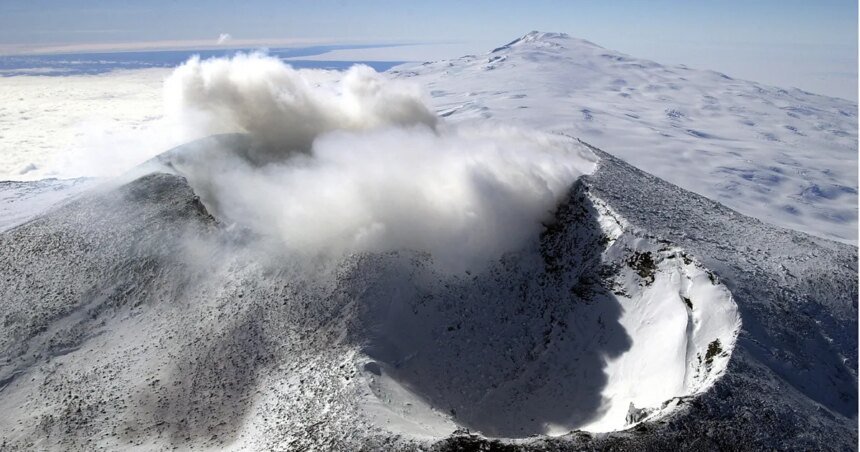
The Erebus volcano in Antarctica continues to amaze scientists, after a recent study added a new wonder to the list of this volcano’s wonders, which is its role in puncturing the ozone layer in the sky.
35 years ago, a study published by the journal Geophysical Research Letters revealed that this volcano not only releases gases and volcanic ash, but also spews out fine particles of gold estimated at 80 grams per day.
During that study, scientists detected the presence of crystalline particles of gold inside the volcanic cloud above the crater of the Erebus volcano. What is most exciting is that the traces of these golden particles were not limited to the areas near the volcano, but were also found in the surrounding air and at distances of up to about a thousand kilometers from their source.
Today, a long time after that study, researchers from the V.E. Zuev Institute of Atmospheric Optics of the Siberian Branch of the Russian Academy of Sciences have discovered a new surprise, which is that this volcano is not only spewing gold, but also gases that play a role in the ozone hole.
For decades, man-made CFCs have been considered the main cause of ozone depletion over Antarctica, but this study, published in the journal Atmospheric Environment, points to the role played by the Erebus volcano.
The study focuses on hydrogen chloride gas, which is one of the compounds capable of contributing to reactions that lead to the destruction of ozone. According to the hypothesis tested by the researchers, the Erebus volcano constantly releases this gas, while tropical cyclones, when they pass over the volcano, transport it to the stratosphere, where the ozone layer is located.

Four decades of data
To reach this result, the researchers relied on analyzing data extending between the years 1981 and 2022 to study the relationship between the area of the ozone hole and the number of days in which polar hurricanes are concentrated over the volcano. They also compared the concentrations of hydrogen chloride gas in the two hemispheres using data from four monitoring stations located in areas of medium and high latitude.
The results showed that the annual changes in the area of the ozone hole during the months of September, October and November are partly related to the number of days that hurricanes pass over the Erebus volcano. The average contribution of this factor in explaining the annual changes was about 29.9% in September, 23.8% in October, and 11% in November during the study period.
It is noteworthy that this volcano is one of the most active and violent volcanoes in Antarctica at the present time.
There are more than 138 volcanoes buried under ice on the continent, most of which are currently dormant, while it is believed that about 8 or 9 volcanoes are still active, including the “Erebus” volcano.
The volcano is located on Ross Island, and has a height of 3,764 metres, making it the second highest volcano on the continent after Mount Sidley.
One of its most distinctive features is the presence of a permanent lake of lava inside its crater, and this phenomenon is very rare globally, as there are only a few volcanoes that contain continuous lava lakes.