Al Jazeera correspondents
Published on 6/19/2026
|
Last update: 11:12 (Mecca time)
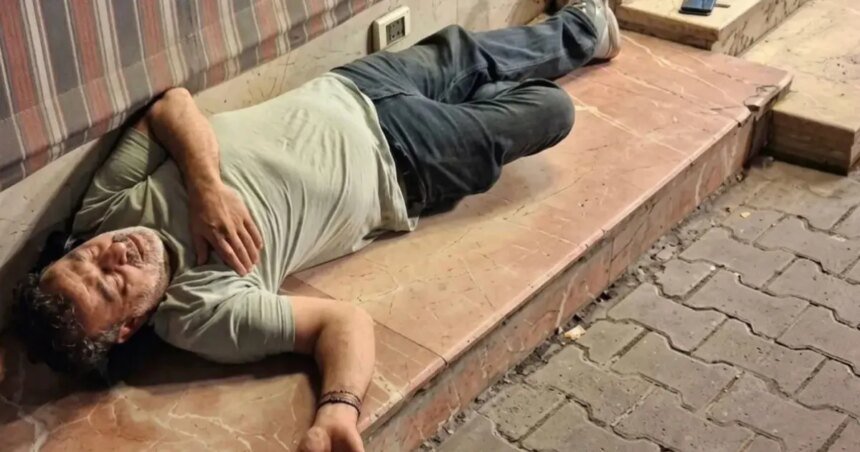
Cairo- The photo that showed Palestinian activist Nadim Awad sleeping on a sidewalk in Giza Governorate in Egypt did not remain just a fleeting snapshot of a man exhausted by circumstances, but rather turned into a loud cry that re-shed light on the conditions of liberated Palestinians who were deported from their homeland after their release as part of a prisoner exchange deal in 2025.
Awad, who spent about 20 years in Israeli occupation prisons and was sentenced to life imprisonment and dozens of additional years, found himself after his liberation facing a new battle outside the prison. It is the battle of searching for shelter and a source of income after his financial allocations stopped and his savings ran out, so he ended up sleeping on the street and sleeping on the sidewalks.
In an interview with Al Jazeera Net, Nadim Awad recounts the details of the harsh days he lived after being expelled from his rented residence. He talks about his feeling of betrayal, the conditions of the deported prisoners abroad, and his vision of the responsibility of the Palestinian Authority and the Arab countries towards the prisoners who spent their years in Israeli prisons defending a cause that does not concern the Palestinians alone.
Image story
Freed prisoner Nadim Awad tells the story of the photo that sparked widespread controversy, saying that he took refuge in the street after he was stranded and ran out of money, in light of the cessation of the “pension” he was receiving from his previous employer, the Palestinian General Intelligence Service, to which he was affiliated before he was arrested by the occupation authorities and sentenced to life imprisonment and an additional 30 years in 2005, on charges of killing an Israeli soldier and wounding three others.
The prisoner, who spent 20 years in occupation prisons, believes that what he described as the Palestinian Authority’s “response” and its “influence” by Israeli and American pressures regarding prisoners’ allowances, established by Palestinian law, is a major reason for the state of affairs of many of the freed persons or the conditions of the families of the prisoners in the prisons, who were receiving their salaries before they were interrupted.
The prisoner deported to Egypt explains that he was a guest with 80 prisoners in an Egyptian hotel, before he was expelled by the body responsible for managing the prisoners’ file due to a dispute with one of his colleagues.
Awad then rented an apartment, but due to the delay in disbursing the allocations provided by the Palestinian Authority to deported prisoners, estimated at $500 per month, the owner of the apartment asked him to vacate it, which forced him to live on the street and sleep under bridges at the end of the night.
He said, “I chose the street to sleep in instead of telling someone to give it to me, or begging on the sidewalks.”
Awad explains that after a photo of him sleeping under a bridge in the Giza area spread, two of his fellow freed prisoners intervened and rented an apartment for him.
Some other freed prisoners also gave him a sum of money to manage his affairs, before a member of the Fatah Revolutionary Council intervened and pledged to provide rent for six months.
Awad says: “I also received a promise from the head of the Palestinian Intelligence, Majid Faraj (Abu Bashar), that my pension would be paid back from the Palestinian Intelligence and that the payment would be regular as well,” adding, “If this is achieved, I will not need any further assistance.”
The man adds with pain that the harshest moments of humiliation and humiliation that he experienced inside Israeli prisons were easier for him than the feeling he felt during the days when he lived in the streets after his money ran out and he did not find anyone to turn to.
He says, “What is more difficult than torture and humiliation in prisons is humiliation while you are among your family, and disappointment from those responsible for you, especially after you sacrificed your life for your cause.”
The freed prisoner continued in his interview with Al Jazeera Net, “After the photo was published, I was flooded with communications from inside and outside Egypt. Thank God, it removed the overwhelming feelings from the Egyptians, who showered me with offers of money and apartments to live in for free, the lump that was in my throat from the neglect I suffered from my people and the Palestinian Authority.”
Awad notes, “I received more than 30 offers for housing. One of the distinguished Egyptian women said to me: I have two apartments, I live in one of them, and my son and his children live in the other, and I will vacate it for you to live in however you want. I thanked her for her sincere feelings. Another woman from the city of Helwan also called me and offered to allow me to live in an apartment she owns without receiving any compensation or rent. I told them: Our authority is better than ours.”

Passports without stamps
Regarding the problem of legalizing the presence of deported prisoners in Egypt, Awad says: “The Palestinian embassy in Egypt gave us passports, but without entry or exit stamps, so these passports became the same thing, and the Egyptian authorities do not accept to grant us residency papers, and accordingly I cannot open an account in any of the Egyptian banks so that my family in the West Bank can transfer money to help me live,” calling for a solution to this problem to be found.
On the other hand, the liberated prisoner thanked the Egyptian authorities for hosting them, at a time when many countries “such as Jordan, Tunisia, and Algeria” refused to host any of the liberated Palestinian prisoners deported from their homeland, adding, “We were informed that we are prohibited from entering any Arab country, and that no one wants to receive us.”
He continued, “I have recently become more sensitive to the homeless on the streets and those who do not have their own homes after I lived with them for several days.”
The liberated prisoner talks about his feelings after the days he spent homeless on the street during his crisis, saying: “Yesterday I was walking in the street, and I found a family consisting of a father, a mother, and a young child sleeping on one of the sidewalks in the Al-Omraniya area in Giza, near the apartment in which I live now. So I went to them and offered to the husband that I would host them in my apartment and sleep in it tonight, and leave it to them so that his wife and child would not sleep in the street.”