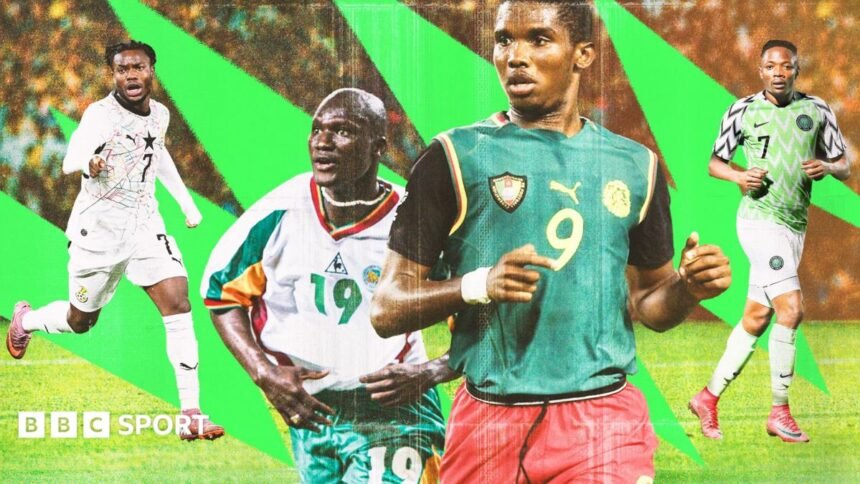
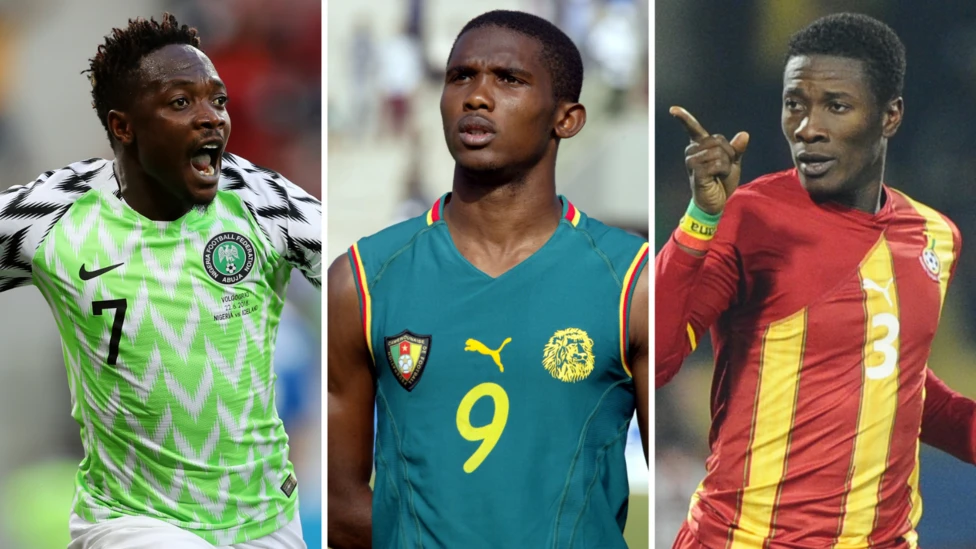
Nigeria’s Super Eagles saw their 2018 kit fly off the shelves, Cameroon’s 2002 sleeveless jersey caused controversy and Asamoah Gyan’s missed penalty in the 2010 quarter-finals means he will forever be remembered in red and gold
Nigeria’s Super Eagles saw their 2018 kit fly off the shelves, Cameroon’s 2002 sleeveless jersey caused controversy and Asamoah Gyan’s missed penalty in the 2010 quarter-finals means he will forever be remembered in red and gold
The World Cup is about goals, drama and emotion – but it is also about great kits.
And when it comes to colourful and iconic designs, Africa has had more than its fair share.
BBC Sport Africa has picked 10 of the continent’s very best for you to rank. Which one is your all-time favourite?
Zaire 1974 (home)

Zaire’s iconic green and yellow 1974 kit featured what was then the name of the country and the team’s Leopards nickname
Zaire’s iconic green and yellow 1974 kit featured what was then the name of the country and the team’s Leopards nickname
The oldest, and possibly boldest, of our kits, this vision in yellow and green was very much of its time.
While the shirt had a big collar and deep V-neck, what really made it stand out was the decision to put both the name of the country and the team’s Leopards nickname and logo on the chest.
Congolese designer Alvin Junior Mak, who has just gone viral after designing the current squad’s leopard print arrival suits, says he went back to the fashions of 1974 for inspiration.
“When you are in Africa, we say if you want to move forward, you have to see where you come from,” he told BBC Sport Africa.
While Zaire’s tournament 52 years ago, which included a 9-0 hammering at the hands of Yugoslavia, turned out to be a failure, at least the kit was anything but.
Algeria 1982 (home)

Algeria’s 1982 kit copied Zaire by having the name of the country written on the front in Arabic script (Al-Jaza’ir)
Algeria’s 1982 kit copied Zaire by having the name of the country written on the front in Arabic script (Al-Jaza’ir)
Another deep neck and big collar also mark this shiny beauty out as a product of its era.
Algeria’s first World Cup appearance in 1982 came towards the back end of the country’s socialist heyday, meaning the kit was manufactured by state-owned clothing firm Sonitex.
“The company is defunct now, so there’s no copyright protection on the design, hence many smaller clothing companies copying and selling it in Algeria and to the diaspora,” said Algerian sports journalist Maher Mazahi.
“That’s also one of the reasons it’s so popular among our football hipsters”.
When will an African side win the World Cup?
Cameroon 1990 (home)

Cameroon became the first African nation to reach the World Cup quarter-finals in 1990
Cameroon became the first African nation to reach the World Cup quarter-finals in 1990
Cameroon’s run to the quarter-finals of Italia ’90 was memorable for many reasons, including their 1-0 victory over holders Argentina in the tournament’s opening match and, of course, Roger Milla’s corner-flag wiggle.
Aged 38, the veteran striker was called out of retirement by President Paul Biya and bagged four goals to inspire his dancing celebration.
“The shirt had an iconic lion roaring on the chest, which to many was a symbol of pride, courage and determination,” explained Paul Njie, the BBC World Service’s man in Yaounde.
“Many people believe that was the best ever performance of the Cameroon national team and some of them attribute that to the luck which came with the kit.”
Nigeria 1994 (away)

Nigeria made their first World Cup appearance in 1994, when a dancing Daniel Amokachi (right) made his name scoring goals against Bulgaria and Greece
Nigeria made their first World Cup appearance in 1994, when a dancing Daniel Amokachi (right) made his name scoring goals against Bulgaria and Greece
Nigeria made their first World Cup appearance in 1994 and immediately set the standard with this jersey.
Rashidi Yekini, Daniel Amokachi and Emmanuel Amunike all scored as the Super Eagles rocked it on their debut, gaining a 3-0 win over Bulgaria.
They wore it again for the 2-0 victory over Greece, meaning they won both games while playing in away colors and lost against Argentina and Italy when sporting their green home kit.
“We see the legends, the players that made the difference for Nigerian football, and if I close my eyes that’s the first shirt that comes to mind,” former Super Eagles skipper William Troost-Ekong told BBC Sport Africa.
“Nigeria’s greatest set of Super Eagles have worn that shirt and all of us strive to be able to imitate that.”
South Africa 1998 (home)

South Africa qualified for their first World Cup at France 1998, with Quinton Fortune among the team’s star players
South Africa qualified for their first World Cup at France 1998, with Quinton Fortune among the team’s star players
This geometric classic was an update on the much-loved shirt worn by South Africa as they claimed Africa Cup of Nations (Afcon) glory on home soil in 1996.
They wore it in all three World Cup group games, but failed to win any of them on their maiden appearance.
“These days South Africa tend to wear yellow, but back in the 1990s their shirts were much more fun,” said Josh Warwick, co-founder of the Cult Kits website.
“In our opinion, Kappa were one of the great brands from that era.”
‘My brother hid in a rice sack’ – The refugee stars at the World Cup
Cameroon 2002 (home)

Cameroon were forced to add black sleeves to their 2002 jersey after Fifa ruled that the sleeveless version broke World Cup rules
Cameroon were forced to add black sleeves to their 2002 jersey after Fifa ruled that the sleeveless version broke World Cup rules
Originally released as a basketball-style vest, the Indomitable Lions wore the sleeveless version as they romped to the Afcon title in February 2002.
“The players didn’t know we would play with a shirt with no sleeves,” midfielder Eric Djemba-Djemba told BBC Sport Africa back in 2023.
“When we came to the dressing room we said, ‘Wow, this is a new generation of shirt’. When we went on to the pitch the world was watching and it became famous.
“Everybody in Africa wanted to wear that shirt.”
But Fifa were having none of it and forced Cameroon to add black sleeves for the World Cup three months later.
Spoilsports.
Senegal 2002 (home)

Papa Bouba Diop scored the famous goal which saw Senegal beat defending champions France 1-0 in the opening match of the 2002 World Cup in Japan and South Korea
Papa Bouba Diop scored the famous goal which saw Senegal beat defending champions France 1-0 in the opening match of the 2002 World Cup in Japan and South Korea
This kit’s World Cup debut could not have gone much better.
The Teranga Lions’ first ever game at the finals saw them shock holders France 1-0 in Seoul, with Papa Bouba Diop grabbing the winner.
A giant figure in midfield, he was famously nicknamed ‘The Wardrdobe’ due to his size, but even on him the baggy fit meant the shirt looked big.
“Of all our kits, 2002 is the best,” said Mamour Insa, a Senegal fan following his team at the current World Cup in New York.
“All our generation, they wear just that kit. A lot of young people wear it more than new designs. It is very difficult to find.”
Ghana 2010 (away)

Asamoah Gyan missed a penalty in the final minute of extra-time against Uruguay which would have taken Ghana into the semi-finals of the 2010 World Cup in South Africa
Asamoah Gyan missed a penalty in the final minute of extra-time against Uruguay which would have taken Ghana into the semi-finals of the 2010 World Cup in South Africa
Gaudy or golden? Ghana wore this bright sensation as they came agonisingly close to becoming the first African team to reach a World Cup semi-final, denied by the width of a crossbar.
With the Black Stars and Uruguay tied at 1-1 deep into added time at the end of extra time, Luiz Suarez saw red after using his hands on the line to deny Ghana a certain goal. But Asamoah Gyan’s penalty clipped the bar and went over, allowing the South Americans to triumph, ironically via a shootout.
“Once the fans see it, they remember the Uruguay game,” midfield legend Michael Essien told BBC Sport Africa.
“I think it was a great shirt, the players loved it,” added the former Chelsea man, while also cheekily suggesting it’s figure-hugging design meant you had to be “well-built” to look good in it.
Pick your favourite World Cup kits
Nigeria 2018 (home)

Nigeria’s 2018 World Cup jersey was a smash hit which saw fans queuing outside shops to get their hands on it
Nigeria’s 2018 World Cup jersey was a smash hit which saw fans queuing outside shops to get their hands on it
This vision in neon green broke the internet and saw long lines of people queueing up outside shops.
“The best football shirt ever,” claimed Troost-Ekong.
“Everyone was trying to get hold of it, I had so many calls and messages.”
Elements in the Nike design pay tribute to Nigeria’s 1994 kit, taking things full circle from that first World Cup appearance to create another stone cold classic, even if Troost-Ekong and his team-mates only got to wear it once in their 2-0 win over Iceland.
Ghana 2026 (home)

Ghana’s shirt for this World Cup features a colourful spiderweb design on its front
Ghana’s shirt for this World Cup features a colourful spiderweb design on its front
Looking like something Spiderman would wear, there is a cultural reason behind the design of Ghana’s stunning new home shirt.
It pays tribute to Kwaku Ananse, a character from Ghanaian folklore often depicted as a spider.
Ananse is seen as a trickster, and something tricky could happen to this kit at the World Cup, with Fifa already having decreed the Black Stars will not wear their home strip for any of the three group matches.
So there is a chance this could be the World Cup classic that never was.