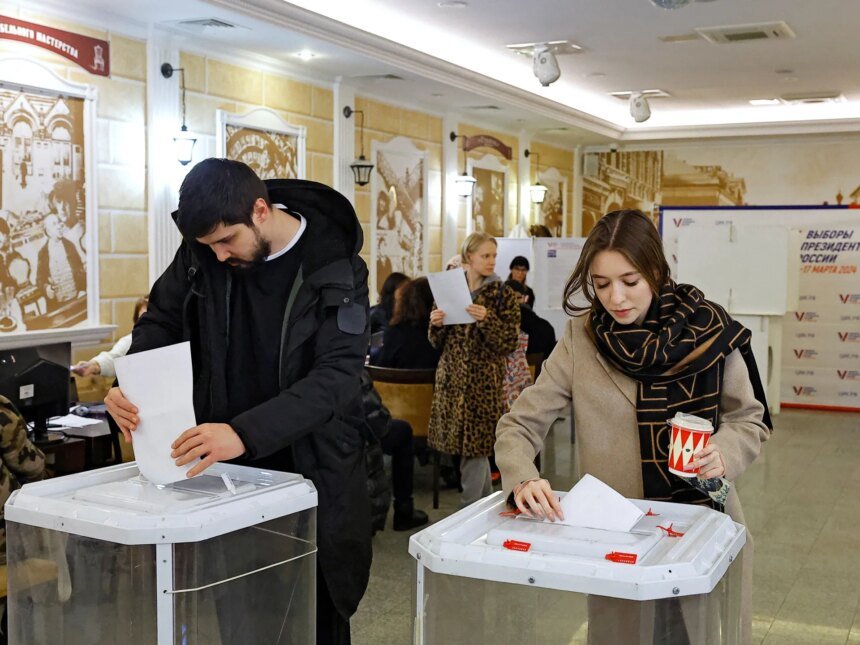
Parliamentary elections are scheduled to be held in Russia on September 20, amid intense competition, in which observers expect the main battle to be between the Communist Party and the ruling United Russia Party.
Writer Sergei Aksyonov considered – in an opinion article on the “Svobodnya Pressa” website – that this will be the first time in Russia’s modern history that the true party balance will be clear to the public.
Read also
list of 2 itemsend of list
The writer pointed out that the media in different regions of the country noticed this in particular, as the Communists imposed, through an intense election campaign, fierce competition on the ruling party.
The writer reported a comment from a specialized channel on the Telegram application, in which she expressed her concern that “this disproportionate electoral effort, coupled with the negativity of the United Russia Party candidates, portends a great danger that the communists will attract a large number of protester votes in the upcoming Duma elections.”
One of these areas is the Sverdlovsk District in the Ural Region, where the writer confirms that there is only the United Russia Party as the “party of power,” while the Communist Party of the Russian Federation represents the “party of protest.”

The writer pointed out that the popularity of the Communist Party is advancing there, which puts pressure on the United Russia Party, which is declining and losing its supporters, a situation that is not limited to the Urals, but also extends to the federal level.
The writer continues, saying that the rest of the parties seem to be focused on maintaining their presence in Parliament and prolonging their political existence only.
The difference between the “red” opposition and the allied parties affiliated with the ruling party – according to the writer – lies in the future vision that they present for the country, as these parties practically lack a comprehensive and unified vision, and their goal seems to be to barter political resources, such as exchanging votes in exchange for trivial services to party officials, as the writer described.
Aksyonov says that what he describes as the “genius of public policy”, the late leader of the Russian Liberal Democratic Party, Vladimir Zhirinovsky, is the one who established this tradition, as he was famous for “wandering in the corridors of the Duma” in pursuit of material gains.
The writer adds that Zhirinovsky is gone, but it seems that his style is still casting a shadow over his allies, as the name of the Liberal Democratic Party first emerged in the 1993 elections, and it did not begin to exploit its political influence until after that, and then the “New People’s” movement initially seemed like a subordinate structure assembled from scratch to revive the “Union of Right-wing Forces.”
As for the “Just Russia” movement, although it is officially a left-wing force that sometimes supports the Communist Party’s pro-people initiatives, it bears the shock of an artificial origin, stemming from the approval and support of the head of state, because its leader is an old acquaintance of President Vladimir Putin. Therefore, the writer wondered, can it be considered a real opposition?

Aksyonov is not surprised that these forces launch strange, and often absurd, initiatives in an attempt to attract attention, such as banning salt and sugar sprinklers in cafes, imposing a standard for shawarma, compulsory insurance for motorcycles, canceling school homework, and so on.
As for the Communist Party, it offers voters – according to the author – a comprehensive vision of the future based on renewed socialism, and most importantly, it does not hesitate to talk about it, unlike other parties that seek only to soften the harsh capitalist reality, mitigate its severity, and remove the threats facing the beneficiaries of the oligarchic system.
Popular program
The socialist vision for the future – according to the author – is presented in the elections in the form of the “Victory Program”, which is promoted by the Communist Party everywhere, and the key word in the program is “justice.”
The writer explains that the program is based on three axes, the first of which, in terms of importance at the present time, is an uncensored Internet, which is a promise that the Russian Communist Party has the right to make without other parties, as the Communists were the ones who drafted the draft law on state guarantees of digital rights for citizens and presented it to the Duma.
The second and most important axis is social security, which requires a radical transformation in the mechanism of work of the health care and education sectors, from merely providing or selling “services” to purposeful human development.
showed A study conducted by the Russian Academy of Sciences showed that 44% of Russians want to live under socialism, while the percentage of those who want to live under capitalism does not exceed 14%.
Building new cities will contribute to creating job opportunities, as well as canceling the pension system reform will ensure dignified old age and help improve the demographic composition.
The third pillar, designed to provide financing for social programs, is the restructuring of the economy according to socialist principles, including nationalizing strategic industries and creating a strong public sector, reforming the tax system while confiscating surpluses from the wealthy, and creating a financial sector based on serving the economy, not serving the bankers.
The Communist Party also emphasizes the peaceful development of the country, and says that a strong army is necessary, and it is enshrined in the “Victory Program” as a basic item, but a public plan must be drawn up to end the war with Ukraine.
Turn left
The writer believes that the communists have the moral right to discuss the Russian military operation in Ukraine, because they have more than 100 dead on the fronts and 150 humanitarian aid convoys to Donbass since 2014, which lends credibility to the party’s words.
The writer stated that German Nazism was defeated under the leadership of the Bolsheviks, and that Lenin turned Ukraine into a “red” zone in just six months, stressing that the mood of the people is not only changing, but has actually transformed, and a turn towards the left has become inevitable.
The writer pointed out that a study conducted by the Russian Academy of Sciences showed that 44% of Russians want to live under socialism, while the percentage of those who want to live under capitalism does not exceed 14%.
Aksyonov warned that the Ministry of Digital Development is planning another “digital chaos” that will negatively affect everyone financially, and the prices of communications services will rise by up to 50%, while the only party that has explicitly declared its opposition to this trend is the Communist Party, out of the five parties listed on the ballot paper, so it will inevitably win a majority of the votes, but the only thing that can prevent such an outcome is manipulation.

According to the author, the tactics used by officials between elections, such as media defamation, and during the election campaign, such as unequal financing, restricting media access to voters, skeptical parties, and during the voting and vote-counting process, are a cunning plan that was invented during the pandemic and has become a tradition.
The writer continues, saying, “We are citizens. No matter how clever the manipulations are, they are unlikely to shake the fundamental basis, which is the true feelings of the people. When people feel the deterioration of their living conditions, see clear signs of an economic crisis, and suffer from an Internet outage, at the instigation of senior officials of the United Russia party, they will vote accordingly. The ruling party and its entourage, who have failed to clarify their alleged opposition course, will be harmed.”
Most likely, all of these parties, along with United Russia, will scatter the votes of undecided voters, while active citizens, who objectively criticize the government, will prefer to support the “party of protest”: the Communist Party.
Indeed, as the author says, signs of a shift in the balance of power have begun to appear, according to independent data, as the percentage of support for the United Russia Party among decided voters decreased by 6 percentage points, and support for the Communist Party increased by an increase of 3.3 percentage points.
With three months remaining until the elections, the writer believes that the features of the party formation in the Duma are beginning to become increasingly clear, indicating that the division between the right and the left will continue in the coming years, represented by the United Russia Party and its affiliated parties on the one hand, and the Communist Party on the other hand.