Under the slogan of pursuing Al-Shabaab and ISIS in Somalia, the United States of America intensified its air campaign to levels unprecedented in years.
But as the pace of bombing accelerates, questions are also increasing about who is actually being killed under these missiles, after civilians, including children, have become among the victims of the hidden war that Washington is waging in the Horn of Africa.
Read also
list of 2 itemsend of list
Civilian casualties
According to the British newspaper The Guardian, the United States carried out 64 raids during the current year alone, at a rate of one every two or three days, exceeding the total strikes carried out throughout the era of former President Joe Biden, which reached 51 raids.
The number of US strikes since President Donald Trump’s return to the White House has reached 190, compared to 219 raids during his entire first term, according to the newspaper.

Despite this escalation, Al-Shabaab still controls large areas of the country, and last year its fighters reached a distance of only 40 kilometers from the capital, Mogadishu, which prompted some analysts to describe the situation as a “strategic stalemate” that air strikes did not succeed in breaking.
While the US military command in Africa (AFRICOM) confirms that only 6 Somali civilians were killed during the years of operations, Air Wars estimates that 103 suspected incidents occurred that resulted in the deaths of up to 170 civilians, according to the Guardian.
What happened in Jamami?
In a separate investigation, the Guardian reveals that 12 civilians, including 8 children, were killed in a raid targeting the town of Jamami in southern Somalia in late 2025.
To reveal the “massacre,” as it described it, the newspaper used photos, recorded clips, and X-rays of the children’s shrapnel injuries, in addition to witness statements.

According to the report, the morning of November 15 that year was no different from others, as children woke up to the usual sounds of daily life, families sat down to eat breakfast, while farmers headed to their fields.
But within a few hours, the quiet town turned into an arena of destruction, when American marches rained down missiles on it, leaving behind dozens of victims, including children, some of whom were no more than 4 years old.
They were killed next to their mother
Muhammad, a grandfather of 4 children who were killed in the bombing, narrates to the Guardian newspaper the first moments after the explosions, and says that he rushed towards the house of his son Abdullah Muhammad Abu Al-Sheikh Ali, who was working in the field at the time, after he heard the sound of the missiles.
The grandfather found traces of destruction and “clothes and books scattered on the ground,” but he could not focus on anything, as he put it, as he was standing in front of the “torn” bodies of his grandchildren.
The targeted house contained his daughter-in-law, Safia Hassan Abu Bakr, who was pregnant, and her four children. Muhammad found her body among the rubble, then began searching for his grandchildren.
Muhammad first found Abdel Fattah, 10 years old, close to his mother. The grandfather says that the child never left her side, and he helped her with household chores until she became completely dependent on him.
“He would always ask me to pray for him so that he could memorize the Qur’an, and I would sometimes call him asking for prayers and he would smile.”
Muhammad’s grandfather
Near him, he found the body of his 7-year-old brother, Abdel Nasser, who dreamed of memorizing the Holy Qur’an. His grandfather remembers his last words, saying: “He always asked me to pray for him so that he could memorize the Qur’an, and I would sometimes call him asking for prayers and he would smile.”
As for the two brothers, Hussein, 6 years old, and Abdul Rahman, 4 years old, their remains were recovered from the rubble.
Muhammad says that Abdullah has not yet understood what happened to his family, and “since that day he has never been the same person.”

There is no escape
These children were not the only victims. Eyewitnesses confirmed to the Guardian that there were 15 explosions in Jamami, which resulted in the destruction of many homes and the school.
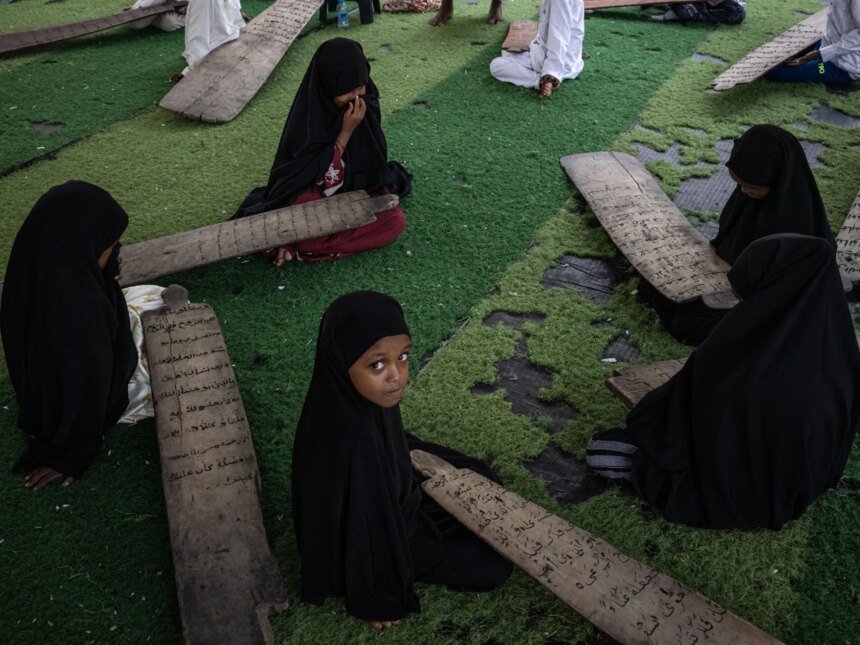
The newspaper highlighted the story of Marian Haji Abdi Guled, who had received her three children returning from the Qur’an school just minutes before the attack began.
She told the Guardian that the sound of the drones was unusually loud and frightening, and then the ground began to shake under their feet.
She recounted what happened next, saying: “My children went outside to see what was going on, and suddenly another missile fell, and when I ran to them, I found them all lying on the ground, covered in blood.”
She adds that the bombing continued even while she was trying to rescue them, and says: “Whenever I tried to reach them, the missiles were falling in every direction.”
According to the newspaper, her children survived death, but were injured by serious shrapnel, and one of her children may lose his ability to walk unless the shrapnel is extracted from his body.

Guled stressed to the newspaper that the town did not include Al-Shabaab fighters. “There were only women, children and the elderly here, and life before the raids was calm and normal,” she says.
As for Marianne Nour Borouji, she spoke to the newspaper about her pregnant daughter-in-law who ran to the Qur’anic school in search of shelter from the bombing, while she was carrying her young child on her back, and a short time later missiles hit the school itself.
Boroji told the Guardian that her stepdaughter was killed on the spot, while the little boy survived in a way she described as a miracle. She added: “She did not die because of a clash or battle, but because of a missile fragment that hit her chest and neck and killed her.”
Search for justice
Although months have passed since the attack, the people say that they have not received any contact from the American authorities or the Somali government, and they have not received any explanations, no announced investigations have been opened, and they have not received compensation.
Buruji demands recognition of their suffering before anything else. “I demand compensation for the crime that befell our family,” she says. “I can’t even provide food today.”

The effects of the attack are still present in the lives of Jamami residents. Even after the bombing ended, drones continued to fly over the town for many months, spreading fear among the residents.
Muhammad, who lost four of his grandchildren, says: “We cannot sleep because of the sound of the planes. They fly over us every night, and even when we try to sleep we fear that we will be killed.”
But what hurts him most – according to what was reported by the Guardian – is not fear of the future, but rather the memory of that morning, and he told the newspaper in a voice mixed with sadness and anger: “I could not even hold their bodies, they were completely torn apart.”
He continues, “They just loved learning the Qur’an, and on their last day, they were deprived of even eating breakfast.”