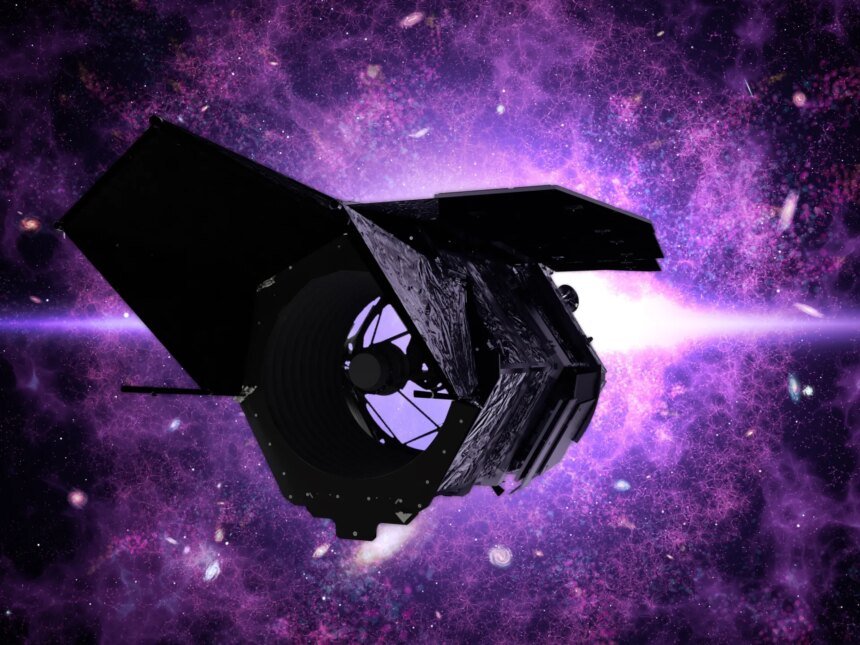
The Nancy Grace Roman Space Telescope represents one of the most important space projects that NASA is preparing to launch on August 30, 2026, in a mission that is expected to open a new chapter in exploring the universe after the successes achieved by the Hubble and James Webb telescopes.
The telescope bears the name of NASA’s chief astronomer, Nancy Grace Roman, nicknamed the “Mother of the Hubble Telescope,” and will feature a field of view more than 100 times greater than Hubble’s, a 300-megapixel infrared camera, in addition to an advanced device to block starlight and observe exoplanets directly.

The telescope will also be used to study dark matter, dark energy, and the evolution of galaxies throughout cosmic history, while one of its most unique features is that its main mirror came from a previous American reconnaissance program before NASA repurposed it to become a tool for drawing the largest maps of the universe and searching for worlds that may be habitable.
Read also
list of 2 itemsend of list
Nancy Grace Roman…the woman who paved the way for Hubble
The telescope bears the name of the American scientist Nancy Grace Roman (1925-2018), who devoted a large part of her life to defending the idea of building space observatories that orbit above the Earth’s atmosphere, allowing the universe to be observed with clarity that is not possible from the surface of the Earth.

Despite the challenges she faced as a woman working in a scientific field that was dominated by men at the time, she continued her efforts to convince decision-makers of the importance of space telescopes.
Her vision and determination helped pave the way for the launch of the Hubble Telescope, and then for all the space observatories that followed, including James Webb and Roman himself, which today continue the scientific legacy that she began building decades earlier.
A spy mirror that turns into a tool for exploring the universe
One of the most interesting stories lies at the heart of the telescope itself. Its main mirror was not made primarily for space research, but rather came as a gift from the US National Reconnaissance Office, an agency responsible for developing reconnaissance and surveillance technologies for US intelligence institutions. When the agency no longer needed this mirror, NASA redesigned it and incorporated it into Project Roman.

The diameter of the mirror is about 2.4 metres, which is close to the size of the Hubble mirror, but it is much lighter in weight, as it does not exceed approximately a quarter of the weight of the Hubble mirror. This allows the telescope to move with greater precision and capture images more efficiently. Its surface is also coated with a layer of silver no more than 400 nanometers thick, making it ideal for observing near-infrared rays that help scientists study distant galaxies and exoplanets.
A giant camera to draw the largest map of the sky
Roman includes a scientific instrument that is considered one of the most advanced cameras in the history of astronomy, which is the wide-field instrument. This system contains a 300-megapixel infrared camera, equipped with 18 advanced sensors, each with a resolution of 16 million pixels.
This technology gives the telescope a field of view more than 100 times greater than that of Hubble, allowing it to scan huge areas of the sky at an unprecedented speed.
NASA estimates indicate that in just 5 years, Roman will be able to cover an area of the sky more than 50 times greater than what Hubble was able to survey during its 3 decades of work. It will also be able to photograph some areas at a speed up to a thousand times faster than Hubble, which may allow monitoring light coming from about a billion galaxies during the life of the mission.
A tool that may bring us closer to discovering life outside Earth
Along with the giant camera, Roman carries an advanced technology known as a star coronagraph, an system designed to block out bright starlight in order to directly see the planets surrounding it.
This technology is characterized by being “active,” meaning that it constantly measures incoming light and automatically adjusts its optical elements to reduce the glare of the star and improve the visibility of objects close to it. Scientists confirm that the performance of this system may be about a thousand times better than similar systems currently used.

If the technology succeeds as planned, it may in the future allow studying the atmospheres of exoplanets, and searching for vital indicators such as oxygen, ozone, water, carbon dioxide, and methane, which are elements that may indicate the presence of environments suitable for life.
Send your name into space with the Roman Telescope
NASA has provided the public with a symbolic opportunity to participate in the Nancy Grace Roman Telescope mission through the “Send Your Name with Roman” initiative (those wishing can register their names to be saved on a small digital memory card installed on board the telescope before its launch).

When the observatory launches to its operational location about 1.6 million kilometers from Earth (the second Lagrange point), millions of names will have traveled with it on its journey to explore the universe.
The initiative aims to enhance the public’s connection with space science and involve people in one of the most important upcoming astronomical missions, similar to the initiatives that accompanied a number of previous NASA missions to Mars and deep space. The window for submitting names closes on July 12, 2026.
Big cosmic questions
Roman will not only study exoplanets, but will try to answer some of the biggest mysteries of modern astrophysics, such as the nature of dark matter and dark energy, and how galaxies and cosmic structures have evolved over billions of years.
Thanks to its ability to scan large areas of the sky with high accuracy, scientists expect that it will provide unprecedented data that will help build the most detailed cosmic maps in history, which may give researchers a deeper understanding of the structure and history of the universe.

In the end, the importance of the Roman telescope does not lie only in its size or technology, but in the idea that it embodies: that human knowledge advances when tools become bridges to the unknown.
From a mirror that was once designed for observational purposes, a project may be born that helps humans understand their place in the universe, and perhaps one day lead them to discover other worlds similar to Earth. Thus science continues its ancient journey; The journey of searching for answers to questions that is still too large for one world or one generation to encompass.