Published on 6/15/2026
|
Last update: 11:13 (Mecca time)
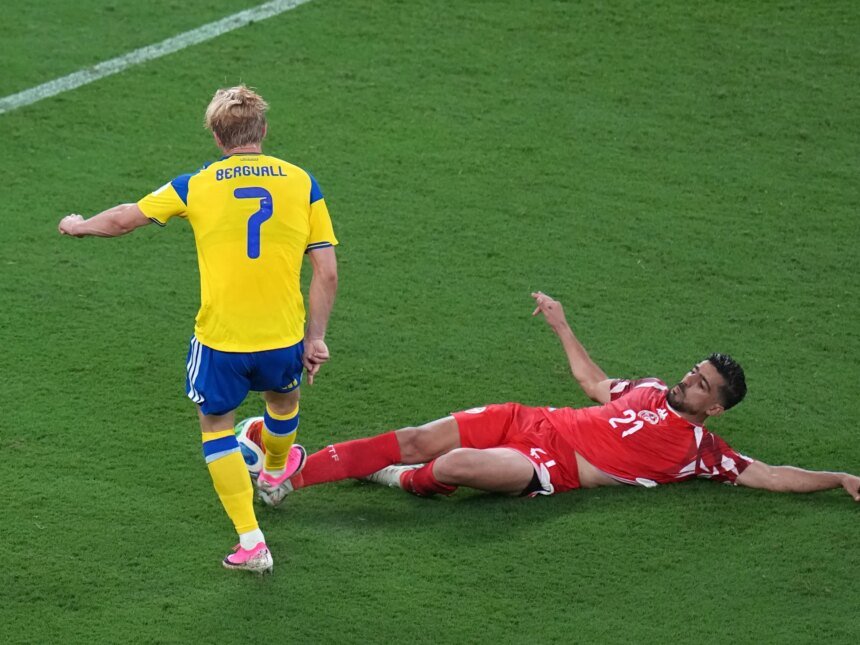
The confrontation between Tunisia and Sweden ended in great disappointment for the Tunisian fans, after the “Eagles of Carthage” suffered a severe defeat, 5-1, against the Swedish team, led by Victor Geukeris.
There were many reasons for this heavy defeat for coach Sabri Lamouchi’s battalion, and the most prominent of them can be summarized in the following points:
Read also
list of 2 itemsend of list
Unsuccessful tactical reading by Lamouchi
Coach Sabri Lamouchi surprised the Tunisian fans by adopting a 5-3-2 plan from the beginning, based on the defense trio of Montaser Talbi, Ali Raqiq and Wissam Ben Hamida, with Yann Valéry on the right side and Ali Abdi on the left side.
In the middle of the field, he relied on Elias Al-Sakhiri, Khedira, and Hannibal Al-Mujabri, while the front line included Elias Saad and Muhammad Ali bin Sulaiman.
Lamouchi’s choices did not appear to be successful, whether from a tactical or technical standpoint.
The national team played most of its previous friendly matches with a four-line defense, before suddenly switching to a three-man defense in an official and detailed match, which the players did not seem to adapt to in the desired manner, especially since it required more time of work and experimentation.
Also, the 5-3-2 system usually requires the presence of strikers with different characteristics; One is quick to exploit space, and the other is capable of playing the role of an attacking station.
However, Lamouchi relied on Ben Slimane, who is mainly considered an attacking midfielder, and Elias Saad, who prefers to play as a winger, which means the absence of the outright striker from the starting lineup, even though Firas Shawat presented positive indicators in this position during friendly matches.
What reinforces this proposition is that the Swedish national team, in turn, played with a 3-5-2 plan, but relied on an integrated attacking duo represented by Victor Geukeris and Alexander Isak, who contributed directly to four full goals.
This system also depends to a large extent on the effectiveness of Al-Rawaq players in providing an offensive addition, especially in quick transitions and counterattacks, which requires players who possess speed and high physical readiness, characteristics that were not sufficiently demonstrated by Valery and Al-Abdi during the match.
Absence of realism
Usually, coaches resort to a plan that includes five defenders and three midfielders with the aim of tightening defensive control and closing spaces in front of the opponent, while relying on rebounds and exploiting the spaces behind the opponent’s defense.
If we assume that Lamouchi wanted to give Sweden possession and lure them forward to exploit the spaces behind their lines, then what happened on the field was completely different.
The Tunisian team tried to keep the ball without having a clear offensive station or quick elements capable of exploiting spaces in the final third.
The primary goal of defensive numbers is to reduce the threat of the opponent and reduce the number of opportunities available to him. However, the Tunisian team, despite playing with five defenders, conceded five goals in total, which reflects the incompatibility of the adopted method with the goals desired from it.
Individual errors
The Tunisian team paid the price for a number of influential individual mistakes, starting with goalkeeper Mohib Chamekh, who did not appear at his best, especially in the first and second goals, to the inability of the back line to limit the danger of Gjokeres, Isak, and Yassine Ayari.
The mistake committed by Elias Al-Sakhiri also contributed to increasing the team’s troubles and gave the Swedes the opportunity to expand the gap, at a time when the team needed to regain its balance.
Lack of pressure on the ball carrier
One of the most prominent factors that facilitated the Swedish national team’s mission was the large spaces that its players had throughout the match.
The Tunisian team lacked effective pressure on the ball carrier, which gave the Swedes enough time to shoot, build attacks, and execute quick double passes (take and give) with great comfort.
There was also no reverse pressure immediately after losing the ball, which opened the way for Swedish counterattacks that were characterized by speed and effectiveness, and made Al Shamekh’s goal vulnerable to danger on more than one occasion throughout the match.
In conclusion, the heavy defeat against Sweden was not the result of one factor as much as it was the result of a group of unsuccessful tactical choices and repeated individual errors, in addition to the inability to keep up with the physical and technical style of the opponent.
Sabri Lamouchi will be required to review his accounts quickly before the upcoming confrontations, because repeating such mistakes may put the Tunisian team out of the competition early and make it difficult to regain confidence among players and fans alike.