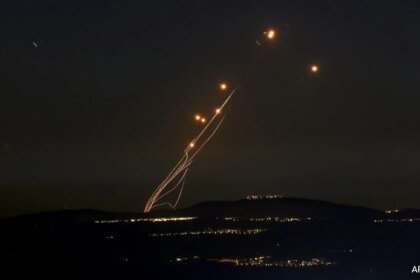
Beit Yahoun is not just a southern village in the Bint Jbeil district, just as Beaufort Castle is not just an archaeological site above Wadi Saluki. In the modern Israeli reading, the two names together go back to a deeper map, which is the map of the security belt, with its memory, ambushes, and withdrawal, and its military temptations that do not stop pursuing the decision-maker in Tel Aviv.
Since the expansion of the confrontation with Hezbollah after October 7, Israel has returned to vocabulary that seemed to have been folded since the May 2000 withdrawal, namely “operational control,” “security field,” “clearing villages,” “supervised areas,” and “removing Hezbollah from the northern settlements.”
Read also
list of 2 itemsend of list
While Beaufort Castle topped the Hebrew headlines as a military and psychological symbol, Beit Yahoun remained less noisy and more indicative at the field level, that is, a road village, the memory of an ambush, and a point in the network of villages that Israel fears will once again turn into a front edge for Hezbollah.
Old memory
The presence of Beit Yahoun in Israeli military memory begins with the ambush of February 17, 1986. In the Israeli army archives, specifically in the “Eitan Branch” material published in 2022, the village is mentioned as being close to the “Beit Yahoun crossing” on the border of the security belt, and there two Hezbollah cells ambushed a camouflaged convoy that included soldiers from the Israeli army and the South Lebanon Army, while the cars were heading on a Lebanese road towards Tibnin.

The most important detail in the Israeli story remains that Hezbollah members “hid in two houses that control the road at the entrances to the town.” With this phrase, Beit Yahoun goes beyond being a geographical name, and turns into an early example of what will occupy the Israeli army for years. The high-rise house, the narrow road, the loss of communication between vehicles, and then a short ambush leaves a long mark on the military consciousness.
That ambush ended with the capture of the two soldiers, Rahamim al-Sheikh and Yosef Fink, before it became clear later that they were killed. But the far-reaching effect of the event was to cement the image of Beit Yahon in Israeli memory as part of the geography of the Belt, a place whose danger lies in its ability to connect the village to the road, the road to the ambush, and the ambush to a broader equation of attrition.
village road
Beit Yahoun does not have the symbolism of Beaufort, nor the presence of Bint Jbeil, but it is located within a sensitive field network between Bint Jbeil, Tibnine, Shaqra, and Majdal Salam. Therefore, its Israeli importance appears from its function, not from its name. It is not a ruling citadel on top of a rock, but rather a village node within an area that allows movement, disappearance, and proximity to the lines of contact.
This explains its return to the Israeli target bank after October 7. In March 2024, the Israeli army announced the bombing of a “Hezbollah terrorist structure in the Beit Yahoun area,” and in June of the same year it announced the bombing of Hezbollah military “buildings” in Beit Yahoun and two friends. These data do not reveal the nature of the targets in detail, but they do reveal that the village is present on the army’s maps as part of Hezbollah’s southern structure.

In May 2026, Or Heller’s report on Israeli Channel 13 gave a new meaning to this importance, as he reported that two Hezbollah members left Beit Yahoun and advanced to about 300 meters from the border, before being targeted inside the Dakhla headquarters.
Here, Beit Yahoun appears in its most clear form. It is not a media symbol, but rather a village that is read by Israelis as a space of transition from Hezbollah’s rural depth to the edge of the border. This is the essence of the Israeli fear after October 7, that is, that Hezbollah will not return to the villages near the border as an environment for preparation, monitoring, and launching.
The symbolic Beaufort
Unlike Beit Yahoun, Beaufort/Beaufort Castle carries a heavy symbolic charge in Israeli memory, as the castle was associated with the First Lebanon War and the Golani Battle in 1982, then it turned into one of the symbols of the Israeli presence in the security belt until the withdrawal in 2000.
Therefore, the Israeli army’s announcement on May 31, 2026 of a large operation in “Ras Beaufort (Beaufort Castle) and Wadi Saluki” was not just field news.

The army statement spoke of an operation aimed at controlling the area and destroying Hezbollah’s structures that were established under Iranian guidance, from which, according to the statement, the party managed the fighting and implemented many plans. It also referred to platforms from which hundreds of rockets were launched towards Israel and the army forces in southern Lebanon. In this sense, Shaqif became a media front for Israel’s return to the positions from which it left 26 years ago.
The “Kan 11” report added a clearer political dimension, when it quoted Defense Minister Yisrael Katz as saying that the soldiers would remain there “as part of the security zone in Lebanon,” which means that controlling Beaufort is no longer just a field maneuver, but rather a declared return to the “security zone” dictionary, albeit in a new form.
New belt
In a paper issued by the Israeli Institute for National Security Studies issued in September 2024, the dilemma of the ground incursion into the north is presented in a precise form. What is required, according to the paper, is to clear the areas overlooking the border line to prevent direct fire and anti-tank weapons and to thwart the possibility of raids by the Radwan Force, but without establishing a permanent security belt.

The paper says that the minimum required militarily is to control a line that has direct visual contact with the northern settlements, or to allow direct fire towards them, and to clear them of Hezbollah’s structures. This idea explains why villages like Beit Yahoun become important, and why heights like Shaqif become a central target. The matter is not just about a village or a castle, but about redrawing a safety line between Hezbollah and the northern Israeli settlements.
However, the paper itself warns against mixing a limited operation with a long-term security zone, as it believes that a long stay inside Lebanon will harm the army and international and internal legitimacy, and that the experience of the old security belt cannot be easily replicated, especially in light of the absence of the South Lebanese Army, and the need for the Israeli Army alone to bear the burden of control.
Attrition trap
The Israeli Army’s history department’s study of “the battle in the security belt” reveals the basic paradox facing Israel today. Israel wanted its presence inside Lebanon to prevent infiltration into its territory, but this presence made it easier for Hezbollah to strike its forces and the South Lebanese Army inside the belt. By the beginning of the 1990s, Hezbollah had become the most prominent military force in Lebanon, benefiting from the support of Iran and Syria, a local incubator in the south, and increasing experience in explosive devices, anti-tank weapons, and guerrilla warfare.
In this sense, Beit Yahoun and Shaqif can be read as a new test of an old lesson, which is that controlling the land may give Israel a temporary tactical advantage, but it may turn the forces there into fixed targets, and the longer the stay, the more the old question of the belt returns: Will the security zone protect the Galilee, or move the arena of attrition into Lebanon?
This warning is repeated in the writings of Eran Ortal, the former leader of the Dadu Center for Military Thinking. In the Israel Hayom newspaper, he wrote in March 2026 that establishing a security belt without a military decision would be a return to a previous mistake, and that “permanent barrier areas inside enemy territory open the door to unwanted wars of attrition.”
In an article in the Yedioth Ahronoth newspaper, Ortal pointed out that long-range missiles, drones, and anti-armor weapons went beyond the logic of the old security belt, and turned Israeli sites inside Lebanon into potential targets.

Geography of memory
Thus, Beit Yahoun and Beaufort meet in one meaning despite their different symbolic size. Beaufort is the high memory, i.e. a castle, a flag, the Golani, a withdrawal and a return in front of the cameras, while Beit Yahoun is the low memory, i.e. a road, two honorable houses, an ambush, a village, and approaching the border.
The irony is that Israel, while trying to distance Hezbollah from the Galilee, is approaching the geography that created its military and political rise in the 1990s, as the old security belt was not only a buffer space; Rather, it was a war school for Hezbollah, and a theater for rebuilding its image as a resistance force that forced the Israeli army to withdraw.
Therefore, returning to Beit Yahoun and Shaqif is not just a return to the ground, but rather a return to a question that has not been resolved since the year 2000, which is: Can Israel control southern Lebanon without giving Hezbollah the theater of attrition it is so good at?
Modern Israeli sources conclude that Tel Aviv wants to prevent Hezbollah from returning to a line of contact that allows monitoring, shooting, and storming, but they also say, in studies by the army, the Institute for National Security Studies, the Dadu Center, and Ortal’s writings, that the security belt may turn from a tool of protection into a trap of attrition, and between Beit Yahoun and Shaqif, Israel is returning to a geography it knows well, but has not yet proven that it has learned how to get out of it.