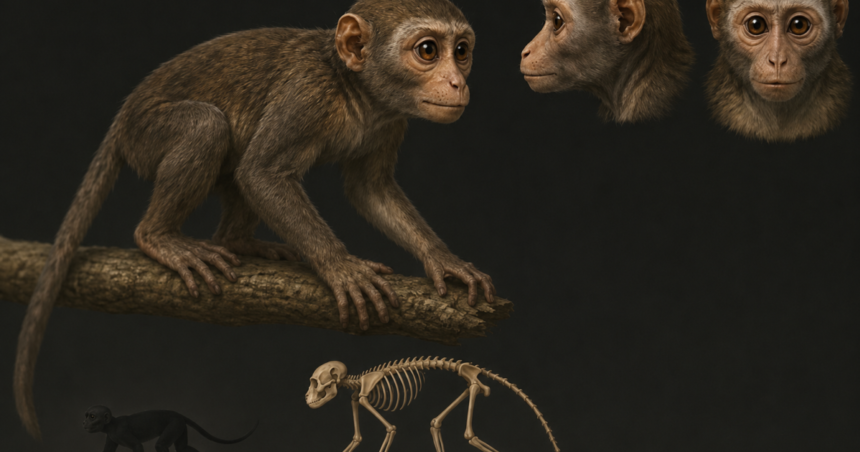
International research teams previously unearthed three ape fossils from the “Dur al-Talh” area, a fossil area located in the Sirte Basin in central Libya.
But the fourth fossil discovered by a French research team in cooperation with Dr. Awad Bilal from the Department of Earth Sciences at the Faculty of Science, University of Benghazi, and Dr. Osama Hilal from the Department of Geology at the Faculty of Science, University of Tripoli, from the same region, and recently announced in the Journal of Human Evolution, was very distinctive, to the point that it can be described as “the strangest ape in the fossil record known to scientists.”
Usually, when research teams discover an ape fossil, they can determine whether it has primitive or modern features. This is what happened with the three fossil teeth previously discovered in “Dur al-Talh,” which belonged to organisms that the researchers called “Byritia bifitoi,” “Talahpithecus parvus,” and “Afrotarsius libiacus.” However, the fourth fossil, which was named “Sahrapithecus salmi,” showed a “mosaic” pattern of characteristics, and the scientists agreed with it. We are unable to determine its historical classification until now.
Yawalak Chaymani from the Laboratory of Paleobiology, Evolution, Ancient Ecosystems and Paleoprimatology, at the National Center for Scientific Research at the University of Poitiers in France, and the lead researcher of the study, told Al Jazeera Net: “Sahrapithecus salmi, which dates back to about 39-38 million years ago, possesses a unique combination of primitive and newer dental features, which have not been observed before in any of the higher primates of the Eocene era, as its upper molars combine cusps. Round, well-developed conical ridges, a complete inner ridge that extends on the inner side of the tooth, specialized cusps that serve as additional crests on the back tooth, and a small crest called the “pre-crest,” which is a line or “small ridge” that connects the parts of the tooth and helps direct the chewing movement.
He explains, “This unusual combination of features distinguishes Sahrapithecus salmi from all known African and Asian higher primates from the Eocene and Oligocene periods. Most importantly, its teeth resemble those of many different higher primate groups without being clearly classified within any of them, which indicates that this ape represents a previously unknown branch of early higher primates.”
This unique fossil was discovered during a work mission in the “Dur al-Talh” area, which began by collecting sediment samples from the fossil-bearing layer, which were then washed and sieved. After that, the remaining dry remains were carefully examined under a microscope.
“Among thousands of small fossil fragments, we recovered a few primate teeth, including a distinctive tooth that was later identified as a new species of higher primate called Sahrapithecus salmi,” says Yawalak Chimani.

The only evidence available
Teeth are among the most useful fossils in studying the history of mammals, as they preserve a tremendous amount of anatomical detail and are more likely to survive fossilization than fragile skeletal bones.
“The arrangement of ridges, crests, belts, and wear patterns can reveal historical relationships, nutritional adaptations, and even aspects of behavior,” he says. “In early primates, where complete skeletons are extremely rare, teeth often constitute the only evidence available to reconstruct lineages and trace them historically across continents. Many branches of higher primates have been identified primarily through dental evidence.”
The importance of the recent discovery, led by the teeth of Sahrapithecus salmi, lies not only in its strangeness, but because it reinforces the hypothesis that Africa was settled by several different lineages of higher primates coming from Asia.

Instead of a common scenario that about 45 to 41 million years ago, only one species of primitive ape arrived from Asia to Africa, and after arriving in Africa, it gradually began to branch out, and from it all subsequent African groups of great apes arose.
He says: “In the Dur al-Talh region, we have now found evidence of at least four groups of higher primates that lived together about 38-39 million years ago, including Perytia bifitoi, Talahpithecus parvus, Afrotarsius libiacus, and the recently discovered Sahrapithecus salmi.”
Older than Fayoum, Egypt
“Dur al-Talh” is currently considered the oldest known site in Africa and the Arabian Peninsula that preserves a diverse community of higher primates, and the site dates back to approximately 39-38 million years, a crucial period that followed the introduction of the first human primates into Africa.
“The site has revealed an impressive collection of small-sized primates, representing several distinct lineages, and provides a rare glimpse into a primitive human primate community before the more famous Egyptian Fayoum primates appeared,” says Yawalak Chimani. “As a result, the site provides an excellent opportunity to understand the early stages of human primate diversification in Africa.”
The Libyan desert has not revealed all its secrets
Despite the importance of what has been discovered so far from the site, Yawalak Chimani stresses that he has not revealed all its secrets. He says: “With each new excavation season, we have succeeded in increasing the known diversity of the site, and it is certain that there are additional species that have not yet been discovered.”
He adds, “North Africa contains huge deposits from the Eocene era that have received little fossil exploration compared to Europe, Asia, and North America. Future discoveries in Libya and neighboring regions may reveal entirely new groups of higher primates, and help answer some of the most important outstanding questions about the origin of higher primates.”