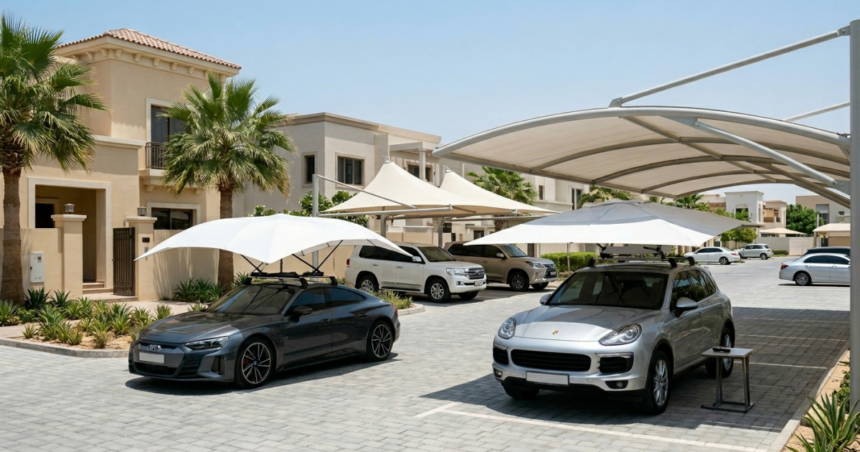
With the onset of summer and record high temperatures in the Arab Gulf countries, open-air parking is no longer just a source of inconvenience, but has turned into a real challenge that threatens the safety of vehicles and the comfort of their drivers.
In this context, innovative solutions have emerged that redefine the concept of vehicle protection, most notably the smart automatic awnings that operate by remote control, which are at the top of the conversation on social media sites and arouse widespread interest as an advanced technical solution to confront the scorching rays of the sun.
Here we review in detail the advantages of this new technology, starting from its working mechanism and advanced materials, to its great benefits, while highlighting its special suitability for the harsh weather conditions in the Gulf region.
The car is a mobile oven
Car experts warn that the temperature inside a car can reach more than 40 degrees Celsius when it is only 20 degrees outside. As for summer days when the temperature exceeds 30 degrees, the inside of the car may reach more than 60 degrees, even if it is parked in the shade or the windows are left slightly open.
This extreme altitude not only threatens the safety of passengers, but also exposes electronic devices (such as phones and portable chargers) to the risk of exploding and igniting, spoils medicines and food, and may cause aerosol cans to explode.

Increasing demand in the Arab Gulf countries
The countries of the Arabian Gulf are witnessing an increasing demand for owning smart car sunshades. In light of the sharp rise in temperatures and frequent exposure to the scorching sun and dust storms, these technical solutions have transformed from being merely a complementary option to an urgent and indispensable necessity for protecting vehicles.
These smart awnings are widely installed in front of villas, homes, and rest houses, as well as in commercial parking lots, to improve customer experience. The designs vary to include pyramidal, arched, sail-shaped, and even suspended shapes without columns, to suit modern architectural tastes.
Types of awnings: from simple to smart
Car sunshades vary to meet different needs, and can be mainly classified into three types:
- Fixed awningsThese are permanent structures installed in parking lots, which are spread in homes, villas, and commercial complexes. They are made of various materials, such as fabric stretched over an iron frame, polycarbonate panels, or sandwich panels (insulated sheet).
- Manual swing umbrellasIt replaced the traditional awnings with light and loose fabric, and now works with a hand-assisted pulling and folding system.
- Electric automatic awnings: It represents the pinnacle of technological development, and is characterized by remote control, ease of use, and smart security systems.
How does an automatic umbrella work?
Smart automatic awnings are advanced shading systems designed specifically for cars, radically different from fixed or manual awnings. Its engineering depends on the following elements:
- Electric motor: It relies on a motor (tubular type) responsible for the opening and closing movement.
- Control means: They are usually operated via a remote control, and in some advanced models they can be linked to smartphone applications or smart home systems.
- Mechanism of action: With the push of a button, the umbrella begins to gradually expand from its folded position to cover the entire car within a few seconds (ranging between 8 and 10 seconds), and when finished, it folds just as easily to return to its compact size.

Structural and technical advantages
Smart automatic awnings outperform their conventional counterparts in several key aspects:
- Significant reduction in temperature: The basic and most important function. Thanks to heat-reflecting fabrics and insulating structures, these umbrellas make a tangible difference.
Data from one specialized company indicate that having a car umbrella can reduce the car’s interior temperature by between 15 and 20 degrees Celsius, while some newer models claim a reduction of up to 30 degrees Celsius.
This significant reduction protects the cabin from damage and reduces reliance on the air conditioning when operating the vehicle. - Comprehensive protection from weather elements: Protection is not limited to the sun only, but also extends to rain, dust, and dust, which is extremely important in the Gulf region, which witnesses dust storms. It also protects the car’s exterior paint from damage and fading caused by UV rays.
- Easy to install and carry (for mobile awnings): One of the most prominent features of portable automatic awnings is their light weight and small size when folded.
It can be easily placed in the trunk of the car, and is easy to install, as it only requires a few minutes to be installed on the roof of the car via a simple tensioning system.
- Built-in smart security systems: To protect the canopy itself from damage, many models are equipped with advanced sensor systems, such as:
- Wind sensors: It automatically closes the umbrella when it senses strong winds that may lead to damage to its structure or its overturn.
- Rain sensors: The umbrella closes automatically when it rains.
- Obstacle sensors: The umbrella automatically stops moving if it encounters any obstacle while opening or closing, protecting the car and the umbrella.
- Sun sensors: In some advanced home systems, the awning opens automatically when the sun’s rays become intense.
Materials of the future: durability and thermal insulation
The efficiency of an umbrella depends largely on the quality of its materials. Modern models use a mixture of advanced materials:
- Rust-resistant structures: The load-bearing structures are made of aluminum or galvanized iron to resist rust and corrosion, ensuring a long service life of up to 25 years in some designs.
- Insulating and UV-resistant fabrics: Cloth is the first line of defense. High-performance fabrics such as PVC, polyester, and 210D Oxford are used. It is characterized by its ability to block up to 99% of harmful ultraviolet rays. Some of them are coated with a reflective layer of silver to enhance the efficiency of heat insulation.
- Fiberglass tips: Some awnings use fiberglass tips to provide rigidity with light weight.
As heat waves intensify and awareness of the importance of protecting vehicles increases, smart automatic awnings are proving to be not just a luxury, but a smart investment to protect an important asset. By significantly reducing temperatures, providing comprehensive protection from weather factors, and ease of use provided by remote control technologies, these umbrellas offer a complete solution for car drivers in the Gulf countries.
While social media sites discuss the latest videos of these innovations, the most important question remains: Will modern technology replace the constant search for a shaded parking lot?