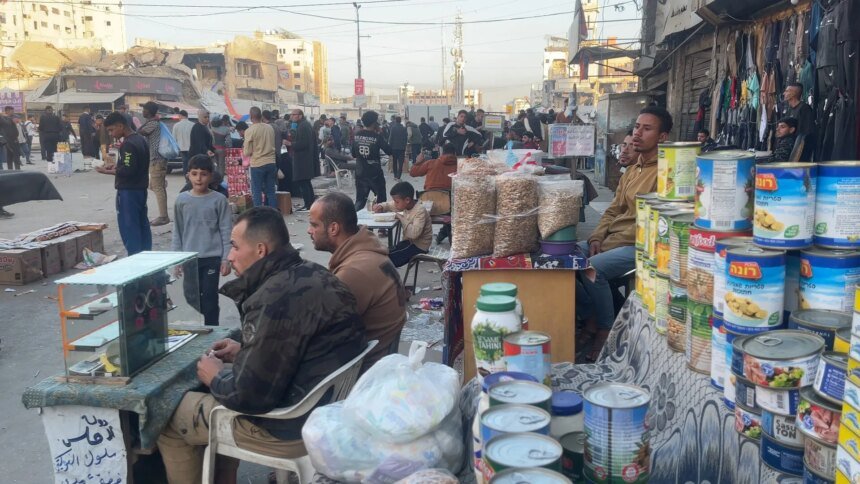
Gaza- In this report, Al Jazeera Net monitors the conditions of a number of businessmen and commercial stakeholders whose situation has been turned upside down and they are barely making ends meet.
In the afflicted Gaza Strip, International Labor Day falls on May 1 this year, burdened by the smell of gunpowder and rubble dust, without celebrations or union activities, or the smells of factories or the noise of workshops.
Labor Day is not measured by the number of working hours, but rather by the size of the void that the war left in the hands of manufacturers, and by the heartbreak that resides in the hearts of men who were transformed from pillars of society into displaced persons searching for a living between the cracks of the impossible.

Owner of restaurants in its ruins
Akila restaurants were not just places serving popular food in Gaza, but rather they were landmarks of the city’s identity and the taste of its beautiful days. Today, Youssef Akila stands in front of the ruins of his “kingdom” that was leveled by planes, recalling the queues of customers and the noise of workers who were divided between martyr and displaced person.
Akila owned a chain of restaurants extending from the north to the south of the Gaza Strip, but due to the war, he lost many of the pillars of that kingdom and its workers.
Youssef says in a tone full of nostalgia and brokenness: “Work now is not the same as before. We have lost everything. The restaurants that were bustling with life have become rubble, and the workers who were the backbone of the place are now searching for lost safety. We refuse to give up and are trying to stand up again. It is true that we have lost places and concrete, but we have not lost the will and tried to build our restaurants from dilapidated nylon scraps.”
A small tent became the restaurant, and wood smoke was an alternative to modern gas, in an attempt to feed the hungry and prove that the “holder of the right” would not be broken, even if the roof of his ambition became just a piece of plastic and tent fabric.

From a major merchant to a street vendor
As for the young man Khaled Al-Katnani, a resident of the Al-Rimal neighborhood in Gaza, who owned famous stores in Gaza and had his eye on the law, he is trying to snatch life from the jaws of death. He says, “For as long as my imagination has roamed the corridors of courts and judicial platforms, today I find myself captive in a scene that I never wrote in my dreams. I graduated from the College of Law with distinction and was among the top of my class. I did not aspire to more than a law firm in which I would defend the oppressed, but war had its own word and its laws.” “Private”.
He continues in his wounded voice: “The planes destroyed my business and my supermarket, which supported my family and brothers.”
Khaled was supposed to wear the black lawyer’s garb and stand in his office interpreting the years of fatigue and effort that resulted in him excelling in his college, instead of standing today behind a modest stand for accessories, and the painful irony is that it is not his, but rather an employee working on it to earn his daily living, as he says.
When the sidewalk finally becomes a shelter
Another story in the Al-Zaytoun neighborhood in Gaza City, whose hero is the young man Ashraf Shaniora, who embodied the state of the stable middle class, as he owned a house and several stores that gave him and his family financial security, and in moments they were all leveled to the ground, and Ashraf turned from a “property owner” into a worker who spread out on tables on the stalls, which are simple stores on the main street.
Ashraf says in a proud tone: We face the harshness of the new reality, and we are trying to provide a living and compensate for what the war took from us from the teeth of want. For me, standing behind the stall is not just a way to save money, but rather a battle for the survival and steadfastness of those who lost the roof and the wall, but did not lose the will.
With regret, he adds, “The pain in Gaza is not the loss of the quarantine, but rather that the owners of hidden properties and houses turn into day laborers searching for sustenance in the crowds of displaced people, but we are steadfast despite the pain, and we cling to a dignity that cannot be sold, no matter how hard the days are.”

He owes the price of a car he is not happy with
Another different experience for the young man, Muhammad al-Ghoula, from the Shuja’iya neighborhood. He is not only facing the loss of his source of livelihood, but he is also facing the specter of “installments” for a car that no longer exists, which made him open a charging point for phones and batteries in Gaza as a cry for help to demand compensation and justice.
This young man’s tragedy did not stop at the moment of the explosion that turned his car and his only source of livelihood into rubble, but rather extended to become a burden that haunts him every morning.
“Before the war, I was roaming the streets of Gaza chasing a living, and today the car was bombed and turned into ashes. However, I am required to pay the installments. So I opened a modest charging point for batteries and phones. This is the forced profession imposed by the war in Gaza. I sit for long hours to collect a few shekels that are barely enough to support my family, and I cannot support myself.”
Muhammad calls on the concerned authorities and international institutions to find urgent solutions for the thousands of workers whose production tools have been crushed.
Workers in numbers
Unemployment is no longer just a statistical number, but has become a story of displacement, loss, and broken identity of an entire generation of unemployed people. In an interview with Al Jazeera Net, the Secretary-General of the Palestine Workers Union, Shaher Saad, described what has been happening to workers in Gaza since October 7, 2023, as “the major crime within the genocidal war that affected all aspects of life.”
He explained that the losses among the labor force exceeded the financial aspect and reached the point of absolute deprivation of food and safety, warning that the gap left by the war in the Palestinian labor market will have effects that extend for many years.
Saad revealed the presence of an army of unemployed people that includes more than 300,000 workers in the Gaza Strip alone, out of 550,000 workers throughout Palestine, stressing that this small geographical area is groaning under the weight of record numbers. The poverty rate reached 87%, which is the highest rate recorded anywhere in the world, in addition to the high unemployment rate that jumped due to the war from 40% to nearly 80%.
Saad refuses to treat these numbers as mere statistics, pointing out the necessity of dealing with them as a cry of pain for thousands of families facing hunger and deprivation in light of the complete blockage of the economic horizon.
He concluded his speech by considering that Gaza workers are the first victims of the absence of international justice, which was unable to provide the minimum standards of decent work or humanitarian protection for them and their children.