In her home in the Jordanian capital, Amman, Shahnaz Bani Taan wakes up early to start a new day by preparing the traditional dishes that she brought with her from her birthplace in the town of Beit Ras in northern Jordan.
While the smell of “Makmoura,” “Eid nettles,” and “Shashashil,” which are dishes for which the Irbid Governorate in northern Jordan is famous, wafts from her kitchen, the retired woman does not view her project only as a means of collecting additional income, but rather as a message to preserve the Jordanian heritage, transfer the flavors of the ancestors to new generations, and transform popular heritage into a sustainable source of livelihood.
Read also
list of 4 itemsend of list
Shahnaz’s story is no exception. In various governorates of Jordan, Jordanian women are turning to establishing small home projects in the fields of traditional foods, handicrafts, baked goods, and home services, in an attempt to create job opportunities for themselves and their families, amid high unemployment rates among women and continuing difficulties in accessing traditional jobs.
These projects reflect the features of what has become known as the “small economy,” which is an economy based on individual initiatives, home projects, and local production, which has become an important source of income for thousands of Jordanian families.
This phenomenon is gaining increasing importance in light of the continuing gap between male and female unemployment rates. According to the latest data from the Jordanian Department of General Statistics, the unemployment rate among Jordanian women reached 32.7% during the first quarter of 2026, a rate that is more than double that of males.
From retirement to a project that revives heritage
After more than 22 years spent as an employee at the University of Jordan, Shahnaz Bani Taan decided to start a new phase of her professional life, but this time from inside her home.
The idea of sitting at home was not an option for her, after early retirement in 2012, so she chose to invest her experience and passion for traditional northern foods in a home project specialized in preparing popular dishes for which the northern region of Jordan is famous.
Shahnaz explained to Al Jazeera Net that the demand for its products is no longer limited to residents of the region, but rather extends to Jordanian expatriates who visit the Kingdom during the summer, or request these products through their relatives, in search of a flavor linked to memory and identity.
Shahnaz relies mainly on electronic marketing through social media platforms, where she displays her products and receives orders from various governorates, stressing that social media has become an indispensable tool for the success of home projects.
But what is most important to her is the message she is trying to convey to other women. She sees that work is not just a way to earn money, but rather a source of energy, confidence and independence, and she stresses that every woman possesses a skill that she can turn into a productive project, whatever the circumstances.

The art of macrame
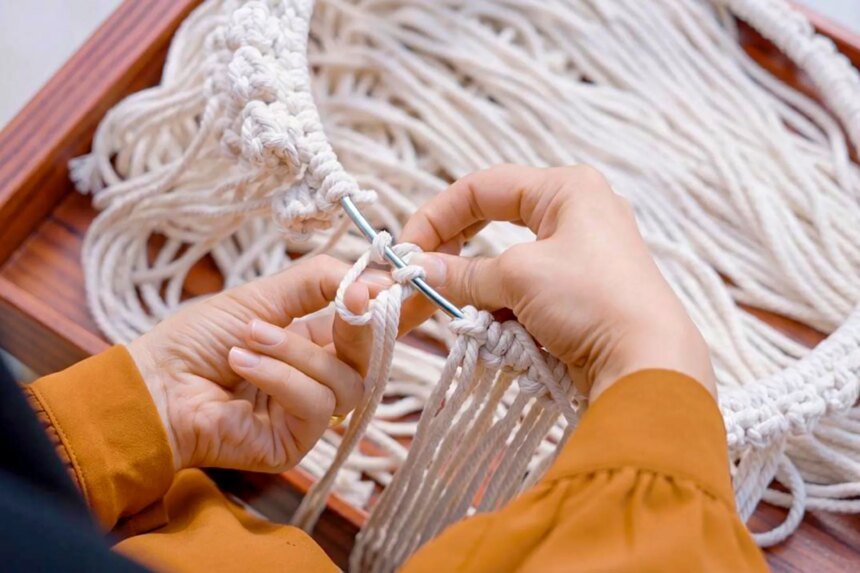
Jordanian architect Wissam Jaber works on designing and implementing handmade art pieces using the art of macrame, which relies on weaving threads and shaping them through different knots to produce murals, mirrors, plant holders, bedspreads, and home decorative items.
Wissam completes her work in her free time, as some pieces take several hours of continuous work, and are executed in different colors and sizes according to customers’ requests.
Wissam told Al Jazeera Net that her turn to the art of macrame came as a temporary alternative to drawing, which she practices in addition to her specialty in architecture, because of the effect of the smells of colors on her young children.
For her, the art of macrame has turned into a space for creative expression and an additional source of income, as she markets her products through her pages on social networking sites, and in the future she seeks to combine her experience in architecture with macrame work to develop more diverse pieces of art and designs.

Folk cooking is a gateway to the world
In the city of Salt, Yusra Al-Hayari chose a different path to preserve heritage and turn it into an economic project.
Yusra serves Jordanian popular dishes in the traditional way that grandmothers are accustomed to, using firewood and old cooking methods that are gradually disappearing from daily life.
Yusra Al-Hayari told Al-Jazeera Net that her project was launched with the motive of preserving Jordanian popular heritage and reviving it for new generations, but over time it turned into a destination visited by visitors from inside and outside Jordan.
Its project includes preparing popular dishes such as mansaf, maqluba, mujaddara, rashof, and peasant breakfast, which are dishes that have become part of the tourist and cultural experience sought after by Arab and foreign visitors.
She points out that she receives requests from visitors coming from the Gulf countries, Europe and the United States of America, which confirms that local heritage can be transformed into an economic product capable of attracting customers of different nationalities.
She adds that the success of the project was not the result of large capital, but rather the result of years of experience, determination and continuous work, in addition to maintaining quality and originality.

A new generation of pioneers
Women’s projects are not limited to traditional foods only. In the sector of home baked goods and sweets, the young Jordanian woman, Maryam Mahmoud Saima, found an opportunity to build her own project after a journey of self-learning, reading, and experimentation.
Maryam began developing her skills in preparing sweets and baked goods from home, before launching a small project that relied on electronic marketing to reach customers.
She believes that home projects represent a real opportunity for girls who have not been able to obtain jobs in the labor market, especially since many of these projects do not require large capital when starting.
According to Maryam, the marketing problem remains the most prominent obstacle facing small projects, especially with the great competition on social media platforms and the high costs of digital advertising.
In an interview with Al Jazeera Net, Maryam believes that product quality alone is no longer sufficient, but rather success has become linked to the ability to reach the public, build a customer base, and maintain their trust.
Small economy with big numbers
Although these projects seem small on the individual level, their economic impact extends beyond the homes from which they originate.
According to data from the Jordan Chamber of Industry, women have become an essential element in economic and industrial activity in the Kingdom, as they constitute about 37% of the total industrial workforce, while the industrial sector alone provides job opportunities for more than 42,000 Jordanian women.
Despite the increasing success stories, women entrepreneurs still face multiple challenges, most notably limited funding, difficulty in accessing markets, high digital marketing costs, and increasing competition.
Some women also face social challenges related to society’s view of domestic work or the limited training opportunities available to them in some areas.
However, field experiences indicate that persistence and modern technology contributed to overcoming a large part of these obstacles, especially with the spread of e-commerce and social media, which allowed home projects to reach wider markets than ever before.