Published on 6/6/2026
|
Last update: 11:54 (Mecca time)
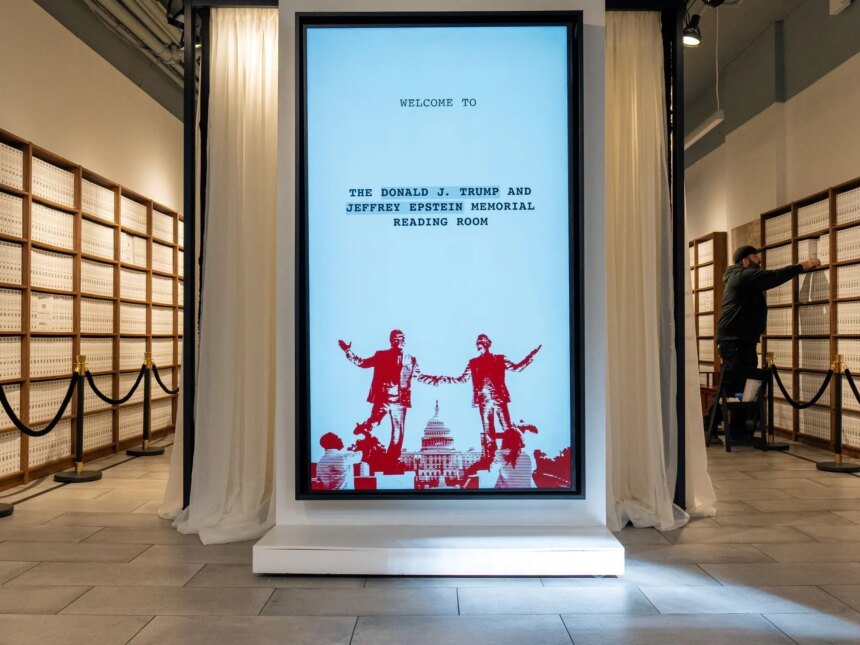
Just a mile from the Manhattan prison where convicted sex offender Jeffrey Epstein was found dead in 2019, a modest gallery in Tribeca (101 Reed Street) has been transformed into a physical archive of cases linked to the scandal-hit financier. There, more than 3.5 million pages of law enforcement documents published by the US Department of Justice were printed, then bound and stacked in 3,437 folders that lined the room’s floor-to-ceiling walls.
The exhibit, called the Donald Trump-Jeffrey Epstein Memorial Reading Room, was organized by the Primary Facts Institute, a non-profit organization focused on transparency and anti-corruption. This hall comes as an attempt to shed light on the many cases linked to Epstein that never reached trial. After he was arrested on charges of human trafficking for sexual purposes in July 2019, he hanged himself in his cell one month later, depriving victims of the opportunity for judicial redress.

A city of paper and silence laden with memory
Shelves hold documents released under the Epstein Files Transparency Act, along with timelines, letters written by visitors, and a memorial space set aside for the victims. Since its opening two weeks ago, the exhibition has attracted a steady stream of visitors, especially survivors of that network.
Among them is Lara Bloom McGhee, who was only seventeen when Epstein assaulted her. She visited the hall last week and told Al Jazeera: “I found in the Trump-Epstein hall something painfully human; proof that our lives were valuable enough to be collected, documented, and finally seen.” She described entering the room as being like entering a “paper city,” which struck her as a physical slap, but what stuck in her memory most was the silence.
The silence was heavy with memory. Row by row, each volume here represents a life, a name, and a day that should have happened if the US government had acted when it was reported to the FBI in 1996.
The sheer size of the archive is intentional; Organizers say that the physical nature of the documents forces visitors to confront the scale of the crimes and the number of lives they affected at the same time, after thousands of victims were identified, including prominent survivor Virginia Giuffre, who died by suicide in April 2025.
Privacy breach
The project is centered around victims, survivors and accountability, says one of the gallery’s co-founders, David Garrett, describing it as part of an effort to create “temporary museums on the ground” to generate public pressure against corruption and institutional failure, with the goal of generating outrage to pressure Congress and the Department of Justice.
But the process of assembling the archive itself was messy; Garrett reveals that the organizers downloaded the files from the Ministry of Justice in March, believing that they had obtained documents whose sensitive information was withheld, and they did not discover until after printing that the names of many survivors remained exposed, while the names of witnesses and accomplices were hidden!
Garrett adds angrily: “It seems that the Department of Justice modified the search feature instead of actually blocking the names. They have brazenly violated the law.”
Finding a place for the exhibition was another battle; Several venues backed down for fear of controversy or retaliation, making the Tribeca exhibition the fifth venue targeted by organizers.
Still, advocates were quick to embrace the project, and the gallery recently turned into a 24-hour file reading site in a live broadcast led by survivor Dani Pinsky, reading out excerpts from the blank folders to ensure that documents were never buried in silence again.

Appearance does not mean justice
Throughout the place, visitors leave flowers and notes of sadness.
Garrett recalls one woman who spent hours walking around silently before revealing to organizers that she was a survivor of sexual assault, saying the archive helped her feel “seen.”
As for Bloom McGhee, this feeling carries both relief and frustration, and she tells Al Jazeera: “For years we were told to be silent and accept compromises, and seeing our facts in a public archive seemed like a long-awaited acknowledgment of our pain, but documentation alone is not justice.”
“These files provide hope because the record has become undeniable, but at the same time they draw a map of systematic failure. Appearing without consequences prolongs the wound, and we need a government that takes action and is put on trial, so that “to finally be seen” turns into “to finally be safe.”