Paris – Going beyond presenting documents or testimonies to questioning the history that is kept silent about: How was it written? Who shaped his narrative? Who was excluded from his voice? Between art and archives, and between images and documents, the Arab World Institute in Paris is trying to awaken a silent history of slavery between the two shores of the Mediterranean, and to rewrite it in the language of art in a vivid and bold recovery of forgotten and forgotten memory, through the exhibition “Slavery in the Mediterranean Basin in the Seventeenth and Eighteenth Centuries,” which runs from March 31 to July 19, 2026.
Questioning history
In the exhibition, layers of the memory of slavery in the Mediterranean basin during the seventeenth and eighteenth centuries are revealed, where the relationship of enslaved people with authority and with bodies that were once transformed into numbers in the records of oblivion is reconsidered, as a historical system whose effects still extend to the present.

In this visual and human space, individual stories intersect with their traces in arts and documents, and a more complex picture is formed than simplified accounts of the Mediterranean allow, the sea that has transformed from a mere geography of exchange into a dense theater of memory, human and historical tensions, and forgotten stories lying in oblivion and the bottoms of commercial ships, because “where justice is denied, oblivion becomes another form of slavery,” as the African-American activist and writer Frederick Douglass says. (1818-1895), one of the most prominent symbols of the movement to abolish slavery in the nineteenth century.
Read also
list of 2 itemsend of list
A forgotten memory between two shores
In this context, Nathalie Bondil, Director of Museums and Exhibitions at the Arab World Institute in Paris, explained that this exhibition is a precedent of its kind because for the first time an entire museum display is devoted to the topic of slavery in the Mediterranean basin, while the focus has long been on the transatlantic slave trade. She stressed that this single focus obscured another, more complex and intertwined history, as slavery took multiple forms within the Mediterranean space that could not be reduced to a single model or narrative.

Average experience
Bondil indicated in her statement to Al Jazeera Net that the word “slavery” itself has ancient historical roots dating back to classical times, where it was associated with the meaning of submission and enslavement, but the Mediterranean experience reveals a multiplicity of its forms and references. This system included people from different religious and geographical backgrounds: Muslims, Christians, Maghreb Jews, and Ottoman Turks, which makes slavery here an issue of religious or sectarian affiliation rather than physical characteristics or color.
“Where justice is denied, forgetfulness becomes another form of slavery.”
She emphasized that this proposal opens a new critical horizon for understanding the phenomenon, because it puts it in comparison with other types of human trafficking throughout history, and at the same time reveals its true size, as the number of those included in this system is estimated at about two million people within the Mediterranean basin, which is a smaller number than the Atlantic trade, but it is no less important for understanding the historical structure of violence in the region.

Between navigation, piracy and captivity
In global social memory, or even in modern human anthropological studies, slavery is almost reduced to one path, which is the transatlantic slave trade. However, this exhibition comes to reopen another historical file that has long remained in the shadows: slavery in the Mediterranean. During the seventeenth and eighteenth centuries, the Mediterranean was transformed from a mere space for trade or navigation, into an open space for piracy, captivity, and forced transportation of people, where destinies intertwine and borders are intertwined in a way that exceeds the simple perception of political maps.
Religious or geographic identity was not a barrier to survival. Muslims, Christians, Europeans, and North Africans found themselves within the same structure of captivity and exploitation, as if the sea itself was constantly redistributing roles between victims and perpetrators.
Here, the dividing line between “other” and “self” disintegrates, and history appears as a complex network of intertwined destinies, where politics, religion, and economics intersect, and human lives are shaped within a system of violence that transcends simple classifications. The concept of slavery is transformed from a mere relationship between a victim and an executioner, into an intertwined social, economic and cultural system that reshapes individuals and societies on both shores of the Mediterranean.

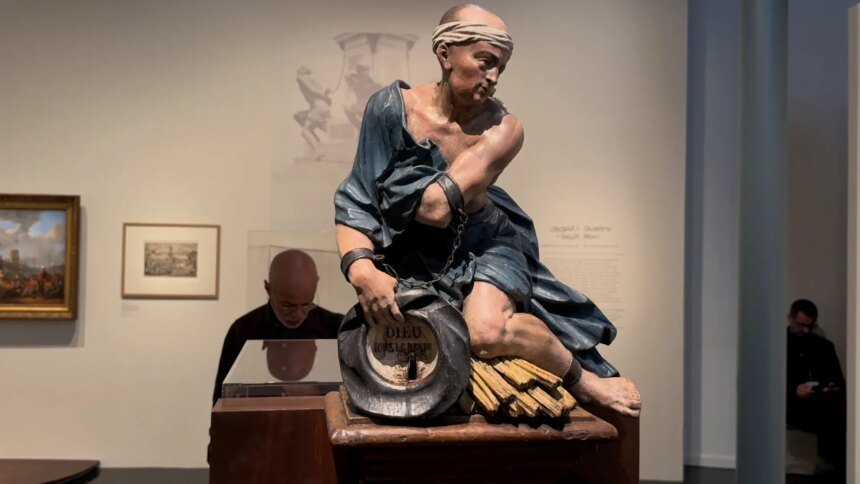
Bondil also pointed out that the exhibition displays examples of artwork that used slaves as models, such as the “Quattro Mori” monument in Livorno, or the scenes of the Ambassadors’ Staircase in the Palace of Versailles as depicted by Le Brun, indicating the presence of slavery even within classical European art, revealing that this history was not as marginal as thought, but rather was part of the structure of the image itself.
From the pain of the collar to the longing for freedom
The experience of entering the “Slavery in the Mediterranean” exhibition is like gradually slipping through layers of time, as the path reconstructs the journey from its beginning, starting with the moment of captivity and crossing the sea, passing through life inside ships, arriving at forced labor in ports and arsenals, and ending with the possibilities of redemption or liberation, in a gradual visual and temporal artistic narrative that makes the experience something that is lived, not just watched, turning captivity in this world into a complete state of existence, constant fear, exhausted bodies, and time suspended in between. Two possibilities without a third.
Daily life within this unjust social system is not an exception, but rather the rule: hard work, constant monitoring, and endless waiting, as if time itself has lost its direction and compass within this harsh human experience.
The Director of Museums and Exhibitions at the Arab World Institute in Paris explained that one of the goals of the exhibition is to reconstruct this daily life in its minute details, through documents, letters, and testimonies that reveal how these people lived within this system, and how they tried to preserve what remained of their humanity, despite the broken circumstances around them.
Away from static material, the exhibition presents historical documents in a living artistic context, making history a sensory experience and not just mental knowledge that visitors to the exhibition experience with all their senses. Paintings, sculptures, and manuscripts are not presented here as visual adornments, but rather as testimonies to a complex human experience that extends between pain, representation, and memory.

Handwritten letters
At the heart of this exhibition, handwritten letters stand out as the most influential elements for the audience, because they attempt to convey feelings of fear, nostalgia, hope, interruption, and longing to break the chain for liberation and salvation to visitors, through the hidden stories of these letters, some of which never reached their final destination, and others remained stuck in the distance between sea and land, but they all carried symbolic hidden messages and still preserved the trace of man in the moment of his brokenness, as if writing itself was a final attempt to resist loss, restriction, and attachment. With the thin thread of hope and the distant light of freedom.
Bondil emphasized that all of these materials, statues, and historical archives on display attempt to convey living human experiences that reconnect the visitor with sounds forgotten by time, and make him approach the experience sensually and humanly before cognitively.

A lived historical experience
In this exhibition, the spatial space and the temporal framework intertwine to transform into a stand-alone narrative element that reshapes the visitor’s relationship with history from within. Scenography here suggests that it organizes the path, but in reality it was designed as an integrated sensory experience that resembles a gradual descent into the layers of memory, where the past rolls from a distant idea to a state of awareness that is lived with the body before the mind.
The exhibition’s path begins as if the visitor is descending slowly into the depths of the ships, where the lighting gradually changes, the sounds in the background intensify, and the halls turn into semi-enclosed spaces, in which shadows intersect with music and whispers, so that the place itself regains its own memory, and the visitor in turn regains the feeling of the steps and cries of the prisoners and the arduous journey of slavery between the crashing waves of the Mediterranean.

From spectator to witness
In this context, Natalie Bondel, speaking to Al Jazeera Net, indicated that the design of the exhibition was an aesthetic choice and a cognitive and human decision aimed at moving the visitor from the position of the spectator to the position of the witness and diving him into the experience itself.
She added that the scenography is based on gradual immersion, as the visitor descends as if he were diving inside the ships to their lower levels, where the rowers were held in harsh conditions.
She also explained that the interwoven voices in multiple languages, such as Arabic with its translation and French with written and audio testimonies, constitute an essential element in building the human sensory experience, because they bring back life to real voices that their owners left behind them through poignant messages that reveal the details of their diaries within families, some of which did not reach their families, but remained a witness to pain and resistance at the same time.
Bondil concludes by pointing out that this scenographic construction does not seek to amaze, as much as it seeks to reshape the relationship with forgotten history so that the visitor becomes part of the narrative and not just its recipient, in an experience in which knowledge intersects with feeling and memory of the present. In her opinion, this artistic project seeks to approach the human being in his essence, his pain, his hopes, and his struggle for liberation and survival.

Bloodstained beauty
In its final section, the exhibition “Slavery in the Mediterranean Basin” opens up to a contemporary question: How do we write this history today? How do we confront a memory full of contradictions without simplifying or reducing it? Here, contemporary artworks intersect with historical documents, rethinking the relationship of art with memory, and the ability of the image to recover what has been silenced.
The exhibition’s path concludes with a work by artist Kevork Murad that he designed and created specifically for the exhibition. This work shows scenes of fields interspersed with majestic architectural monuments that express the greatness of art history at its finest, but through openings and windows, the hard work of slaves and their suffering behind this apparent glory can be felt. This calls us to reconsider history, away from its glorified image, to understand the profound human suffering it conceals.
The visitor discovers this contradiction between the apparent glory of history, and the layers of work and suffering that were based on it, in an artistic translation and hidden symbolic evocation of the saying of the sociologist Abdul Rahman Ibn Khaldun: “History, on its surface, is no more than information, but inside it is consideration and investigation.”