Published On 6/5/2026
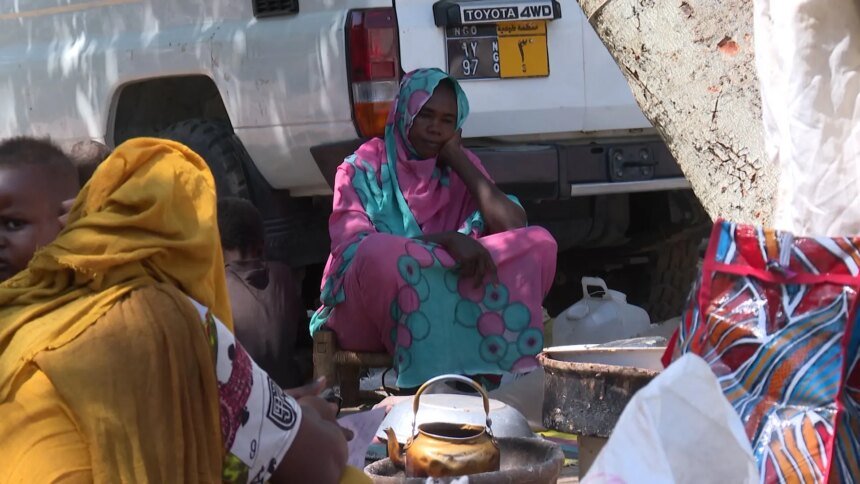
In the middle of a modest displacement tent in the city of Damazin in Blue Nile State, south-eastern Sudan, Amna Hussein sits surrounded by her six children, trying to appear strong even though her exhausted features reveal all the fear, hunger and exhaustion she has been through.
She raises her voice from time to time to reassure her children, but inside she realizes that reassurance itself is absent.
Amna narrates in a heavy voice how her life in the city of Dandro turned into complete chaos after the drone attacks that targeted the area located within the Blue Nile.
She says that her children are still living the details of those moments: fires consuming homes, smoke covering the sky, and the sound of explosions driving everyone to flee without a destination. The family had no choice but to flee on foot, a journey that lasted two full days, during which she was pregnant, while her young children stumbled from fatigue and hunger and then got up to continue on the road.
The beginning of suffering
But arriving at the camp was not the end of the suffering, but rather the beginning of it in a different form. Inside crowded tents that barely protect against the heat of the day and the cold of the night, Amna faces a harsh reality of lack of food and aid.
She says that she often sleeps with her children without adequate food, while her fear increases day by day for her pregnancy and for her children, whose health has deteriorated due to malnutrition.
In another camp, the tragedy intersects with the story of Mashaer Ahmed, who was displaced from the city of Kurmuk after an unforgettable night, in which gunmen stormed her house and killed her husband in front of her, before her eldest son was kidnapped. She says that her eight children are no longer what they were, as they wake up terrified by any sound, as if the war is still following them even inside the camp.
After fleeing, the family took refuge in the mountains, where they took shelter inside rock caves for three nights without food or medicine, living on stagnant rainwater. Feelings recounts how they were drinking water whose “smell changed,” but they had no other choice.
Inside the camps, these stories are repeated daily. Psychiatrist Hiam Abdel Ghani says that children suffer from sleep disorders and anxiety, and resort to drawing war scenes instead of childhood drawings, while pregnant women experience double pressures between hunger, fear, and loss of safety.
She warns that the continuation of these conditions without urgent intervention may leave an entire generation burdened with long-term psychological and behavioral trauma, a generation that is trying to grow up, but is still living under the shadow of war.