Published On 3/6/2026
|
Last update: 17:19 (Mecca time)
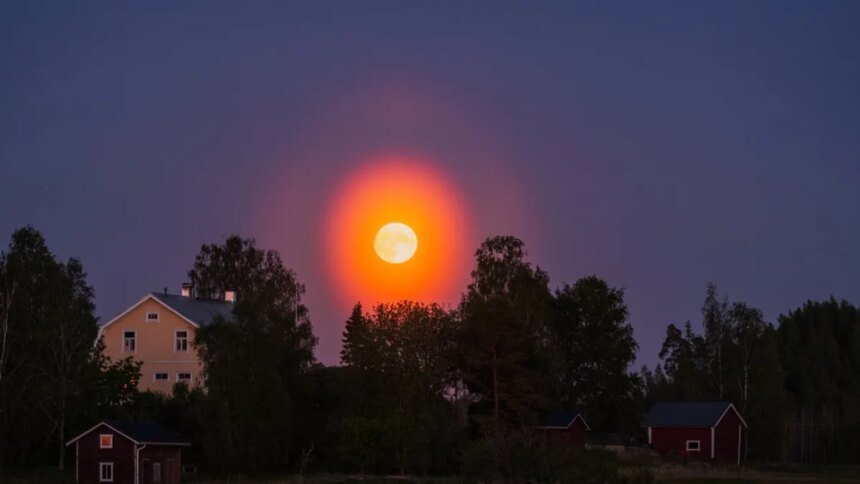
The skies of Finland and the Scandinavian countries witnessed a rare astronomical and environmental phenomenon, as the full moon (known astronomically as the blue moon) appeared surrounded by a lumpy, irregular light ring of bright orange color, in a charming natural painting that caught the attention of astronomer enthusiasts.
Finnish astrophotographer Matti Heylin documented this unique phenomenon, commenting: “It was the most beautiful pollen corona I had ever seen. The shape of the corona or halo and the presence of yellow dust on everything confirmed that the phenomenon was entirely caused by pine tree pollen.”
Read also
list of 2 itemsend of list
Physics meets botany
This phenomenon, known scientifically as “pollen corona,” occurs when sunlight or moonlight is exposed to diffraction and scattering through billions of tiny pollen grains suspended in the atmosphere, and usually coincides with the peak flowering seasons at the end of spring and beginning of summer.

At this time of year, the male cones of northern European pine trees release huge amounts of yellow grains, with a single tree producing millions of grains and relying on the wind to transport them. Although this method is not the most biologically efficient for reproduction, it is ideal for the formation of these photogenic coronas.
The secret of the Mickey Mouse hat
What gives pine pollen wreaths their distinctive lumpy oval shape – as opposed to the regular, circular halos caused by water droplets – is the geometric structure of the pollen grain itself. When examined under a microscope, the grains look like the hats of the famous cartoon character Mickey Mouse, because they contain two air sacs that help them float and fly long distances.
These air sacs align the grains in a uniform direction as they fly with the wind, which results in uneven scattering of light, so that the individual structure of each pollen grain is reflected in the overall shape of the light corona.

It is noteworthy that the term “blue moon” does not mean the moon is colored blue, but rather it is a metaphorical astronomical description of the appearance of a second full moon in the same Gregorian month. While the sky was celebrating this amazing visual spectacle, environmental experts point out that this period also witnesses the peak of the “spring allergy” season for residents of those areas due to the high density of these grains suspended in the air.