Published On 4/22/2026
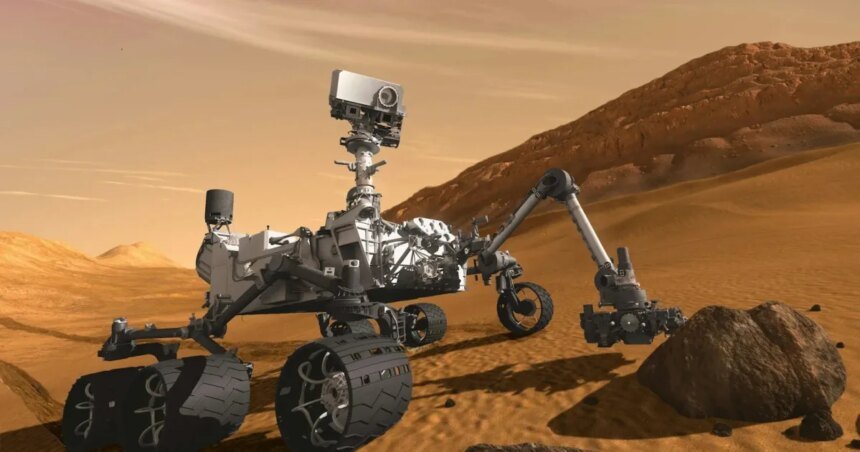
In a scientific achievement that expands the boundaries of astrobiology, the Curiosity probe of the US Space Agency (NASA) succeeded in carrying out the first chemical experiment of its kind on the surface of Mars, revealing complex organic molecules that had been preserved inside rocks for about 3.5 billion years.
This discovery came as a result of careful analysis of rock samples from Gale Crater using an advanced analysis system, and its results were published in the journal Nature Communications, led by researcher Amy Williams.

What is noteworthy is that scientists did not just detect organic “traces”, but were able to dismantle huge molecules that were hidden inside the rocks, which opens a new door to understanding the chemical history of Mars.
Read also
list of 2 itemsend of list
“SAM” technology… a mobile chemical laboratory on Mars
This achievement relies on a sophisticated device known as Sample Analysis at Mars-SAM, which serves as a miniature chemistry laboratory inside the rover.
In this experiment, scientists used tetramethylammonium hydroxide (TMAH) to perform a process known as “thermo chemolysis.”

In simple terms, this technology works like “chemical scissors”, breaking down large organic molecules that are difficult to detect, and transforming them into smaller compounds that can be analyzed and their composition precisely determined.
What did Curiosity find at Glen Torridon?
While exploring the Glen Torridon area inside Gale Crater, the probe analyzed ancient sandy clay rocks, specifically on the Knockfarrel Plateau, to reveal more than 20 types of organic molecules.

These molecules included aromatic compounds, which are complex carbon structures, in addition to molecules containing elements such as nitrogen and sulfur, which are essential elements in the formation of amino acids and proteins on Earth.
Most importantly, the analysis showed that these materials are “authentic Martian,” meaning that they formed on Mars itself, and are not the result of terrestrial contamination or materials brought by meteorites.
The study’s surprise… amazing resilience over time
The researchers found that one of the most prominent results of the study is that these organic molecules remained preserved despite their exposure to billions of years of cosmic radiation and fossilization processes, which is the process in which sediments turn into rocks.

This persistence indicates that the interior of Mars, even at shallow depths, may be able to preserve “biosignatures” better than expected, which enhances the chances of finding signs of ancient life in the future.
Does this mean the discovery of life?
The precise scientific answer: No, but we have taken an important step closer. What scientists have discovered are the “building blocks of life,” that is, complex organic compounds that can be part of vital processes. But these molecules may also be formed through abiotic processes, such as geochemical reactions or even by meteorites.
Therefore, it is not yet possible to confirm whether these materials are evidence of ancient life, or just active chemistry in the ancient Martian environment.
Bigger picture.. Comparison with other results
The importance of this discovery increases when compared to the results of the Perseverance probe, which also detected organic compounds in other regions of Mars using various instruments.

This agreement between two independent missions indicates that organic carbon is not a local phenomenon, but rather may be widespread in several regions on the Red Planet, which strengthens the hypothesis that Mars was a habitable environment in the past.
What does this mean for the future of exploration?
This experiment represents a turning point in the design of tools for searching for extraterrestrial life. Tetramethylammonium technology has proven its effectiveness and is already part of future tools such as:
- ESA’s Rosalind Franklin rover.
- The Dragonfly mission heading to Titan, Saturn’s largest moon.

The European Space Agency (ESA)’s Rosalind Franklin rover will carry a European landing pad dedicated to the surface of Mars (ESA).
These missions will use similar techniques to analyze complex organic chemistry in different environments, which could help uncover the origins of life elsewhere in the solar system.
A step closer to understanding the origin of life
What Curiosity has achieved is not just discovering organic molecules, but proving that Mars maintains a rich and complex chemical record spanning billions of years. These results mean that the search for life is no longer just a theoretical idea, but rather a scientific project based on tools and techniques capable of “reading” rocks and extracting their secrets.
As technology continues to develop, the question in the future may become not “Was there life on Mars?”, but rather “What was that life like?” Scientists are still assembling the pieces of the “Martian puzzle” from various locations to form a complete picture of the history of the Red Planet.