Published On 2/6/2026
One of the most important opinions put forward by the French computational neuroscientist Yann Lacon during the dialogue held between him and the other French cognitive neuroscientist Stanislas Dehaene is, “Cosmic development always tends towards greater complexity. Intelligence develops, but it does not have to remain completely human.” This brings us to a set of questions that are completely linked to human consciousness and its ability to manage its own affairs.
On the other hand, this opinion may be the beginning of a coming stage in which the intelligent machine will be a partner with humans. There is no doubt that the innovations in the digital environment are nothing but the product of the human mind, but can this human mind withstand the digital innovations? If these innovations interfere with the value and moral considerations of the human being, what will happen to modern humans?
Read also
list of 2 itemsend of list
Human identity in front of smart inventions
In this new world, we see smart inventions that have a clear impact on the human gender identity. Perhaps I find that the most vital innovations are those that interact with his moral and ethical issues. If we examine the nature of implanting the artificial womb of a robot, this smart repository that can store the fetus for nine months, which is the same period of time that it spends in the mother’s womb, then if we explain the truth of this matter, which has its consequences on the psychological and cultural structure of the human being, many questions will become clear to us, the first of which is: Did these smart industries help? For humanity, or is it trying to participate with the essence of man in order to annihilate his intellectual powers in how to make his decisions?
But we have to look at the other positive side of it. Scientific innovations may have come to help people at this stage, and there is no doubt that science has changed many concepts and even produced new concepts for us at all levels. For example, a woman who does not want to be exposed to the labors of pregnancy and its consequences resorts to an artificial womb, and the matter has become clear in most countries. It remains for us to ask: Is a person’s actual lifespan governed by these smart technologies that address important aspects of his human formation? Is it necessary to deal specifically with the fundamental aspects that represent the value of the human being?
Artificial womb: from theory to the “Ectolife” center
The truth of the matter is that the first person to preach about the manufacture of an artificial womb through important scientific research was the scientist Emanuels Greenberg (1911-1982). Other scientific research centers sought to improve this content until we reached the Ectolife Center, the first medical center for an artificial womb in the world that works with renewable energy, which was announced by the Yemeni researcher Hashem Al-Ghaili.
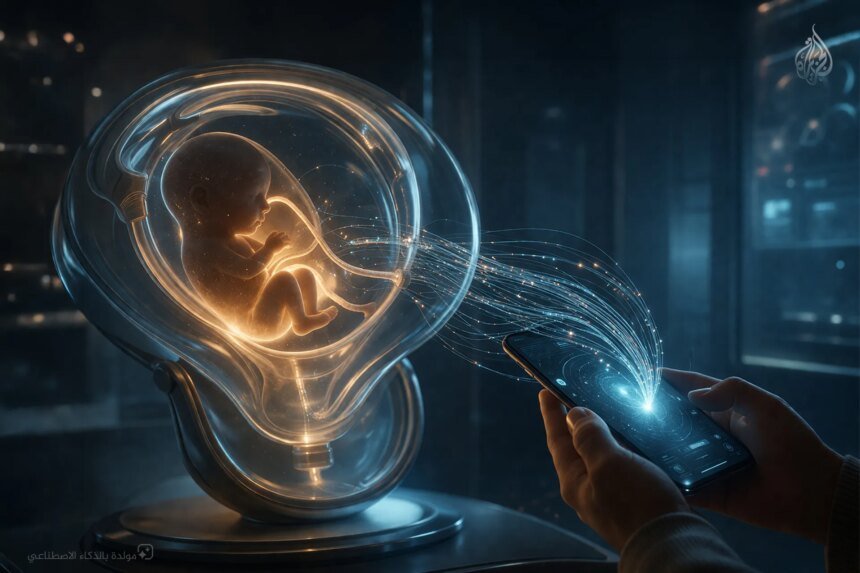
This center allows infertile people to have children externally. The center includes 75 equipped laboratories, each of which can accommodate 400 reproductive incubators. The incubator consists of sensors that match the temperature of the fetus in addition to monitoring its heartbeat. This glass reservoir also contains a liquid that replaces the amniotic fluid of the human mother to provide the child with nutrition and allow it to grow.
Because of the material the incubator is made of, germs are prevented from entering, so the fetus lives in a disease-free environment. Each fetus is shown a daily report showing its needs and the extent of its effectiveness with the environment. The artificial intelligence system follows up the process of the body’s growth and sends a notification to specialists about the presence of any disorder that occurs in it.
This data is sent to the parents’ phone device, so the follow-up process takes place in a serious manner. The parents can choose the language or type of music for their fetus through the play button on the phone device that is directly linked to the incubator. The smart glasses give them a virtual world to connect directly to the fetus and monitor its movements in the most complete way, allowing the parents to get to know their child and the stages of his development, as well as broadcasting a specific context to him at the level of sound and image and preparing him as they want. They also sense his movements.
“Does a person feel psychologically about his birth, or does he have an underlying idea that the world is run by machines? Can he realize that his reality is managed by intelligent technologies that are not subject to emotion and conscience?”
The dilemma of emotion in the presence of the machine
Naturally, I find that the human being agrees with any scientific action that has the potential to enable him to shorten the path and reach his goal easily and with high efficiency, especially innovations that deal with issues with a human dimension. If we extrapolate the results of the smart incubator, we will find that we are facing a great scientific proposal that has the potential to produce for us a human baby.
But we are faced with an important question on the moral and ethical level: How does a person view the essence of this innovation? Does he feel psychologically about his birth, or does he have a hidden idea that the world is run by machines? Can he understand that his reality is managed by intelligent techniques that are not subject to emotion and conscience? How much emotion does this baby have? If things became possible on the social level to open birth centers using smart incubators in many countries, would the mother be able to have the inner desire to sense her fetus and keep pace with its growth as if it were in her womb? This is what makes us think seriously and ask: Does science have thresholds of truce, or does it continue in the path of the human being and create its problems?
Searching for anthropocentrism
In fact, after the Fourth Industrial Revolution, which was concerned with smart inventions, which became a vital part that had a clear impact on man’s cultural system, and even became integrated into his social formation as well, it became necessary for man to determine his centrality, and in my opinion, any scientific innovation can re-create the world to open another different path that has its own new qualifications.
But we are faced with a different technical proposal that relates to the reality of the human being, and this is what creates for us a different world at the level of reception, behavior, and action. Here we are supposed to point out another cognitive question: Can the human being be aware of these innovations and understand their purpose, especially after the intelligent machine was able to anticipate his reality, specifically when it participated in his genetic preparation, and this is what created in him an involuntary feeling of being completely dependent on it. It has been able to achieve a qualitative leap at the level of scientific history. And humanity, but after all these great inventions that are supposed to enhance man’s status and increase his value, how can he illuminate his existence?