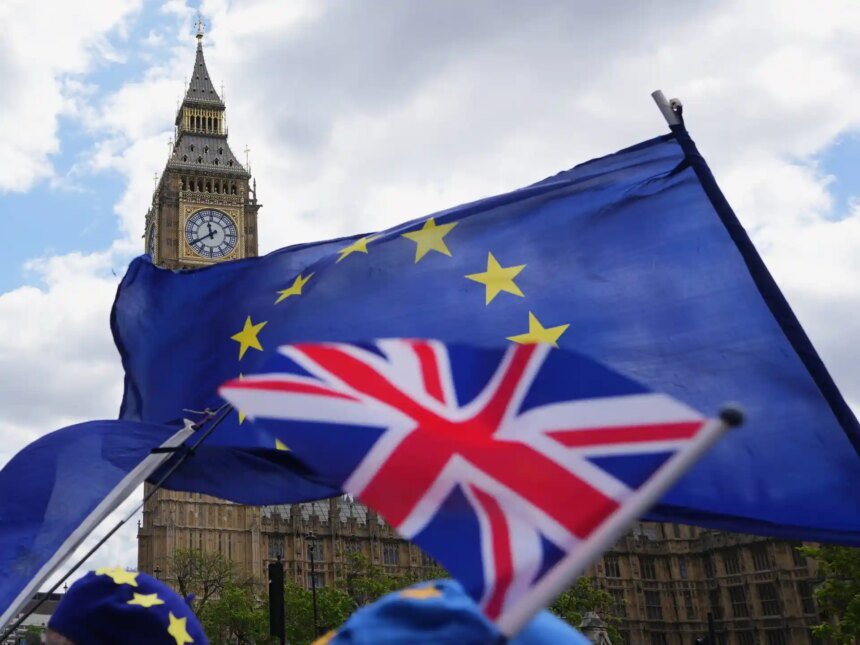
Ten years after Britain’s exit from the European Union, or what is known as Brexit, the debate is escalating over London’s return to the union amid widespread economic losses acknowledged by senior officials in the British government.
For the first time, a minister in the British government, Chancellor of the Exchequer Lord Spencer Livermore, announced his support for reversing the result of the referendum held on June 23, 2016, which resulted in support for leaving the European Union by a simple majority, amounting to approximately 52% of the voters’ votes.
Read also
list of 4 itemsend of list
Lord Livermore explained before the House of Lords last Monday that he believes that returning to the European Union is “inevitable,” adding, “Of course, the United Kingdom will return to the European Union because that is completely in our national economic interest,” according to what was reported by the British Financial Times.
British Prime Minister Keir Starmer said in a press conference last May that he was working to “reset” the relationship between his country and Europe to become better and broader, and stressed that leaving the European Union had caused severe damage to the British economy.
But Starmer avoided talking about completely reversing the referendum result and returning to the European Union for fear of angering a sector of voters who reject this return, and fearing that it would lead to opening Britain’s doors to European migrant workers.

The immigration issue represents an important pressure card on Starmer, especially after the gains made by the hard-right Reform Party, led by Nigel Farage, in the local council elections in England last May, which completely refuses to return to the European Union in any form, after being one of the most prominent advocates of its departure.
Widespread economic losses
Lord Livermore explained that the losses of Britain’s exit from the European Union are estimated at between 6% and 8% of GDP, according to a study by the Office for Budget Responsibility, a research body that conducts assessments of the impact of decisions taken by the government on economic activity.
The British newspaper “The Independent” pointed to the dispute in the House of Lords between Lord Livermore and Lord McKinlay, a former Conservative Party MP and supporter of Brexit, where the latter said that the current Labor government is benefiting from the flexibility achieved after leaving the European Union in providing support to various sectors such as the agricultural sector to drive growth.
However, Lord Livermore stressed that these limited benefits do not equal the huge losses that Brexit caused to the British economy, which the government is currently working to mitigate.
It is noteworthy that Britain’s gross domestic product exceeded $4 trillion in 2025, according to data published by the British Parliament, which means that a loss of at least 6% of it would mean losses exceeding $240 billion.

Accumulated and gradual losses
A study by the National Bureau of Economic Research published in November 2025 showed that the economic losses since Britain’s exit from the European Union included the following:
- Britain’s per capita GDP declined by between 6% and 8%, compared to what would have been achieved if Britain had remained in the union.
- A decrease in investment by between 12% and 18%, given that the British private sector was severely damaged as a result of Brexit.
- Job opportunities declined by between 3% and 4%.
- Productivity declines by between 3% and 4%.
The study showed that the losses incurred by the British economy as a result of Brexit were gradual, and were not apparent in the period from 2017 to 2018 immediately after the referendum, but they accumulated over 10 years, as a result of the expansion of trade barriers with the European Union, which represents Britain’s largest trading partner.
On the other hand, British Finance Minister Rachel Reeves confirmed that leaving the European Union “caused long-term damage” to productivity in Britain.
High cost of trade and declining investment
In this context, Ziad Al-Hashimi, an international economist residing in London, said in a statement to Al Jazeera Net that one of the most prominent reasons for Britain’s widespread losses is the high cost of trade with the European Union, as British companies were buying and selling from the European market without obstacles, as if it were an expanded local market, when Britain was a member of the Union.
But after exiting this market, new costs appeared that were added to British producers and exporters, as Al-Hashemi explains, including customs procedures, inspections, certificates of origin, and additional fees for obtaining them. At the same time, the cost of supply chains arriving from Europe increased, as a result of imposing customs duties on them.
The result was that British companies became less competitive compared to European companies, and dealing with them became more complicated after Britain was outside the European Common Market.
Another reason that Al-Hashimi points to is the decline in investment in Britain as a result of its exit from the European market, as investment declined between 12% and 18% according to his estimate, which contributed to weak productivity and a decline in the competitiveness of British producers.
Also, many investors from outside Europe now prefer to pump their money into market countries to benefit from the European market without obstacles, unlike the case if their investments were in Britain, where they will face obstacles in accessing the European market.

Britain’s most important trading partner
According to data from the British House of Commons, 41% of Britain’s exports were destined for the markets of the European Union countries, which are 27 countries, in 2025, while the percentage of Britain’s imports from the EU countries amounted to about 50% of its total imports.
Britain’s total exports of goods and services reached 931 billion pounds ($1.25 trillion) in 2025, while its total imports amounted to 970 billion pounds ($1.3 trillion).
It is noted that Britain suffers a deficit in the trade balance with the European Union, which is related to trade in goods, amounting to 242 billion pounds sterling (about 324 billion dollars) in 2025, as the country imports more goods from the Union than it exports to it, according to data from the British House of Commons.
But Britain has a surplus in the balance of services with the European Union amounting to 203 billion pounds sterling (about 272 billion dollars) in 2025, due to the vast financial services sector that Britain enjoys.
This huge volume of trade between Britain and the European Union explains the losses incurred by the British economy as a result of depriving the country of benefiting from the European common market after its exit from the Union.
The advantage that Britain enjoys in the financial services sector confirms its need to access the European common market without obstacles, to provide various transactions for this giant market, which was one of the most important reasons relied upon by those who opposed Britain’s exit from the European Union.
But the dilemma facing those demanding a return to the European Union is the political cost of this decision on the one hand, in addition to the difference of views within the pro-European Union camp about the best formula for economic partnership with it.
Among these formulas is joining the European Customs Union, which is limited to trade in goods, or joining the European Common Market, which includes goods and services and the free movement of labor and capital.