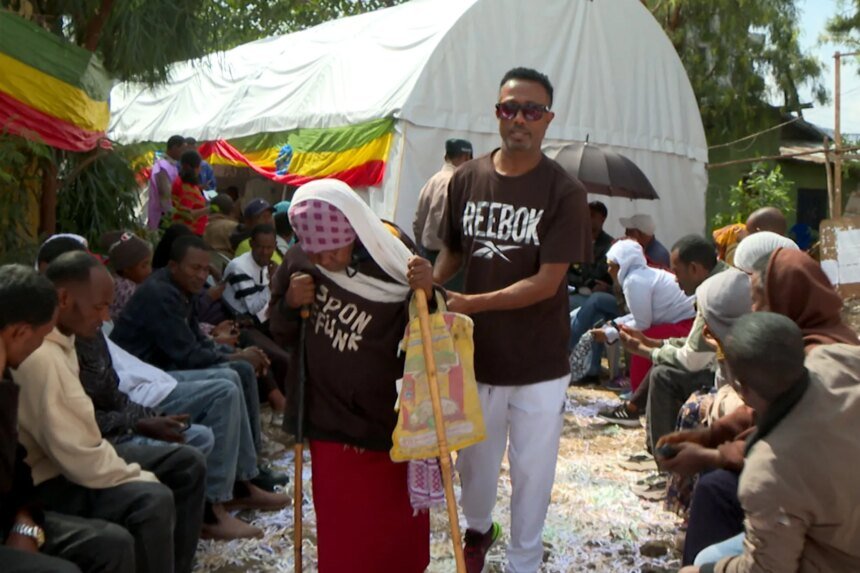
Addis Ababa- An elderly woman voter, who is over eighty years old, said on the sidelines of the ongoing elections in Ethiopia that this electoral moment represents an important turning point in the country’s history, stressing that what is happening today is not just a passing political entitlement, but rather a necessary step towards a more stable future for their children and grandchildren.
She added that she lived many years in which she witnessed fluctuations, difficulties, and painful events that made her realize the value of peace and stability, and that people are only built when they abandon violence and believe in the ballot box as a means of change.
Thousands of polling stations opened their doors since the early hours of the morning, in a scene that reflects the importance of the political entitlement, which regional and international circles are following with great interest.
andAmidst extensive organizational procedures and an extensive deployment of forces charged with protecting the electoral process, More than fifty million Ethiopian voters headed to the polls with the start of general elections across the country, with forty-two political parties competing for the 547 seats in the Federal People’s Assembly. The party or coalition that wins the majority will get the right to form the government and lead the country during the next five years.

The Ethiopian President: Exercising the right to choose wisely in a way that supports Ethiopia’s continued progress
The President of the Federal Democratic Republic of Ethiopia, Tai Eske Selassie, cast his vote in the seventh general elections taking place in the country, where with the end of the constitutional term of the current government simultaneously with the holding of the elections, the President of the Republic, in his capacity as head of state, assumes his constitutional duties until the final results are announced and the leader of the party or coalition that holds the parliamentary majority is assigned to form the new government.
The position of President of the Republic in Ethiopia is characterized by its consensual and independent nature, as it is held by a person who does not belong to any political party during his term, which enhances his symbolic and unifying role among the various national components.
After casting his vote in the elections taking place in the country, Ethiopian President Taiye Esqi Selassie said, in exclusive statements to Al Jazeera Net, that these elections are important not only for Ethiopia but for the entire African continent, with the aim of preserving the peaceful atmosphere for which Ethiopians are known for exercising the right to choose wisely in a way that supports Ethiopia’s continued progress.
The President appreciated the role of the African Union, which participates in monitoring elections to promote democracy, exchange experiences between African countries, and develop African best practices within the principle of African solutions to African problems, so that countries rely on innovating their own solutions and exchanging experiences instead of copying external models.

Opposition Azima Party: The success of the elections under the current circumstances is a success in itself
In light of these elections, the Azima Party emerges, which participates in these elections as the second political party in terms of weight among the opposition parties, and aims to increase its parliamentary seats and expand its political presence without expecting a direct competition for national power.
The opposition party enters the elections with its eye on democracy, human rights, and the free economy. The party confirmed participation in the elections – as it is a right in a country whose democratic experience is still new.
Party member Ayoub Masavant said, in exclusive statements to Al Jazeera Net, that voting is an essential step to consolidating democracy in Ethiopia, especially in light of the difficult circumstances the country is going through, and that the electoral process actually began during the campaign period and witnessed some irregularities and problems, most of which were resolved through negotiation with the National Elections Council, which made the process better compared to previous elections.
The same politician indicated that there was a clear turnout and enthusiasm from voters in the first hours of the voting day, and he explained that his party’s goal is to win and form the government, with his belief in strong opportunities to achieve this, considering that simply participating and holding the elections under the current circumstances is in itself a victory, and that the party’s obtaining the second largest number of candidates is considered a definite achievement.

Abiy Ahmed: Ready to accept any decision taken by the people through the ballot boxes
The head of the Ethiopian Prosperity Party and outgoing Prime Minister Abiy Ahmed cast his vote in his hometown of Bashasha village, located on the outskirts of the city of Jimma in the Oromia region, as part of the ongoing general elections in Ethiopia.
After casting his vote, Abiy Ahmed said that the next five years require more work, struggle and thinking, stressing the need for concerted efforts more than ever before, calling on the competing political parties to realize the magnitude of this responsibility and prepare for it.
He stressed that the Ethiopian people are capable of making their political decisions on their own and without external guardianship, noting that political competition should not be measured only by the logic of winning or losing, but rather by the parties’ ability to improve services and the lives of citizens.
At the same time, he expressed his readiness to accept any decision taken by the people through the ballot boxes, calling on the winning parties to serve the citizens sincerely, and urging the parties that did not achieve victory to accept the results in a responsible spirit.

Extraordinary elections
Observers from the African Union, IGAD, and independent missions view the Ethiopian elections as an important test of the path of political transformation in the country in light of the relative improvement in organization, with the call to enhance transparency, expand political participation, and the need to ensure stability.
In statements to Al Jazeera Net, former Kenyan President Uhuru Kenyatta, who participated in the Ethiopian elections as head of the African Union Election Observation Mission, described the ongoing Ethiopian elections as exceptional and positive in terms of participation.
He said, “The elections began on time in an environment that was carefully prepared, which made our impression from the first moment positive.” He added that voting means citizens exercising their right to choose their representatives and leaders, considering that democracy is a value that the African Union seeks to consolidate on the continent in order to enhance true representation, inclusion, and participation and enable people to choose their leaders.
It is one of the largest electoral processes on the African continent in terms of the number of voters and the geographical spread of polling stations. The electoral process is taking place in eleven out of twelve federal territories, while the Tigray region is absent from this electoral cycle in light of the special political and administrative conditions that the region is witnessing due to the existing dispute between the Front and the Electoral Council.
42 registered political parties are participating in the seventh Ethiopian general elections, along with 73 independent candidates. The parties fielded more than 10,900 candidates to compete for seats in the federal parliament and regional councils, and the number of registered voters is 50 million, 514,155 male and female voters.
Meanwhile, the electoral authorities prepared more than 52,000 polling centers and stations throughout the country, under the supervision of about 300,000 workers and employees.
This electoral scene across the country comes after the completion of the technical and logistical arrangements necessary to complete the voting process, which is monitored by local and international bodies in a country that is the second largest African country in terms of population and one of the most influential actors in the Horn of Africa region.

Observers view the current elections as an important test of the state’s ability to enhance political stability and consolidate its democratic institutions at a time when the attention of neighboring countries and international partners is directed to the results of this entitlement and the repercussions it could have on the future of the entire Horn of Africa and on the political and security balances in one of the most important regions on the level of the African continent and the developing world.
These elections are of exceptional importance that go beyond Ethiopian borders due to the geopolitical position that the country occupies in the Horn of Africa, as Ethiopia is located in the heart of a region that is considered one of the most sensitive and strategic regions in the world and constitutes a link between East Africa, the Red Sea and international trade corridors. It is also connected to borders with six countries and directly affects the files of security, stability, immigration, combating terrorism and regional economic integration.
Citizens’ impressions varied between optimism and caution, with many voters seeing the elections as an opportunity to participate in shaping the country’s future, enhancing political stability, and improving economic conditions, while others expressed concerns related to the security challenges and conflicts that some regions have witnessed in recent years, stressing at the same time the importance of continuing the democratic path and preserving the unity of the state.

While awaiting the outcome of the election results, the political and security circles in Ethiopia are anticipating the repercussions of the next stage on internal security issues and neighborhood relations in a region witnessing rapid transformations compared to the 2021 elections, which took place in an atmosphere of war and internal tensions.
As the country, which includes dozens of nationalities, continues its electoral path after centuries of monarchy and then more than two decades of military rule, observers view this experience as an important test for consolidating democratic practice on the African continent amid mounting concerns about coups and the continuation of some patterns of non-participatory governance.
Since the adoption of the modern federal system, the country has witnessed the transfer of power between five presidents of the republic and three prime ministers, while the legislative elections held every five years remain the constitutional mechanism for choosing the people’s representatives. Given that the modern Ethiopian electoral experience began in 1995, simply resorting to the ballot boxes in the second most populous African country represents a message of encouragement to the peoples of the continent.