Published On 4/28/2026
|
Last update: 16:54 (Mecca time)
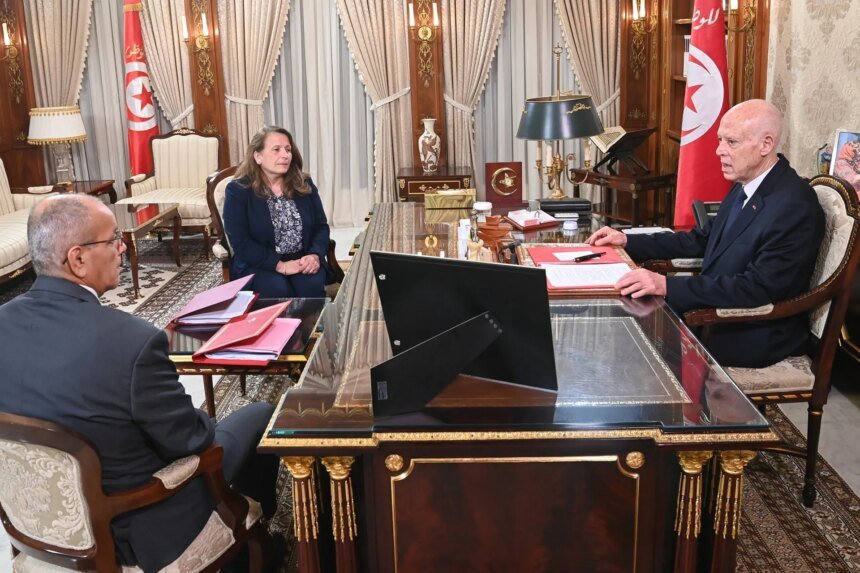
Today, Tuesday, Tunisian President Kais Saied dismissed Energy Minister Fatima Thabet, in a “surprising” move that comes ahead of an expected vote in Parliament on renewable energy projects that are sparking escalating political controversy.
Saeed said that he assigned the Minister of Equipment and Housing, Salah al-Din al-Zouari, to temporarily supervise the Ministry of Energy, without providing direct reasons for the dismissal decision, according to what Reuters reported.
Thabet was dismissed from her duties after more than two years in office since January 2024.
During a meeting with Prime Minister Sarah Al-Zanzri two weeks ago, Saeed criticized a number of officials, stressing the need to “conduct many reviews” in government and administrative work, within the framework of improving the state’s overall performance.
He added that a number of officials were chosen based on previous commitments and pledges, considering that those who did not adhere to them would be compensated with other competencies, without mentioning specific names. According to what was reported by Anatolia Agency.
Projects in the renewable energy sector
The dismissal step coincided with the government’s efforts to pass a package of projects in the renewable energy sector, which is scheduled to be presented to a vote in Parliament later today.
The total capacity of these projects is about 600 megawatts, while the associated investments are estimated at about 500 million euros ($585 million), as part of Tunisia’s efforts to enhance clean energy production and reduce dependence on traditional sources.
However, these projects face criticism from some representatives and politicians, who described them as “energy colonialism,” expressing their rejection of the mechanisms for their implementation.
Opponents also criticized the exclusion of the Tunisian Electricity and Gas Company from these contracts, considering that awarding them exclusively to foreign companies raises questions about economic sovereignty.
For its part, the Tunisian Observatory of the Economy warned of the “risks” that threaten national sovereignty and the country’s financial balances, with regard to awarding tenders for electricity production from renewable energies, according to the Tunisian Africa News Agency.
This controversy comes at a time when Tunisia seeks to attract foreign investments in the energy sector, in light of economic challenges and increasing pressure on public finances.