In the spring of 1982, former British Foreign Secretary William Hague was a student at Oxford University on his way to a debate at an American university when he exceeded the speed limit. However, as soon as the American policeman heard the young man’s British accent, he smiled at him, overlooked the violation, and expressed his support for Britain in the Falklands War.
During that period, the “special relationship” between London and Washington was at its peak, as the US Department of Defense (the Pentagon) provided undeclared support to Britain in its dispute with Argentina over sovereignty over the islands, according to Hague’s article in the British newspaper The Times.
Distance does not mean the end of the relationship, but rather its transition to a more mature stage.
Today, the writer believes that those friendly feelings have faded, pointing to an internal Pentagon memo stating that the White House is considering reevaluating its diplomatic support for what are known as European “imperial possessions,” such as the Falkland Islands.

Upcoming visit
While the memorandum is seen as a product of the US administration’s dissatisfaction with the United Kingdom’s refusal to join the war on Iran, Hague also believes that it comes in the context of the deterioration of European-American relations over the past years.
Read also
list of 2 itemsend of list
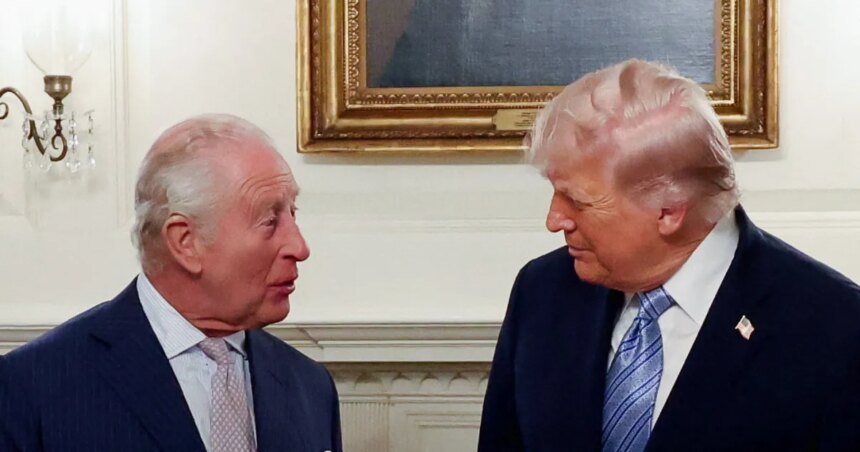
British newspapers were full of analyzes about the future of the relationship, coinciding with the visit of British King Charles III to the United States on Monday – a four-day visit – and the effects it could have on the course of relations between the two allies.
While Hague calls for the continuation of the British-American relationship on new terms, Gideon Rachman, chief foreign affairs commentator for the Financial Times, believes that the relationship between Washington and Europe as a whole is going through an unprecedented stage of tension, which may have serious consequences.
This report presents the authors’ analyses, along with the point of view of Andrei Kortunov, an expert in the “Valdai International Dialogue Club,” as contained in an article entitled “Let NATO Rest in Peace” published by Al Jazeera Net.

“More mature” stage
Hague offers a less pessimistic view than the other two essays, acknowledging that the “special relationship” between Britain and the United States has eroded, but not ended.
He likens the relationship between the two countries to two close friends who moved to live in different regions. The United States is increasingly moving towards confronting Chinese influence, while Britain is strengthening its connection with Europe to confront the Russian threat.
This shift is normal in international relations, as priorities change over time
In his opinion, this distance does not mean the end of the relationship, but rather its transition to a “more mature” stage.
Hague believes that this shift is natural in international relations, as priorities change over time. After the two countries brought together common goals during the world wars and the war on terrorism, these interests began to diverge, not only during the era of US President Donald Trump, but also since the administration of former President Joe Biden.

The writer does not hold Washington fully responsible, pointing out that Britain itself has changed and become weaker militarily and economically, and is no longer able to perform the role of a strong ally as before.
Accordingly, the writer presents his vision for a new relationship based on three axes:
- First, Britain should strengthen its independence, especially in the areas of defense and technology, through investment and reducing dependence on the United States.
- Second, avoid becoming hostile or sentimental toward Washington, and maintain a pragmatism that serves national interests.
- Third, adherence to special British values, especially in the face of what he sees as a moral decline in some aspects of American political life.

“unhappy marriage”
As for Rachman, he says that for the first time in his life, it has become possible to imagine that the American military presence in Europe may end.
He points out that the war in Iran revealed the depth of the differences, after European countries expressed reluctance, and sometimes refusal, to use their bases in American operations, which angered the Trump administration, which questioned the feasibility of the continued American military presence in Europe.
The Europeans are also angry, feeling that Washington ignored them and launched an “ill-planned and illegal” war, which has eroded confidence in American leadership.
But on the other hand, the writer confirms that the Europeans are angry as well, as they feel that Washington ignored them and launched an “ill-planned and illegal” war, which led to the erosion of confidence in the American leadership.
Rachman emphasizes that this crisis comes within a broader context of deteriorating relations, which included the imposition of American customs duties on allies, and American threats to seize Greenland, which prompted European public opinion to view the United States as a source of threat rather than as an ally.
However, he warns that talk of a complete “divorce” ignores the deep intertwining of interests between the two countries.
On the one hand, the United States still relies on its bases in Europe to manage its military operations, especially in the Middle East.
On the other hand, Europe relies heavily on the American security umbrella, especially in the face of Russia, as it lacks necessary capabilities such as air defense, intelligence, and military transportation.
The author concludes that the two parties are stuck in an “unhappy marriage”: Europe is angry but unable to give up American protection, and the United States is upset but cannot give up its strategic position on the continent.
Despite the escalation of hostile rhetoric, the cost of complete separation is still very high, making the relationship continue, but in more fragile and dangerous conditions than ever before.

Security necessity
Andrei Kortunov agrees with Rachman’s point of view, noting that the North Atlantic Treaty Organization (NATO) as a whole is going through a deep structural crisis, and that its problems are the result of “accumulations extending over many years.”
He asserts that the alliance has become a “victim of its own success” with its geographical expansion and the complexity of its management as “the largest military-political bloc in human history.”
Kortunov does not expect relations to collapse soon, as Europe still relies on the United States as its “largest partner.”
In his opinion, Trump’s hostile approach towards his allies not only made the situation more complicated, but also revealed fundamental contradictions within the alliance and made them “more present and public,” as he put it.
Despite this, the writer does not expect relations to collapse soon, as Europe still depends on the United States as its “largest partner,” which will keep the alliance in place despite the escalation of separatist tendencies within it.
Conclusion
In conclusion, “divorce” does not seem imminent, but it is no longer as impossible as it was before.
Between the erosion of trust, the divergence of priorities, and the rise of pragmatic calculations, Western relations are entering a sensitive transitional phase. The alliances may not collapse, but they will not return to what they were, according to the analyses.