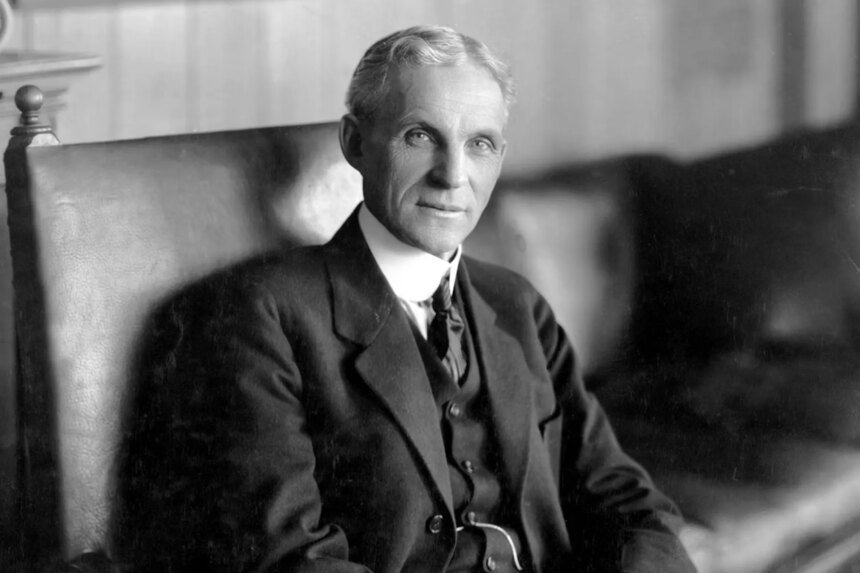
One of the most prominent industrial pioneers of the twentieth century, he is an American businessman and engineer who contributed to a radical transformation in the automobile industry and modern industrial production. His name was associated with the founding of the Ford Motor Company, and with his success in transforming the automobile from an expensive product reserved for the wealthy into a practical means of transportation within the reach of the middle class, through the development of mass production methods and moving assembly lines.
Birth and upbringing
Henry Ford was born in 1863 on his father’s farm in Dearborn, Michigan, USA, into a middle-income family that relied on hard work in rural life. Ford grew up in an agricultural environment that required a lot of hard manual labor, but from a young age his interest was directed more towards machines and mechanics than agriculture.
Ford noted in his memoirs, “My Life and Work,” that witnessing exhausting work on farms prompted him to think early about more efficient ways of doing work, which strengthened his interest in studying mechanics. During his childhood, iron tools and simple mechanical parts were a source of passion, joy and discovery for him.
Henry Ford did not show much interest in traditional studies or elite paths. Rather, he aspired to work in a field that provided a broad service to the largest number of people, and he saw in mechanics a practical way to achieve this. When he was thirteen years old, he became interested in repairing watches and mastered this skill early.
Despite his father’s desire for him to inherit the agricultural profession, Ford did not show interest in this path, as his true passion was to understand and work on machines. When he was seventeen, he left school and joined the Dry Dock Engine Works Company. He also worked at night in a jewelry store to repair watches, investing in his precision and interest in fine mechanical work.

Steam engine the beginning of the road
The features of Henry Ford’s practical path began to take shape from his early childhood, when, at the age of twelve, he encountered a steam engine during a trip to Detroit, an event that he later considered a turning point in his life.
That engine represented the first means of transportation he saw that did not depend on horses, which sparked his curiosity and prompted him to try to understand its working mechanism and imitate its design through small models that he made himself, before he was later able to develop a model that worked well.
In 1879, Ford began his actual practical steps by working with a local representative of the Westinghouse Company in the field of installing and repairing automatic engines. During this experiment, he gained important technical knowledge, but he was not convinced of the reality of the steam engines available at that time because of their heavy weight and high cost, as they were limited to owners of large farms. Therefore, he began thinking early on about inventing a lighter, more practical vehicle or machine that could perform heavy work and be accessible to a larger number of people.
Despite his interest in steam engines, Ford realized the limitations of their use in the United States of America, whether due to poor road infrastructure or their high economic cost, which prompted him to search for more efficient alternatives. He only lasted a year at Westinghouse, as he felt he had absorbed what could be learned from tractors and large engines.
Later, his professional curiosity led him to learn about the Otto gas engine, after reading about it in a scientific magazine during his training period. In 1885, he had the opportunity to repair one of these engines at Eagle Iron Works in Detroit, which allowed him to study the new technology closely.
Only two years later, he succeeded in manufacturing a four-cycle engine inspired by Otto’s model, in a step that reflected his transition from a mere repairman to an innovator seeking to understand technical principles and reproduce them in practice.

The birth of the first car
After years of work and experimentation, Henry Ford returned to his father’s farm with a clear ambition to establish his own mechanical workshop. Despite his father’s attempt to steer him away from this path by offering to give him forty acres of land in exchange for giving up his passion for mechanics, Ford initially agreed in search of a measure of financial stability after his marriage, but he soon returned to the world of mechanical experiments again.
In 1890, Ford resumed work on developing engines, and he was able to design a double-cylinder engine, a step that paved the way for the completion of his first car, which came in a form close to traditional horse-drawn carriages, but operated with independent mechanical power.
Ford used his first car for approximately 1,000 miles between 1895 and 1896, before selling it for $200 to Charles Ainslie of Detroit, the first sale of a car he built himself. However, his goal was not commercial as much as it was a practical test of his idea, as he soon began thinking about developing a new, more efficient model.
In 1896, Ford began manufacturing a second car similar to the first, but lighter and more advanced. At that stage, the idea of a horseless carriage still seemed strange to investors and businessmen, and many did not see the car as an industrial project with a promising future.
Despite the limited capabilities, Ford embarked on his major professional adventure on August 15, 1899, when he entered the field of automobile manufacturing more seriously. Due to a lack of funding, he agreed to have the model he designed manufactured by the Detroit Automobile Company, which later became Cadillac, while he served as chief engineer.
However, the project did not achieve the success it aspired to. For three years, the company continued to produce limited-number cars based on his first design, without achieving significant spread. In March 1902, Ford made a decisive decision to submit his resignation, preferring to go through his experience with complete independence, away from administrative restrictions.
After that, he rented a small, modestly built workshop, but for him it represented a space of complete freedom for experimentation and innovation. There he spent two continuous years transforming the place into a practical laboratory for developing a four-cylinder engine, laying the first foundations for his major industrial project.

In 1903, Henry Ford founded the Ford Motor Company, with the clear goal of producing practical cars that could be used daily by as many people as possible.
At the beginning of the company, he worked on developing two models, one of which bore the name “999” and the other the Arrow, with a clear focus on speed and performance, in an attempt to prove the efficiency of new cars and their ability to compete with traditional means of transportation.
Although his name was associated with the company, Ford was not initially the ultimate decision-maker within it; He held the position of vice president in addition to his duties as a designer and mechanic, while his share did not exceed a quarter of the company’s shares, which limited his administrative influence. But this reality gradually changed, and by 1906 he was able to increase his share to 51%, before raising it later to 58%, so that he had the strongest say in managing the company, while his son Edsel acquired the remaining percentage in 1919.
In the same year in which the company was founded, Ford launched its first commercial vehicle under the name Model A, offering it at a price of $850, supported by an advertising campaign that clearly expressed Henry Ford’s industrial philosophy. The marketing message focused on providing a simple, safe car suitable for daily, family and professional use, far from complexity or exaggerated speeds, and that can be accepted by men, women and children alike.
In the following years, the company continued to develop new models. Between 1905 and 1906, it produced more advanced cars, including an expensive four-cylinder model, as well as a less expensive model. However, the real transformation came in 1908 with the launch of the Model T, which later became a milestone in the history of the automobile industry, not only because of its performance, but also because of its continuous decline in price, which made it accessible to a wide segment of Americans.
The price of a car gradually declined from $825 in 1908 to $690 in 1911, then to $490 in 1914, and the decline continued until it reached $290 in the 1920s, a price that became close to the cost of buying a horse at that time.

Thus, the car was transformed from an elite commodity into a means of transportation available to the middle class, which gave Ford a growing share of the American market, reaching more than 60% in the early 1920s.
The company’s success was not limited to cars only, but also extended to the manufacture of agricultural tractors, which became an essential part of the work tools on American farms. Henry Ford’s name was also associated with a revolution in industrial production methods, after he introduced moving assembly lines into the company’s factories in 1913, a mechanism that reorganized work inside the factory in an unprecedented way.
Instead of workers gathering around the car during its manufacture, the product moved through a sequential production line, in which each worker performed a specific and repetitive task, which contributed to increasing production, reducing costs, and accelerating manufacturing.
This model was based on the ideas of work organization developed by Frederick Taylor, in which Ford found an effective way to streamline industrial processes and expand employment opportunities, even for workers with limited skills.
With the expansion of his company’s influence and the success of his industrial experiment, Henry Ford gained worldwide fame within a short period, and he became one of the most influential names in the world of industry during the twentieth century.

Policy controversy
Henry Ford’s political positions in the 1930s sparked widespread controversy, especially regarding his relationship with Nazi Germany and his position on World War II. He was known to reject the United States’ entry into the war, and he did not hide his intellectual affinity with some German trends in that period.
In July 1938, Ford accepted the highest decoration that Nazi Germany granted to foreigners, in a move that reflected the amount of official appreciation he received from the German regime at the time.
On the industrial side, historical reports covered by the Washington Post indicated that the German branch of Ford was one of the most prominent suppliers of trucks to the German army, coming in second place after General Motors, which reflected the industrial role played by major automobile companies in supporting the military logistical infrastructure at that stage.
Research documents, including what was known as the Schneider Report preserved in the US National Archives, also covered information indicating the existence of commercial arrangements that provided Nazi Germany greater access to some strategic raw materials, including rubber, through deals linked to American industrial companies.
In the same context, researcher Snell referred to a testimony he attributed to Albert Speer, Minister of Armaments in Nazi Germany, in which he spoke about the importance of foreign industrial technology in supporting German military capabilities.

In June 1940, accounts from Ford’s associates stated that he used his influence to reject a US government-backed plan to produce Rolls-Royce engines for British fighter aircraft, a position framed as his objection to direct American involvement in the war.
On the other hand, press reports, including those published by The Atlantic, indicate that Adolf Hitler denied receiving any direct funding from the Ford Company, but he did not hide his strong admiration for Henry Ford, as he considered him an influential and inspiring figure from the perspective of his political and economic vision.
Ford and Nazi Germany
The relationship between Ford and Nazi Germany has roots dating back to the 1920s and 1930s, a period that witnessed widespread competition between American automobile companies to enter the German market, which was considered economically promising. At the same time, Adolf Hitler showed great interest in the American industrial production model, particularly the methods of mass industrialization that were associated with Henry Ford.
According to researcher Neil Baldwin in his study of Henry Ford and the Jews, Ford represented a striking model in the eyes of Hitler since the beginnings of his political activity in the city of Munich in the early 1920s, as he was influenced by the image of an industrialist capable of combining economic influence with public discourse.
Historian Norman Cohen also suggested that Ford’s writings may have been among the factors that contributed to the wider spread of what was known as the Protocols of the Elders of Zion.
During that period, Henry Ford published, through the Dearborn Independent newspaper, a series of articles that dealt with the Jews, and contained contents that were later described as anti-Jewish. They received attention and follow-up from Hitler, who referred to Ford with admiration in the second part of his book Mein Kampf, and considered him a strong figure who, in his view, confronted the influence of the Jews.

Historian Andrei Kaspi notes that the press campaign associated with the Ford name suddenly stopped in January 1922, after it began to negatively affect the image of the Ford brand, in addition to economic and media pressures, including threats from Hollywood movie producers to show Ford T cars in accident and rollover scenes, which might harm the company’s reputation.
However, the articles were published again in 1924, before the issue turned into legal disputes that ended years later in the courts. Ultimately, Henry Ford issued a formal apology in a lengthy letter and paid damages for the issues related to those publications, in an attempt to contain the repercussions to his public image and his company.
Death
On April 7, 1947, Henry Ford died at the age of 83 at his home in Dearborn, Michigan.