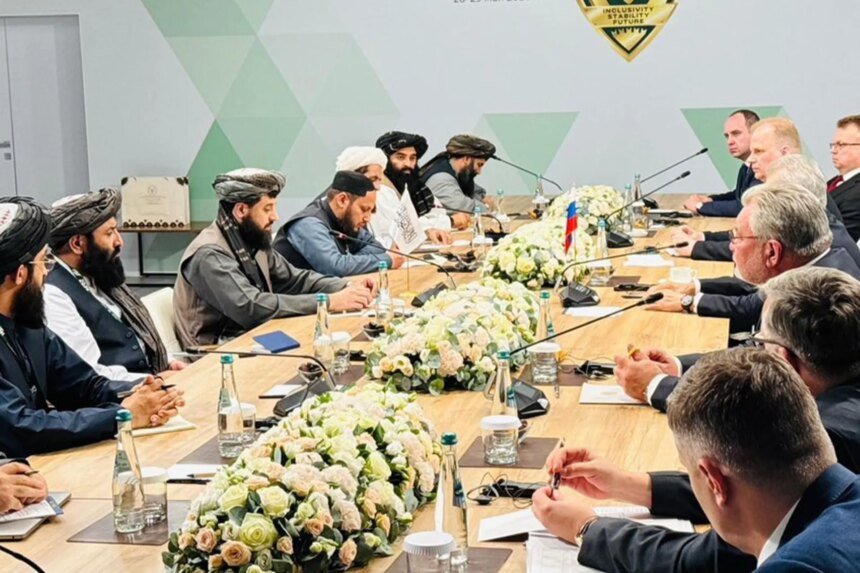
cable- The participation of Afghan Defense Minister Muhammad Yaqoob Mujahid in the International Security Forum in Moscow from May 26 to 28, 2026, opened the door to questions about the nature of the transformation witnessed by relations between Russia and the Afghan government, and whether this step represents a transition from the level of political and diplomatic communication to a more advanced stage of security and military coordination.
The visit is of particular importance as it is the first foreign move by the Afghan Defense Minister since the Taliban returned to power in August 2021. It also comes in the context of the escalation in the pace of communication between Moscow and Kabul in recent months, amid regional transformations that have prompted various powers to reread the Afghan scene from a security and strategic perspective.
It witnessed a meeting between Yaqoub Mujahid and Secretary of the Russian National Security Council, Sergei Shoigu, which discussed bilateral relations and a number of files of common interest, in a move that observers considered an indication of a mutual desire to advance the relationship to levels beyond traditional diplomatic channels.

Military cooperation
According to a statement by informed sources to Al Jazeera Net, who preferred to withhold their identity, the Afghan minister was able to convince Russia to provide his country’s government with advanced air defense equipment. She added that discussions in this regard had previously taken place between the two sides, but the recent visit to Moscow witnessed a push towards implementing the agreed upon commitments. She also explained that the agreement also includes ground military armaments and training programs for Afghan forces.
This document was signed in Moscow in the presence of Shoigu and Yaqub Mujahid, in a step described as a qualitative expansion in the nature of military cooperation between the two sides. This is the first time since the tensions with Pakistan and the emergence of challenges in the Afghan air defense system that Yaqoub Mujahid has signed a military and technical cooperation agreement with a regional country.
Analysts believe that Moscow views Afghanistan as an essential part of the Central Asian security equation, in light of continuing Russian fears of the expansion of armed organizations and the repercussions of any security disturbance on its allied republics in the region. It appears concerned with building direct security channels with Kabul, based on a pragmatic approach based on dealing with the existing authority as a party that cannot be bypassed in regional stability arrangements.
Aziz Jalal, a specialist in Central Asian affairs, believes that the increasing openness between Moscow and Kabul reflects a broader pragmatic shift in the approach to regional security in Central Asia, as the countries of the region are gradually moving towards integrating Afghanistan into the equations of security understanding instead of keeping it outside strategic calculations.
He explained to Al Jazeera Net that this transformation is not only related to the development in bilateral relations, but also reflects a growing regional awareness that the stability of Central Asia cannot be separated from the situation inside Afghanistan.
He added that Kabul’s participation in international security events and forums represents an indication of a growing desire to reposition itself within the regional environment, providing opportunities to build broader channels of cooperation in border security issues, combating cross-border threats, and managing common risks.
Growing relationships
According to Jalal, the Russian approach in this context opens an important window to reformulate balances in the region, as it is based on dealing with the Afghan reality as an effective element in regional security, and not just an isolated file. It is considered that this trend, if it continues within clear institutional frameworks, may contribute to enhancing regional stability and opening the way for more realistic and effective cooperation arrangements within the regional system.
He pointed out that this path may push Central Asian countries to adopt more flexible approaches towards Kabul during the next stage.
The Afghan government enjoys growing relations with Russia, as recent years have witnessed mutual visits by official delegations, in addition to Moscow keeping its diplomatic channels open in Kabul.

Russia is among the few countries that have not closed its embassy in Kabul after 2021. It also signed an economic agreement with the Afghan government in 2022 related to securing part of Afghanistan’s oil, gas, and wheat needs. However, Moscow and Central Asian countries continue to repeatedly express concern about the presence of armed groups in Afghanistan, while the Afghan government confirms that it has made progress in dismantling these networks.
In this context, Yaqoub Mujahid said on the sidelines of his participation in the forum: “We have achieved important achievements in dismantling networks of sedition.” He stressed that the government will not allow the use of Afghan lands against any other country. However, these guarantees are still – according to observers’ estimates – insufficient to remove all existing regional concerns.
Shoygu also announced – during the forum – that Moscow is working to build a “full partnership” with the Afghan government, and encourages countries in the region to expand cooperation with it, within the framework of a broader regional approach to managing the Afghan file.

Important post
Russian President Vladimir Putin had confirmed – in previous official statements reported by RIA Novosti in 2024 – that maintaining relations with the Taliban is important for changing the situation in Afghanistan, indicating that the country is now completely under the movement’s control, and that effective influence requires a direct relationship with the leadership in Kabul.
On the other hand, participation represents an opportunity for the Afghan government to demonstrate its presence in an international security forum that includes dozens of delegations, and to send a message that it seeks to engage in regional discussions related to security and stability, which may contribute to alleviating its external isolation.
For his part, political affairs researcher Ghouth al-Din Amiri believes that the Afghan Defense Minister’s participation in the forum reflects a continuing gradual shift in Kabul’s foreign policy approach, towards greater pragmatism and openness to regional actors, instead of being limited to managing internal files.
He told Al Jazeera Net that this path reflects an attempt to present the Taliban as a security party that can be dealt with in border issues and combating passing threats, but he pointed out that this openness is still in its early stages, and needs a broader and more stable political environment in order to transform into long-term institutional cooperation.
However, observers rule out that this rapprochement will lead, in the near term, to comprehensive international recognition of the Afghan government, considering that Moscow is adopting a realistic approach governed more by regional security calculations than by considerations of full political recognition.
Conditional convergence
Political analyst Rashid Mesknyar believes that this increasing rapprochement reflects a mutual repositioning in the strategic calculations of both parties, as the Afghan government seeks to expand the margin of indirect recognition and involvement in regional tracks, while Moscow deals with the Afghan reality from a pragmatic security perspective imposed by considerations of regional stability.
He added to Al Jazeera Net that this rapprochement may give Kabul a wider diplomatic space, but it remains governed by the complexities of the international system and the differences in the positions of the major powers.
For his part, the professor of international relations at Kabul University, Sibghatullah Al-Kozi, considers that what relations between Moscow and Kabul are witnessing represents a gradual redefinition of the nature of interaction in the Central Asian space, as it is no longer measured solely by the criterion of political recognition, but is now shaped around common security interests and the management of regional risks.
He assured Al Jazeera Net that the future of this path will depend on the extent of the ability of both parties to transform current communication channels into more sustainable and clear institutional cooperation frameworks.
It is noteworthy that the International Security Forum in Moscow witnessed the participation of more than 180 international delegations from various regions, including the countries of Central Asia (Kazakhstan, Uzbekistan, Tajikistan, and Kyrgyzstan), in addition to China, Iran, a number of member states of the Shanghai Cooperation Organization, and delegations from Asia, Africa, and Europe.
It is a major annual platform organized by Russia through the National Security Council to discuss international and regional security issues, most notably the fight against terrorism, Central Asian security, and military cooperation between countries.