Tripoli In a Libyan scene burdened by division and faltering experiences, the international movement is returning to the forefront with new momentum led by Washington, relying on a UN umbrella and a mini-negotiating formula intended to break the prolonged stalemate.
Between promises to relaunch the electoral process and fears of bypassing existing institutions, these moves raise fundamental questions about the nature of the American role and its limits, and whether they pave the way for a real breakthrough in the Libyan crisis or reproduce it with different tools.
The new American initiative aims to break the political and structural blockage that has characterized the Libyan scene for years, and places at the top of its priorities the unification of the executive authority and the military institution and the unification of public spending between the two parts of the country.
Data indicate that the initiative recorded initial progress on some tracks, especially the issue of unifying public spending for the first time in 13 years, which was described in circles as breaking the state of financial fragmentation, in addition to the participation of military units from both parties in the Flintlock 2026 exercises organized by AFRICOM in the city of Sirte, in a move that carried indications of the gradual opening of military communication channels within a scene that is still under formation.

Mini dialogue
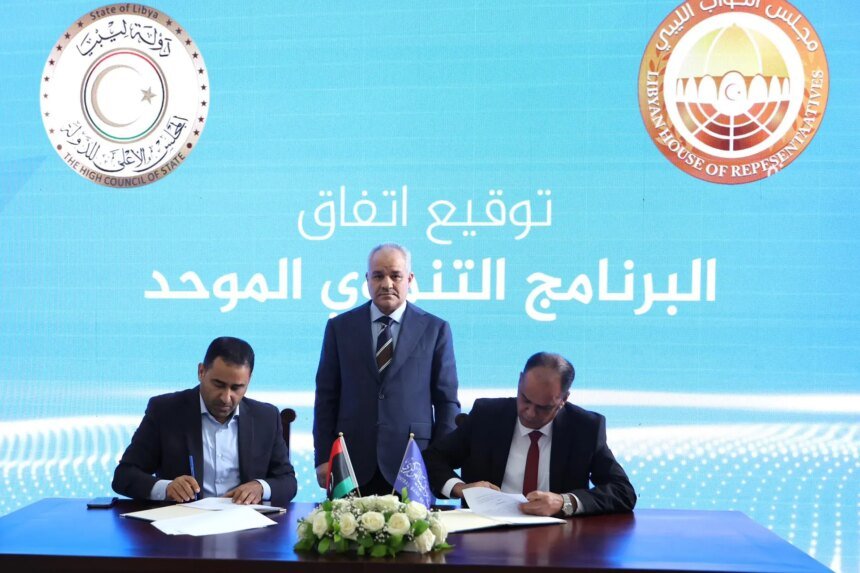
The initiative stipulated the formation of a mini-committee that includes four representatives of the Prime Minister of the Unity Government, Abdul Hamid Al-Dabaiba, namely Walid Al-Lafi, Mustafa Al-Manea, and Abdul-Jalil Al-Shawish. In return, representatives from the East are also present, headed by the Deputy Commander-in-Chief of the Army, Saddam Haftar, Abdul Rahman Al-Abbar, and Al-Shaibani Abu Hamoud.
The work of this table is devoted to a package of files, the most important of which is restructuring the Board of the Election Commission and agreeing on electoral laws.
In an interview with Al Jazeera Net, the spokesman for the UN mission, Muhammad Al-Asadi, believes that this step came due to the House of Representatives and the State’s failure to make any progress – despite the passage of 8 months of consultations – in implementing the first two steps of the UN road map announced by envoy Hannah Tetteh in August 2025.
He added that this prompted the mission to activate the alternative announced by the UN envoy to the Security Council last February, which proposes overcoming the blockage and advancing the electoral process by addressing the election laws and completing the Election Commission Council based on the recommendations of the Advisory Committee.
Differences in attitudes and opinions
Member of the House of Representatives, Issam Al-Jahani, says that this initiative, which began through the economic track before extending to the security and military side, and then was followed by a third track, represented by proposing the formula of the mini-committee known as (4+4), which includes representatives from eastern and western Libya, came against the backdrop of political impasse.
In an interview with Al Jazeera Net, Al-Jahani described these steps as political realism – despite the reservations surrounding them – and the absence of clear alternatives that can be built upon at the present time, praising the UN mission’s movements even if they appear slow.
He pointed out that the paths of structured dialogue and committees did not lead to decisive results, but the mission’s adoption of this initiative during the UN envoy’s recent briefing before the Security Council is a precedent, even if rejecting positions were issued by some parties.
As for Member of the State Council, Ahmed Lenqi, in his speech to Al Jazeera Net, he called for cautious dealing with international initiatives and subjecting them to careful and careful studies in a way that ensures that the national interest is taken into account and the preservation of sovereignty.
Lenqi pointed out the need for the House of Representatives and the State to participate alongside the political elites in this path, as the Constitutional Declaration and the Political Agreement have previously been subject to amendments and new amendments can be introduced to them with the consensus of the two Houses, if the political settlement requires that.
External dictates
For her part, State Council member Amina Al Mahjoub expressed in an interview with Al Jazeera Net her rejection of the initiative as presented, noting that the Council is not closed to any path of political dialogue, but is committed to the solution coming from Libyan legitimate bodies away from external dictates.
Al-Mahjoub also pointed out that the State Council voted to refuse to enable any external parties or international missions to choose their representatives in the mini-table – in reference to the member of the State Council and representative of the unity government in the mini-table discussions, Abdul Jalil Al-Shawish, whose membership the Council voted to freeze if he participated in this table – stressing that dealing with the Council is through its official institutions and not through individual names.
During his meeting with UN envoy Hannah Tetteh, the head of the Presidential Council, Mohamed Al-Menfi, expressed his reservations about the foundations on which the mini-committee (4+4) was built, stressing the necessity of a clear separation between the United Nations track and any parallel tracks, and adherence to the terms of reference of the road map and the political agreement, according to the media office of the President of the Council.
Current challenges
In his reading of the nature of the challenges surrounding the initiative, Member of Parliament Ali Al-Soul said in an interview with Al Jazeera Net that this path faces a number of challenges, most notably what he called military alignments, warning that these balances may lead to confusion or faltering of the path.
He pointed out the presence of unnamed parties with connections and agendas led by armed formations, which, in his estimation, will seek to obstruct the initiative for fear that its success will lead to its exclusion from the scene or expose it to accountability.
Political analyst Muhammad Mutairid, speaking to Al Jazeera Net, believes that the American initiative supervised by the mission has made progress in files that have remained outside the scope of actual solutions for years, primarily the financial and military tracks.
He pointed out that the initiative sponsored the step of unifying the budget, followed by organizing the Flintlock 2026 maneuvers with the participation of military units that brought together the Libyan parties, while previous approaches focused on managing the political track through interactive formulas and expanded committees in the East and West without leading to real results.
As for political analyst Muhammad Mahfouz from Tripoli, he considered, in his interview with Al Jazeera Net, that reducing the political path to two specific figures, Abdul Hamid Al-Dabaiba and Saddam Haftar, does not reflect, in his estimation, the complexity of the scene nor the actual balances of power on the ground.
Multiple powers
He explained that there are multiple forces, including military formations in the West, the Presidential Council, and the State Council, in addition to parties in the East, that have the ability to disrupt any path that does not enjoy broad consensus, which makes limiting the solution to specific names a factor that may exacerbate the levels of objection to the initiative instead of facilitating its passage.
The diplomat and Minister Plenipotentiary in the Ministry of Foreign Affairs of the Unity Government, Adel Issa, considers that the American role in the Libyan file is moving within a dual pattern that combines work within the international framework and direct communication outside some of its paths, in parallel with regional and international coordination that includes parties such as Egypt, Turkey, and Saudi Arabia.
He explained that Washington did not adopt a declared leadership for the Libyan file, but it exercises political and diplomatic influence, with a preference to work through the umbrella of the United Nations and in a way that allows the proposed understandings to be passed within a diplomatic formula that reduces the intensity of objections, according to his statement to Al Jazeera Net.
Issa pointed out that the Libyan crisis has been linked for years to external interference and internal division that undermined the ability of the Libyan parties to manage their differences away from international influences, but this approach, according to his belief, is based on linking the economic and military tracks to the political track and adopting diplomatic pressure mechanisms to support elections and unify institutions. This reduces the margin of international competition within the Libyan arena.