Published on 6/13/2026
|
Last update: 15:02 (Mecca time)
“Under the window on the 28th floor, the new Daria unfolds. The Daria does not look like the one we knew in old photos: facing glass towers, hanging gardens, skyways with silent vehicles passing by, and trees planted according to geometry that takes into account the direction of the wind. There is no trace of a scar here, or so it seems from this height. Everything is carefully rearranged, even the sky seems closer, as if it were part of the project.”
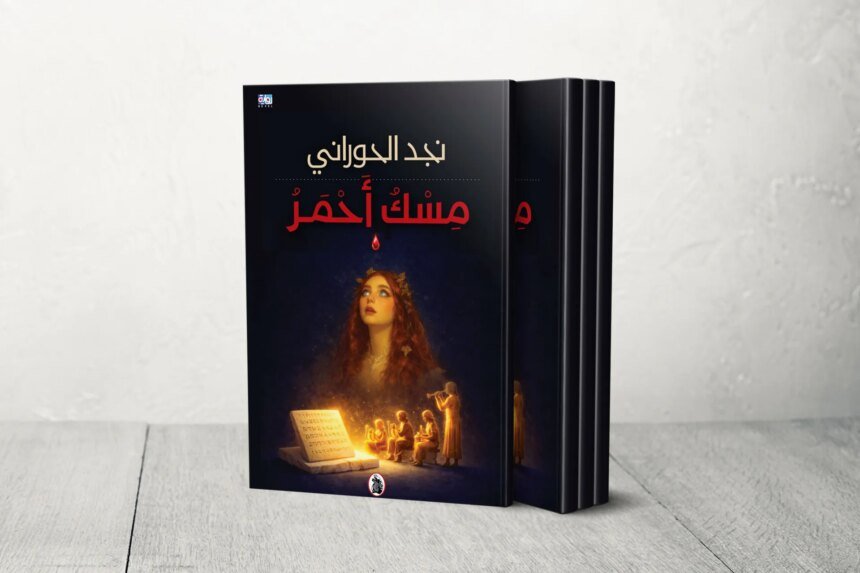
With this forward-looking scene from the year 2051, Alma overlooks the city of Daraya in the Damascus countryside. The city that was transformed by the brutal machine of the previous regime into deserted ruins, abandoned by life. It is a bold future leap with which the Syrian writer Najd Al-Hourani wanted to open her novel “Red Musk,” to place the reader from the beginning before a literary vision of a city from which the dust of war has been dusted off, and whose architecture and memory have been reshaped in a way that raises profound questions about the meaning of reconstruction and the limits of forgetting.
The novel – which extends over 191 text pages and nearly half a century in time – attempts to employ this future horizon to present a different approach to Syria after the era of the Assad regime, through the biography of a family and generations of characters whose lives intersect with the country’s major transformations.
Read also
list of 2 itemsend of list
As Hourani traces the fates of her characters, the narrative moves between memory and the future, between the effects of devastation and the seduction of new beginnings, to explore how a society emerging from a long war can rebuild itself. Not only at the level of quarantine, but at the level of relationships, culture and collective memory.
Daria between reconstruction and alienation
The novel relies on the technique of multiple voices and narrators. Mother Salma, daughter Alma, and Salma’s former fiancé Ahmed are the three main characters and narrators, all of whom hail from Daraya.
The first chapter begins with Alma’s return to her city after graduating from medical school in France in the year 2051. Through her, we get to know the new Daria with tall towers and sweet, fragrant scents, and to Salma’s family, who chose to return to Syria after decades of exile in Paris to establish a new life.
My pain sheds light on very sensitive areas in Syrians’ perception of the future. Between the decision to return to the homeland and participate in building it, and remaining in exile, Alma’s choice remains suspended. But her mother, Salma, seems more clear and decisive. Alma quotes her saying: “It is Salma’s deep call to contemplation: that we live between generations, not just as passers-by, but as those who contribute to the continuation of existence… She wants me to put the burden of my knowledge in her hands to plant a seed in the land of musk, instead of it being planted in the land of foreigners.”
Regarding this existential call, the writer Najd Al-Hourani declares to Al Jazeera Net, saying: “It is the duty of literature to remind the Syrians of the extent of the sacrifices that were made to reach this historical moment, and one of the manifestations of fulfillment of those sacrifices is by contributing to the return and rebuilding of what was destroyed, especially since many Syrians gained valuable experiences in the diaspora.”
It is the duty of literature to remind Syrians of the extent of the sacrifices that were made to reach this historical moment, and one of the manifestations of fulfillment of those sacrifices is to contribute to the return and rebuilding of what was destroyed, especially since many Syrians gained valuable experiences in the diaspora.
The tragedy of loss
From the threshold of the future, Al-Hourani suddenly takes us back to the past, this time with Salma, who in her youth embarks on a school trip to the archaeological site of Ugarit, where the first alphabets of humanity are located. In a poetic scene, we see Salma absorbing the details of the ruins, then moving on to talk about her emotional longing for Ahmed, who “became a crack in the light, and a window into another galaxy.”
It is only a few pages before the war begins to beat its disastrous drums, with its fires reaching the very center of Salma’s house, who was forced to flee to a closed school “because her new mission is no longer teaching the alphabet, but rather drawing a clear path towards death.”
As the scope of the conflict expanded, Daraya turned into a target for the regime’s military machine, whose shells fell indiscriminately. At the crossing checkpoint towards safety, a regime member shot her younger sister, Alma (7 years old), with a treacherous bullet, killing her. At that tragic moment: “Everything froze… as if the whole city decided to look at us in cold silence.” At that moment, Salma realized with sadness that they were no longer a cohesive family, but rather a mere “torn bag.”
Hope for small victories in exile
The bitterness of loss led the family members to take a trip to the sea, seeking refuge. During that terrifying journey, Abu Salma died, so she had to say goodbye to his painful body, under duress, so that the “balam” (rubber boat) would not sink.
Salma and her mother arrived in France with half their family, and began an arduous journey to gather the bleeding soul from the loss of her sister and father, Ahmed (the preacher who disappeared in the regime’s prisons), and Syria as a whole. A journey that did not stabilize until 2023, when she launched her first fashion collection in Paris.
Despite the euphoria of this small victory, memories of the past kept interrupting her. Even after she overcame her passion to marry another man (Ziyad), she continued to feel an inner pain similar to “betrayal” of her old covenant with Ahmed. However, the will of hope prevailed and gave birth to a new Alma, in memory of her baby sister.
“Reasonable love” and reclaiming the roots
Al-Hourani leads us once again to the point of looking forward to the future (2051). Where young Alma meets “Zaid”, a university professor coming from France for a conference in Damascus. On the way back to Daria, Zaid chooses a road that leads them to the archaeological site of Ugarit. The same place that witnessed the love story of Salma and Ahmed. There, Zaid asks for Alma’s hand in marriage, and an intellectual dialogue opens between them about the meaning of homeland after liberation.
In this dialogue, the novel summarizes its vision; The homeland, according to Zaid, is like a love relationship that has matured and weathered its storms. After the intense emotions that follow liberation, the time has come for “reasonable love” based on affection and compassion. Hence, his dream of establishing a college of languages bearing the name “Ugarit” emerges, indicating that the country’s true renaissance is based on knowledge, culture, and restoring roots, not on politics alone.
“Ahmar Musk” falls within what can be called “post-Assad era literature.” Al-Hourani emphasizes that the literature of the next stage must preserve the memory of sacrifices, and at the same time establish a new vision based on citizenship and partnership, far from the duality of “executioner and victim.”
The novel concludes with a central idea that the reconstruction of destroyed homelands does not begin with the engineering of buildings, but rather with the restoration of man himself. Love, language, and memory are the essential elements that give individuals the ability to emerge. This is why “Ugarit” is present as a symbol of a civilization that rose after the fall, and “Daria of the Future” is present as a symbolic image of Syria, which is not content with removing material devastation, but seeks with certainty to restore the conscience of the person who lived it.