Published On 4/26/2026
|
Last update: 12:02 (Mecca time)
France stands on one foot awaiting the outcome of the crippling navigation crisis in the Strait of Hormuz in light of the continuing rise in the cost of fuel, and amid internal warnings of a possible and imminent energy shortage if the crisis continues for more weeks, despite the reassurances issued by President Emmanuel Macron on Saturday.
France has developed a program to support hundreds of thousands of people affected by the rise in fuel prices in their work, at a time when ambiguity dominates the negotiations related to the conflict in the Middle East, including mainly the liberalization of navigation in the vital Strait of Hormuz, through which a fifth of the world’s oil and gas supplies pass.

‘Geopolitical uncertainty’
The continuation of the situation as it is may exacerbate the cost of exceptional government support, and may also threaten France’s energy reserves in the near term.
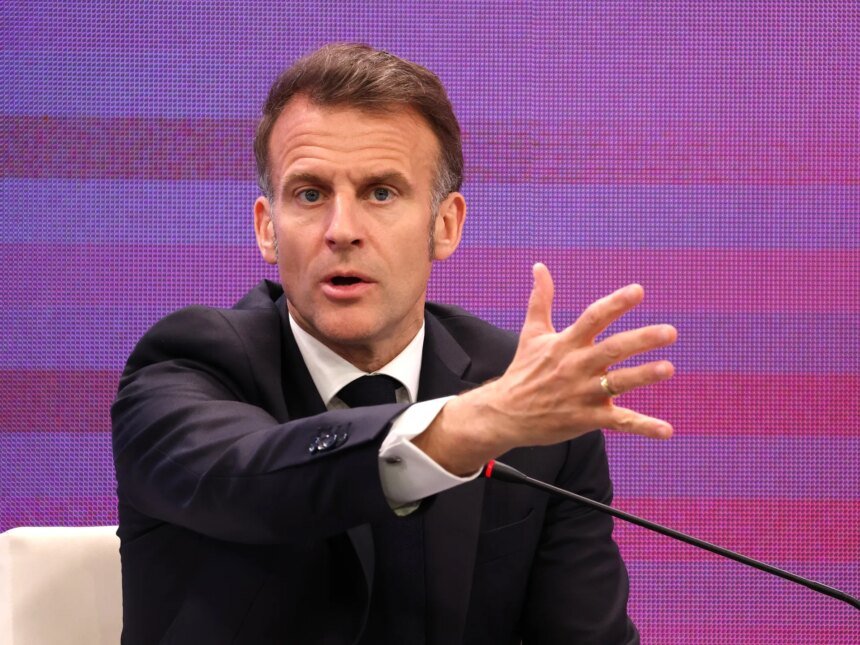
During a joint press conference with Greek Prime Minister Kyriakos Mitsotakis in Athens on Saturday, President Emmanuel Macron said that anxiety caused by “geopolitical uncertainty” could itself lead to energy shortages.
However, Macron sent a message of reassurance to the French that the “worst-case scenario” is still far away, and that the situation is still under control, and he also denied the existence of an energy shortage.
In his statements, Macron stated that the current goal is to fully reopen the Strait in the coming days and weeks in line with international law and guarantee freedom of navigation without paying fees for crossing.
The French government raised the cost of allocated fuel subsidies For May To 180 million euros, an estimated increase of 20% compared to this April, in a step to support professionals working in sectors that use the most fuel, such as agriculture, fishing, and transportation.
The government has set standards for beneficiaries of support, including a level below the average taxable income with traveling distances equivalent to 30 kilometers per day on professional tasks, and an average of 8,000 kilometers annually for health care service providers.
So far, about 3 million people have benefited from aid, yet the government is facing pressure to expand the conditions for obtaining support in light of several professional sectors being affected by the disruption of transit through the Strait of Hormuz.
Total Energies suffers losses
The government has not made longer-term plans if the Strait of Hormuz continues to be closed for more weeks. A day ago, Total Energies CEO Patrick Pouyanne warned that France could enter an “era of energy shortages” if the blockade of the Strait continued for “another two or three months.”
The French company says that it has lost 15% of its production in the Middle East due to the conflict, while Pouyanne stressed that solving the “Strait of Hormuz problem” is a “very important issue” that requires “flexibility” in the face of the blockade, pointing to investments in alternative plans such as “new pipelines” to reduce dependence on this strategic waterway.
More than a dozen countries announced their readiness to join an international mission led by France and Britain to secure navigation in the strait when conditions permit. Macron said in his statements in Athens, “We are all in the same boat, and it is not a boat we chose, so to speak. We are victims of geopolitics and this war that broke out several months ago.”

“Panama Canal” and make the most of it
Meanwhile, the suspended situation in Hormuz caused a noticeable shift in global trade flows, as the Panama Canal Authority announced a doubling of transit expenses through the canal with the rerouting of several ships.
Average prices for crossing the canal range between $300,000 and $400,000, depending on the ship. Previously, companies paid for early passage between an additional 250,000 and 300,000 dollars, but in recent weeks, the average additional prices jumped to about 425,000 dollars.
Ricawarte Vaske, the canal’s director, stated that one of the companies, whose name was not mentioned, paid an additional $4 million when its ship loaded with fuel was forced to change its destination due to geopolitical tensions, while other oil companies paid $3 million in addition to the transit price to speed up its passage in light of the rise in oil prices.
Panama’s government is “trying to get maximum revenue from the canal,” said Rodrigo Noriega, a lawyer and analyst in Panama City.