In a world where wars are raging and the clanking of weapons intersects with the repercussions of climate change and shrinking humanitarian funding, a large-scale humanitarian tragedy is unfolding in the most fragile places on Earth, where famine turns from a potential danger into a daily reality that silently grinds millions of people.
Thus, in his field investigation for the New York Times from the heart of Somalia, writer Peter Goodman paints a bleak picture of a collapsing relief system, while crises are exacerbated by the war in the Middle East and the decline in international support.
Read also
list of 2 itemsend of list
When meat and milk become a dream
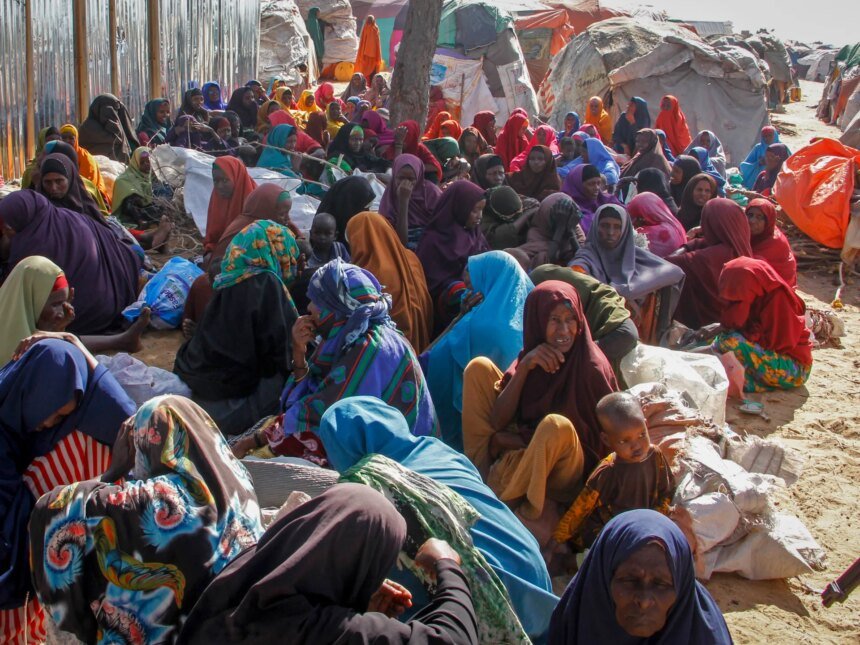
The tragedy, as monitored by journalist Goodman, begins with the details of the arduous journey of the Abdalla Abdi Abdi Abdel Rahman family, consisting of 9 members, as they traveled a distance of 224 kilometers on foot under the scorching sun through barren lands in southern Somalia in search of food to satisfy their hunger.
They were taking turns carrying their daughter, who was no more than 3 years old, on their shoulders, to escape a drought that had wiped out all their goats and sheep, which represented the misery of their lives and their life savings.
The family members traveled all this distance in 9 days towards the border town of Dollo with Ethiopia, where relief organizations are based, motivated by the hope that guided more than a hundred thousand displaced people before them.
But the surprise that awaited them when they arrived in late January at the outskirts of the town was that the relief camps had been emptied of their contents after the administration of US President Donald Trump dismantled the United States Agency for International Development (USAID), cutting off the main lifeline and backbone of humanitarian aid in Somalia.
The matter was not limited to Washington, but the fever of reducing aid extended from London to Berlin, with humanitarian organizations finding themselves faced with impossible choices that forced them to choose among the hungry. Unfortunately, the displacement camps in the town of Dollo were among the areas affected by the interruption of relief, as medicines were absent, cash grants disappeared, and medical clinics closed their doors.
In a broken tone that tears hearts apart, Abdullah Abdi (47 years old) expressed this bitter human reality to the New York Times, saying that meat and milk have become a dream, and that his family survives on one daily meal of sorghum porridge and wild grasses that they pick from the banks of the river, stressing that what hurts him most every second is seeing his children starving.

The closure of the Strait of Hormuz contributed to cutting off aid to thousands of displaced people in countries such as Somalia (Getty Images)
Unprecedented international coldness
Only a few weeks had passed since the shock of the absence of support in the camps, when disasters followed with the outbreak of the American-Israeli war on Iran, casting a dark shadow on this already dilapidated environment.
The closure of the strategic Strait of Hormuz led to a complete paralysis of supplies of oil, fertilizers, and basic commodities from the Arabian Gulf, causing sea shipping costs to rise to record levels.
In a country like Somalia, which imports about 70% of its food needs, the prices of basic materials such as wheat and rice have doubled in the blink of an eye, turning silent hunger into a rampant monster that threatens to prey on millions.
Perhaps Abdullah Abdi’s testimony summarizes a broader reality confirmed by data from the World Food Programme, which warns that the number of people threatened by acute food insecurity has risen to more than 363 million, an increase of 45 million compared to the situation before the outbreak of war.
This disaster comes – according to the New York Times – at a time when the international community shows unprecedented coldness and retreat. Four years ago, when the Russian-Ukrainian war broke out and grain supplies were affected, international powers rushed to pump $43 billion as an emergency aid package, $17 billion of which was provided by Washington, which contributed to reducing the aggravation of the tragedy.
In Somalia alone, the World Food Program has enough funding for only 300,000 people per month until next July, a number that is far less than the nearly two million people in need.
An era of indifference
Today, total global funding has shrunk to $28 billion, and the American contribution has declined to only $4 billion, as the downsizing train continues on its way.
Kate Phillips Barrasso of the American humanitarian aid organization Mercy Corps summarizes this shameful decline by saying that the relief system has been completely dismembered and destroyed, stressing to the New York Times that the world is currently living in “an era of comprehensive international indifference.”
This indifference is evident in international organizations being forced to invent surreal and distressing categories of suffering; Hamid Nuru, Director of the World Food Program in Somalia, explains that they have begun to choose between degrees of death from starvation, and they can only reach those who are on the verge of immediate death, which means providing support to children and denying it to pregnant mothers, in a harsh equation that literally boils down to the comparison now revolving around who dies first and who dies next.
In Somalia alone, the World Food Program has sufficient funding for only 300,000 people per month until next July, a number that is far less than the approximately two million needy people who were receiving its assistance monthly.

Crises come one after the other
At the heart of this tragedy, investigative journalism follows the story of Somalia, a country suffering from a series of overlapping crises ranging from severe drought, devastating civil war, and Al-Shabaab attacks.
The recent drought has destroyed crops and killed livestock, while 6.5 million people face emergency levels of hunger, including 1.8 million children suffering from acute malnutrition.
But the war in the Middle East added a new layer of collapse, as the disruption of maritime traffic due to the closure of the Strait of Hormuz and the subsequent rise in fuel and fertilizer prices disrupted supply chains.
This led to essential food shipments being delayed by 40 days, depriving hundreds of thousands of women and children of timely assistance.
In Sudan, the crisis has worsened to the point of famine in some areas, with relief convoys halted due to fuel shortages and fear of unsafe roads.
Transport costs have doubled, and the prices of fish, wheat and rice have risen sharply, while some families in Somalia are buying smaller amounts of food despite the high prices.
The investigation presents details of daily life in Somalia, which is under the pressure of food inflation. Transportation costs have doubled, and the prices of fish, wheat, and rice have risen sharply, while some families are buying smaller amounts of food due to the rise in prices.
Even water, which relies on diesel-powered pumps, has become more expensive, prompting some organizations to halt solar projects due to lack of funding.
In another scene from the New York Times investigation, the effects of the crisis on children in hospitals appear. In a feeding center in the capital, Mogadishu, dozens of severely emaciated children sit between their mothers awaiting examination, and some of them receive nutritional treatment, while critical cases are transferred to special units in hospitals where children lie connected to feeding and oxygen tubes. He was body One of the 18-month-old children is so thin that his bones protrude, in a picture that sums up the depth of the disaster.
The investigation indicates that more than 205 health clinics in Somalia have been closed recently, depriving thousands of women and children of early care that could save their lives. In Banadir Hospital in Mogadishu, the number of acute malnutrition cases among children has doubled compared to the previous year.
Amidst this scene, a greater tragedy is unfolding in a global relief system that is losing its ability to respond as the disaster expands, because funds are declining, supply chains are disrupting, and international policies are moving towards reducing humanitarian commitment in favor of domestic or military priorities.
In his investigation, Goodman concludes that what is happening in Somalia is not an isolated case, but rather part of an interconnected network of crises extending from the Horn of Africa to the Middle East.