Published on 4/25/2026
|
Last update: 17:10 (Mecca time)
Attention is turning to the Pakistani capital, Islamabad, where developments indicate signs of an expected second round of talks between Iran and the United States, mediated by Pakistan, amid American talk and Iranian denials of a direct meeting between the two parties.
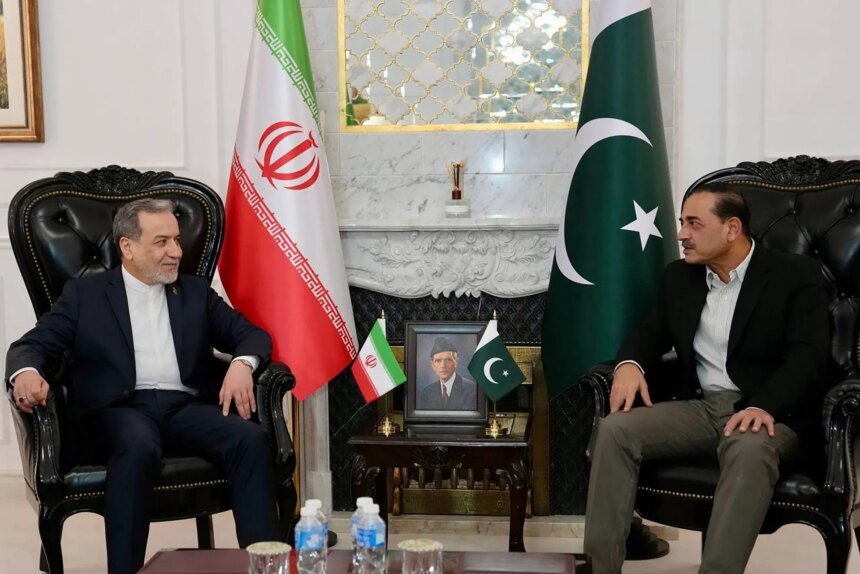
According to the director of Al Jazeera’s Islamabad office, Abdul Rahman Matar, Iranian Foreign Minister Abbas Araghchi left the Pakistani capital, Islamabad, heading to the Omani capital, Muscat, after an official visit that lasted about 19 hours.
According to Matar, 4 helicopters took off from the Pakistani Prime Minister’s residence towards the Nour Khan military base, transporting the Iranian minister to complete his regional tour.
Intensive meetings and active mediation
The visit witnessed extensive meetings, culminating in a final meeting with Pakistani Prime Minister Shehbaz Sharif, in the presence of the Ministers of Foreign Affairs and Interior, Army Commander Asim Munir, in addition to the National Security Advisor, who heads one of the most important Pakistani intelligence services.
The Al Jazeera correspondent stressed that Islamabad’s role goes beyond simply acting as a “mailbox” to transmit messages, as the Pakistani army commander plays a pivotal role in formulating ideas, proposing solutions, and trying to bring viewpoints closer to dismantle the intractable knots between Tehran and Washington.
Iranian television had reported that the Iranian Foreign Minister conveyed Tehran’s response to proposals presented by the Pakistani army commander during his visit to Tehran in the middle of this month, stressing that the response is comprehensive and takes into account all of Tehran’s observations.
Diplomatic sources reported to Al Jazeera that the Pakistani side is currently studying and evaluating the Iranian proposals to improve them, before presenting them to the American side at a later stage, in an effort to persuade Washington to send its envoys to hold a second round of negotiations.

Tehran’s conditions and the “compromise solution”
In Tehran, Al Jazeera Bureau Director Nour al-Din al-Daghir explained that the Iranian vision was formulated by the “National Security Council” and essentially aims to get out of the state of “no war and no peace” that Tehran rejects, leading to a comprehensive end to the war.
According to Al Jazeera sources, the Iranian conditions include providing legal guarantees (via the United Nations, the Security Council and the host countries) that prevent the United States and Israel from repeating the attack on Iran in the future, in addition to lifting the blockade on Iranian ports and resolving the Strait of Hormuz crisis.
Al-Daghir revealed a “compromise” proposal proposed by Pakistan and currently under discussion, which stipulates a limited and mutual reduction in escalation. So that Iran will loosen its grip on the Strait of Hormuz and allow the passage of a limited number of ships, in exchange for a parallel American easing of the blockade imposed on Iranian ports.
Tehran is awaiting the American response to this proposal, considering that any toughness from Washington regarding the ports file will obstruct any future negotiating path.
With Araqchi’s departure to the Sultanate of Oman, the chances of holding a direct meeting in Islamabad with American envoys Steve Witkoff and Jared Kushner are dashed. This is a scenario that sources in Tehran had described to Al Jazeera as “very weak and does not exceed 10%,” and is linked exclusively to the extent of the prior American response to Iranian conditions.

American confirmation with a second round
Coinciding with Araghchi’s visit to Pakistan, White House spokeswoman Carolyn Levitt confirmed that envoys Steve Witkoff and Jared Kushner will leave on Saturday for Islamabad to hold direct talks with the Iranian side, mediated by Pakistan.
The White House spokeswoman said that Vice President J.D. Vance “will remain deeply involved in the course of this entire process regarding Iran.”
In turn, US President Donald Trump said that Iran wants to hold talks and discuss the possibility of reaching an agreement, and that it intends to make an offer that meets American demands.
The Washington Post quoted the White House spokeswoman as saying – today, Saturday – that President Trump is focusing on negotiations to ensure the removal of the Iranian nuclear threat, noting that he made it clear that “the economic disturbances are temporary and that the world will become safer,” according to what Levitt quoted him as saying.
The Washington Post had previously quoted officials as saying that the decision not to send the US Vice President to Islamabad is in line with the protocol that requires him to negotiate with counterparts at the same level, indicating that his absence may make it easier for the US administration to deal in the media with the repercussions of the failure of the talks.
Yesterday, Friday, the New York Times newspaper reported from Iranian officials that Araqchi will travel to Islamabad, carrying a written response to the American proposal for a peace agreement, and that he is expected to meet in Pakistan with Witkoff and Kushner to continue negotiations.
Iranian denial
After the aforementioned White House confirmation of direct talks with the Iranian side, the Iranian Foreign Ministry spokesman said that there are no plans to hold any meeting between Iran and America in Islamabad.
Iranian television also said, last Friday evening, that Araqchi does not plan to meet with Witkoff and Kushner, indicating that the Pakistani mediator will convey Tehran’s observations on ways to stop the escalation to the American side.
Fars Agency also quoted sources close to the Iranian Supreme National Security Council that there are no negotiations with the United States.
American proposal
According to the director of Al Jazeera’s office in Tehran, information and sources indicate that a proposal reached the Iranians via Pakistan from the American side, centered on how to deal with the blockade of Iranian ports and the Strait of Hormuz, and the mechanism that could be a middle line between what pleases Tehran and what pleases Washington.
Al-Daghir stated that Araghchi’s visit enjoys the support of the Iranian National Security Council, and he revealed – based on his information and sources in Iran – that the level of negotiation and the Iranian negotiating team may change, and negotiations may take place between Araghchi and the American envoy Steve Witkoff, and the location of the negotiations may change from Pakistan to the Sultanate of Oman.
It is likely that the entry of the Sultanate of Oman and Russia into the line may confirm that there are other proposals, and that the Russian side will try to overcome obstacles between Washington and Tehran, especially on the issue of the Iranian nuclear program.
Between the American assertion that the discussions will be held and the Iranian denial that they will be held, Al Jazeera correspondent Farah Al-Zaman Shawqi says that intensive security preparations are taking place in Islamabad, and that Pakistan is behaving as if it is preparing for American-Iranian discussions, while the situation remains in anticipation of what developments the coming hours may bring in this regard.