Published On 4/24/2026
Today, Friday, the US Central Command (Centcom) announced the presence of three aircraft carriers in the Middle East, operating simultaneously, for the first time in decades, coinciding with the announcement of a visit by Iranian Foreign Minister Abbas Araqchi to the Pakistani capital, Islamabad, in the context of the ongoing movement to resume negotiations with Washington.
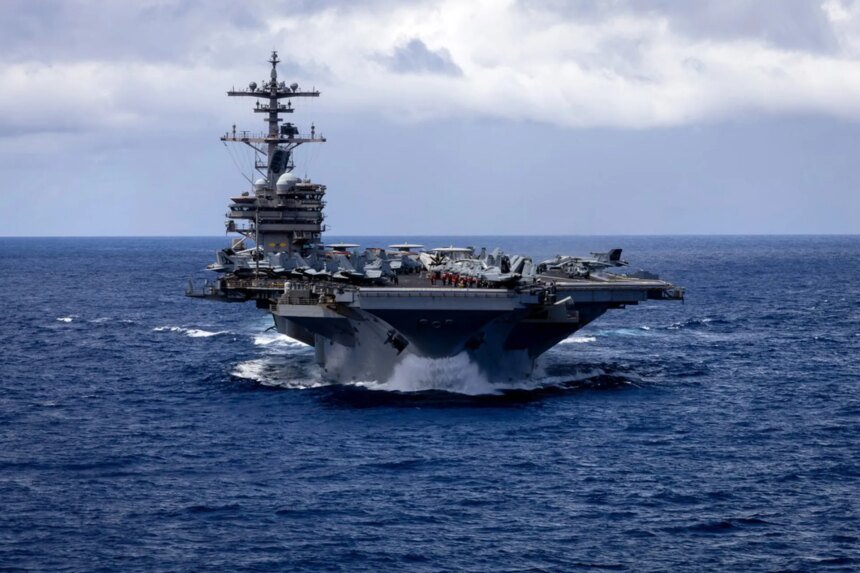
Centcom’s announcement comes after the arrival of the US aircraft carrier USS George Bush to the region, joining the aircraft carriers Abraham Lincoln and Gerald Ford.
Centcom said, through its account on the
Specifications of the third aircraft carrier
The nuclear-powered aircraft carrier “George Bush” carries on board 80 combat aircraft and helicopters of various types, including F-18 fighters, the V-22 helicopter, and CH-53 helicopters.
The carrier is 333 meters long, rises 20 stories above sea level, has a 200-meter runway for aircraft, carries 5,700 navigators and soldiers on board, and operates through two nuclear reactors, in addition to multiple equipment and weapons to protect it.
New military plans
CNN, citing informed sources, revealed on Friday that American military officials are working on new plans to target Iran’s capabilities in the Strait of Hormuz, if the ceasefire collapses.
The sources reported that the US military may implement President Donald Trump’s previous threat to strike Iranian targets, including energy facilities, in an attempt to force Tehran to sit at the negotiating table.
Trump had stated more than once that his country would resume military operations if a diplomatic solution to the war was not reached.
According to CNN, additional US strikes – if they occur – are likely to target remaining Iranian military capabilities, including missiles and launchers, and production facilities that were not destroyed during the first 40 days of the war.
The network quoted sources as saying that Trump’s extension of the ceasefire is not temporary, and that the US army is ready to resume strikes if necessary.

Iran in Pakistan…an indicator of escalation
Regarding a question about the variable that prompted the Iranian Foreign Minister to go to the Pakistani capital, Islamabad, Hisham Al-Ghanem, a researcher at the Carnegie Endowment for International Peace, told Al Jazeera that the main variable is the American preparation for major military operations in the Strait of Hormuz, considering that the Iranian regime is experiencing a state of panic at this time.
He added that the fundamental motive for the Tehran delegation going to Pakistan was the desire to find an agreement, in an effort by the Iranian regime to avoid the return of war and destruction, likening the upcoming negotiations to the previous nuclear talks in Oman before the outbreak of war on February 28 of last year.

It seems that Araghchi’s visit will not be limited to Pakistan, as the Iranian News Agency reported that Foreign Minister Araghchi will begin a foreign tour today that will lead him to Islamabad, Muscat, and Moscow, noting that the goal of the tour is to hold bilateral consultations and discuss the latest developments in the war on Iran.
Al Jazeera’s correspondent also quoted a Pakistani government source as saying that Araqchi will meet in Islamabad with the Pakistani Prime Minister, in the presence of the Army Commander.
In this context, Hassan Ahmadian, professor of Middle Eastern studies at the University of Tehran, believes that the present time represents the calm before the storm, given the American moves to bring in military capabilities.
Ahmadian said that the reason Iran is insisting on ending the naval blockade is because it is a cover to mobilize more military forces in preparation for the next stage.
He concluded that the United States failed to achieve its goals in the war, and that it could not live with this failure, which prompted it to seek to change the image by bringing in new forces.