BeirutIn southern Lebanon, where stories mix with the smell of gunpowder, Lebanese journalist Amal Khalil was writing war diaries from her heart, not from its margins. She was not just a field correspondent, but rather a voice accompanying the people in the border villages, conveying their details as they were, and accompanying them in moments of fear and waiting.
For years, her name was associated with covering confrontations in the south, as one of the few who chose to remain in the field despite the risks. But this sound suddenly stopped, when an Israeli raid targeted a house where she took refuge in the town of Al-Tiri, after her car was pursued, so she could rise while performing her journalistic work.
Her passing was not a passing event in the media, but rather a widespread shock. Media organizations and Lebanese officials condemned her, and her targeting was considered a “described crime” and a clear violation of international humanitarian law, in light of the escalation in the targeting of journalists during their field coverage.

A popular farewell
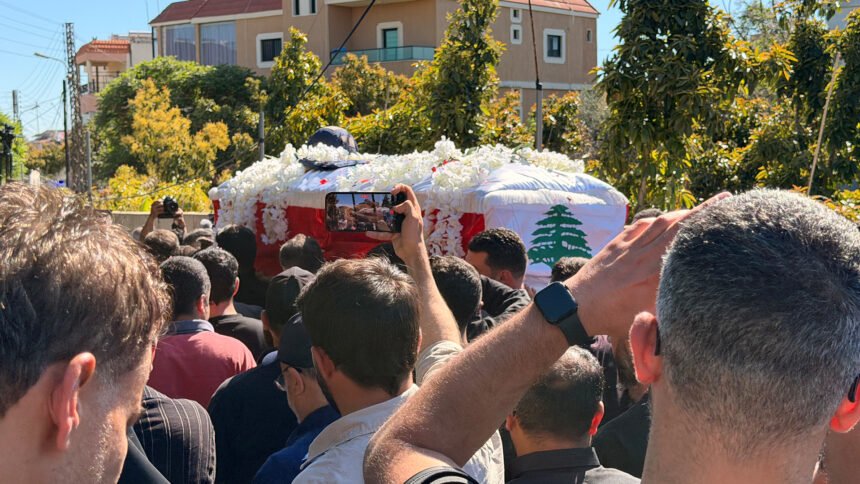
As her body was transported from the site of the attack to the hospital, and then to her hometown in the town of Al-Bisariya in southern Lebanon, the farewell scene began to take shape. There, family and colleagues gathered to mourn her in a farewell that had a popular and professional character at the same time, for a journalist known for her closeness to the people and her constant presence among them.
The funeral was not just a ceremony, but rather turned into an intense moment that summed up her journey: a coffin carried on the shoulders of those she accompanied in their daily lives, images returning from the square to the street, and voices bidding farewell to those who conveyed the voices of others.

Part of the story
In this scene, Amal Khalil seemed as if she was finally returning to the place she had written about for so long, but this time, not to tell the story, but to become a part of it.
In a voice mixed with anger and loss, Ali Khalil, the martyr’s brother, recalls the hopes of the last moments before the connection was cut off, as if time stopped at that minute and did not move forward after that. He is not talking about a passing incident, but rather about a “crime with complete evidence,” as he describes it to Al Jazeera Net. It began by targeting a convoy once, then it was re-targeted, before those inside it took refuge in a three-story building that did not survive the bombing.
In his novel, there is no room for coincidence; What happened – for him – was a clear insistence on killing, which opens the door to heavy questions about responsibility and accountability.
Holding the killers accountable
This feeling of injustice is inseparable from a demand that Amal’s brother considers self-evident, stressing that her blood cannot be left unaccounted for, hinting at the existence of some negligence, even if its features are not yet clear, and placing the responsibility on the relevant authorities to take action, based on the fact that she is a journalist who was supposed to receive greater protection.
When we recall the last moment, it goes back to a call that took place around four-and-a-fifteen in the afternoon. Amal, as usual, was in contact with her colleagues, continuing her work as if nothing was stopping the rhythm of the field. Only a few minutes later, at about 4:27 p.m., the raid occurred and everything stopped at once. From that moment on, there was nothing but silence, a heavy silence that filled the void she had left.
However, in his view, the loss goes beyond the family. Amal was not just an individual, but a living presence in her surroundings, with extensive relationships and an unmistakable impact. He describes her as a “magic lantern” who is able to fulfill everything that is asked of her, and to carry out her professional and family responsibilities at the same time.

Targeting details
In parallel with this story, Civil Defense official Musa Shaalan recalls, to Al Jazeera Net, the details of the last hours with remarkable accuracy, as if they were still present with all their weight, and indicated that Amal had been in contact with them hours before, following what was happening and coordinating the arrival of the ambulance teams. But between three-thirty and four-thirty, everything changed.
She called to inform them of the presence of martyrs, and asked to rush to transport them, confirming that she was waiting for them. The team moved from the Hadatha center towards the outskirts of the town of Tiri, accompanying the Lebanese army, until they reached the last checkpoint, where it was impossible to advance due to the lack of permission.
At that moment, it seemed possible to reach them, as the distance did not exceed 100 meters, separated by a small hill. She was asked to move towards them, but the scene quickly changed.
The pursuit began with drones, and Amal’s voice over the phone suggested mounting anxiety. Moments later, everything changed: she couldn’t move anymore… she was injured. Still, I tried to survive.
Then the connection is cut off. Unable to network. Moses realizes what has happened, without saying it. He could not reach, nor could the army, in the absence of permission. Only the Red Cross was later able to enter and remove the two bodies. The arrival process took about half an hour, a heavy task, the details of which should be kept away from the public.

Colleague testimony
Al Jazeera journalist Mubasher Jawad Shukur confirms that Amal was a teacher, a professor, and a humanitarian and professional reference for an entire generation. She was not content with conveying the news, but rather sought to provide everything her colleagues needed, and open the way for them in areas she knew in detail.
Shukr points out that she chose to be at the heart of the event, even in places that were inaccessible to many.
In testimony closer to revelation, Al-Mayadeen correspondent Jamal Al-Gharbi talks about Amal as part of his daily life. She was not just a colleague, but a “sister,” and a refuge in details beyond work. In her home, the meetings were a space of warmth amidst busy days in the field, and in her reports, it was “the story of the South” with all its pain and details.
The same image is repeated in the novel by the new correspondent, Ibrahim Dawi, who summarizes her relationship with him in two words: mother and sister. She would start her day by checking up on him, asking him about his small details, as if she was making up for a personal absence in his life. Even one day before her martyrdom, she invited him to lunch, a simple detail that sums up the depth of the relationship.
In all these testimonies, one picture is formed: that Amal was not just a journalist reporting the news, but rather a part of it, with her human and professional presence that extended across people and places, and her absence left an impact that cannot be summed up in words.

Repetitive pattern
The targeting of journalists in southern Lebanon since October 2023 is no longer a passing detail in the context of the war, but rather has become a recurring pattern that raises mounting concerns about the safety of those working in the field. Since the outbreak of the recent confrontations, several cases have been recorded in which journalists were killed and others were injured while covering events, despite the clarity of their media identities and their adoption of approved safety measures.
Some of these targeting show signs of deliberate or gross negligence in protecting civilians, in violation of what is stipulated in international humanitarian law, which guarantees the protection of journalists as civilians.
On the other hand, calls for independent investigations and accountability of officials are increasing, amid warnings that impunity creates a more dangerous environment and threatens the right to truth in conflict areas.