Published On 2/2/2026
|
Last update: 22:03 (Mecca time)
If you are thinking of visiting Bali, Sacred Monkey Forest Sanctuary should be one of your essential destinations.
The charming reserve is located in the village of Padang Tegal, in the heart of Ubud, the most famous icon on the island. It is not classified as just an ordinary zoo, as it combines the magic of nature with the cultural roots and spiritual symbolism of the place. It is a natural reserve and a Hindu temple complex extending over an area of 12.5 hectares (about 30 acres).
Philosophy of place
The people of Padang Tegal village manage the forest based on an ancient philosophy called Tri Hita Karana, which forms one of the cultural and social foundations of the Indonesian island of Bali, and literally means “the three causes of happiness” or “the three sources of harmony.”
This philosophy is based on a comprehensive vision of how to achieve balance in individual and collective life, by creating harmony between three elements: (man with man, man with the environment, and man with the spirit). This is what makes the visitor feel that the place is alive with life beyond just sightseeing.
The place is also surrounded by a group of local legends and beliefs, including that the monkeys here are not just wild animals but guardians of the temples. This legend is linked to the famous epic “Ramayana”, specifically with the character “Hanuman” (the white monkey god).
Local residents also believe that spirits reside in the roots and branches of huge banyan trees, and in Bali mythology these trees are considered bridges between the human world and the world of spirits.

The long-tailed macaque, the original inhabitants of the forest
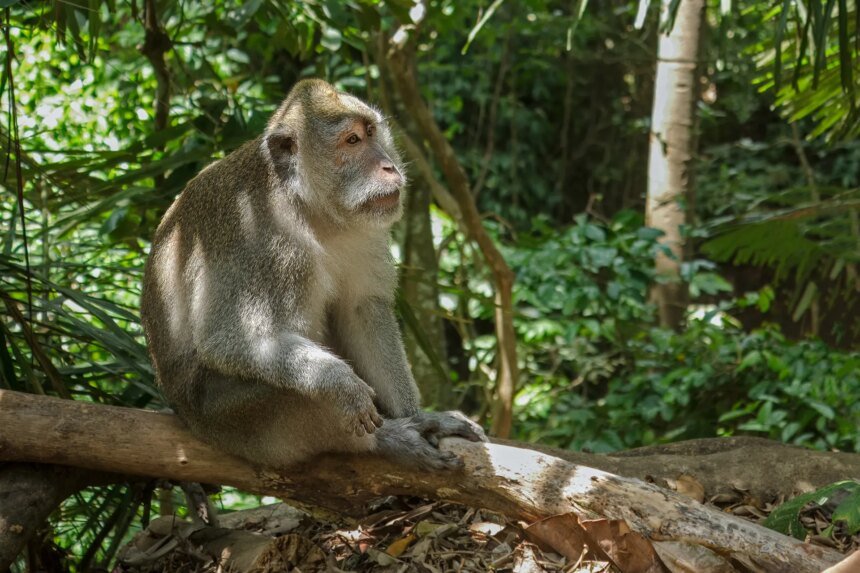
The Monkey Forest is home to more than 1,260 Balinese long-tailed macaques (Macaca fascicularis), the indigenous inhabitants of this natural space. These monkeys live within six relatively independent social groups, each of which has its own domain within the reserve, and operates according to a clear hierarchy that governs power relations and interaction between them.
As you wander through the forest, you will notice behaviors that seem funny at first glance, but they reflect a complex social life. Monkeys spend their time eating, cleaning each other, and playing, but they do not hesitate to interact directly with visitors in ways that may sometimes be provocative. She may surprise you by trying to snatch a bottle of water, mess with your hair, or lie down quietly for a nap in the middle of the walking paths as if the place belongs to her, which it actually does.
One of the funniest experiences you can have in the forest is what is known as the “monkey selfie,” where the employees use a simple trick based on attracting the monkey with sunflower seeds behind the phone, so he extends his hand towards the device so that it appears in the picture as if he took it himself.
Between the humor and light chaos, the presence of these monkeys remains an essential part of the place’s identity, giving it a vitality that cannot be separated from the forest experience itself.
Temples and monuments
The reserve includes architectural treasures dating back to the fourteenth century (around 1350), which are temples of great religious importance to the local community:
- Pura Dalem Agung: The main temple dedicated to Lord Shiva.
- Pura Beji Temple: A temple dedicated to purification and healing with a spring of holy water.
- Pura Prajapati Temple: The temple adjacent to the cemetery, used for cremation ceremonies.
- Highlights: Don’t miss the concrete “Dragon Bridge” that runs over a deep valley and is guarded by stone dragon statues, as well as moss-covered “Komodo Dragons” statues, and a giant banyan tree that is more than 100 years old.

Safety rules.. How to avoid monkey riots?
The Sacred Monkey Forest Reserve is a wild place par excellence, so you must be careful and follow some important safety instructions:
- Collectibles: Avoid wearing large earrings, jewelry, or glasses (prescription and sunglasses); The monkeys snatch them with lightning speed.
- Food and Bags: It is strictly forbidden to bring outside food or plastic/paper bags, as monkeys associate the sound of bags with food and will attack you to get them.
- Eye contact: Do not look into the eyes of monkeys and do not smile showing your teeth, as this is interpreted as a sign of aggression.
- Touching: Let the monkey touch you if it wants, but do not try to touch or hold it, especially mothers who are fiercely protective of their young.
Rabies and Herpesvirus B
When searching for details of a visit to a sacred monkey sanctuary, you may come across some warnings stating that the monkeys may be infected with rabies. But according to what was reported on The World Travel Guy website, a number of scientists from America and Australia, who examine monkeys annually, have confirmed that they are free of this disease.
- Vaccination: In 2023, the authorities began a comprehensive vaccination campaign for monkeys as a precaution.
- Herpes B virus: According to the same site, an American study in 2002 proved that the strain carried by these monkeys is not pathogenic to humans, and no cases of infection have been recorded historically in Bali.
- First aid: If you are bitten, there is a first aid office on site to use sterilizers and antiseptic creams.

Basic information and logistics
Here is some basic information you should know before visiting the reserve:
- Location: Jalan Monkey Forest, heart of Ubud.
- Operating hours: 9:00 am – 6:00 pm (ticket sales end at 5:00).
- Entrance fees: Adults (100-120 thousand Indonesian rupiahs, approximately 6.5-8 US dollars), children (80-100 thousand Indonesian rupiahs, approximately 5-6.5 US dollars), as the price varies depending on the day of the week.
- Facilities: Restrooms, parking for cars and bicycles, photo gallery, gift shop, and first aid are available.
- Expert Tip: The best time to visit is early morning (9:00 – 11:00) to avoid crowds and heat, and in the dry season (April – October).

Nearby tourist alternatives
If you feel that Ubud Forest is too crowded, you can head to:
- Sangeh Forest: less crowded and quieter.
- Alas Kedaton: A sanctuary for monkeys and giant bats (flying foxes).
However, try your best not to miss visiting the reserve, as it is the best place where you can see the harmony between humans and animals in the Sacred Forest Palace, and enjoy the beauty of more than 115 species of tropical trees.