

There is no longer a distance between threat and implementation. While Washington threatens that every next Iranian bullet will be met with a 20-fold hit, and declares that the memorandum of understanding that stopped the war has “ended.” The Revolutionary Guard responds that “any repeated aggression will expand our overwhelming responses to include it,” rejecting any American or “Atlantic” role in managing the strait.
It is an escalation of statements that are no less hot than the flames of fire that have been burning around the Strait of Hormuz for two days, and behind this exchange of words and deeds, the readings intersect and diverge: who sees that the current strikes are nothing but a prelude to a painful strike that will force Tehran back into full compliance with the Memorandum of Understanding and put pressure on it in order to improve the terms of future negotiations. Whoever believes that what is happening is nothing but a “symptom” of a deeper conflict and whose goals are beyond the immediate vision of the course of the escalation.
Both sides have a completely opposite definition of the concept of “victory” itself:
- Washington does not accept anything less than complete compliance.
- Tehran is asking nothing more from this round than “steadfastness.”
Between the two readings, a picture emerges of a war that may take the character of fragmented clashes interspersed with fragile truces rather than the character of a quick resolution.
If the scope of the confrontation expands, the bank of goals itself is likely to expand. From barracks and missile platforms to what is described as the “innocence” of the Iranian economy represented by energy facilities, ports, and supply lines, this is a strategy that seeks to tighten the stranglehold on the regime’s ability to withstand, not just exhaustion.
Will the two parties reconsider their calculations towards a decisive strike that will end the round and revive the memorandum of understanding to improve strategic negotiation, or will the region open up to a prolonged exhaustion that no one will resolve? Will the North Atlantic Treaty Organization (NATO) and the Iranian Resistance Axis remain on the sidelines of the scene, or will they become two active parties in an equation that has not yet been resolved?
All of them are questions that open the door to readings by 4 researchers and analysts in statements to Al Jazeera Net. Their viewpoints differed, but they converged on one conclusion: “No resolution soon, and no imminent stability.”.

Scenarios of a return to war
Between the possibility of a painful strike that will force the parties back to the point of agreement and negotiation under the influence of fire, and the possibility of a gradual slide towards a confrontation in which victory cannot be measured by a single standard, analysts’ readings are distributed over an area of expectations that meet at a minimum and diverge at the essence of the path: Is this round being conducted to end the crisis or just manage it?
There is a precise detail that reveals Washington’s intentions in this round. When it chose to describe its strikes as “attacks” and not a “military operation,” it thus avoided deserving prior congressional approval, an indication of its desire to escalate without sliding into a comprehensive confrontation for which it would be held politically accountable.
On the basis of this approach, the political affairs and maritime security expert, Major General Mohamed Abdel Wahed, places the possibility of a return to all-out war in a deliberate gray area, noting that the scenario is “high but not very high,” as US President Donald Trump’s fiery statements and Israel’s pressure to complete the war clash with its high cost and the approaching electoral elections in Washington and Tel Aviv.
Major General Abdul Wahed added – in his statements to Al Jazeera Net – that if the war breaks out again, it is likely to be closer to repeating the “39-day war”: “Intense air strikes exploiting complete air superiority, with a focus this time on the “centers of gravity” that were not completely targeted previously as a result of wrong American-Israeli calculations.”
On the other hand, military and strategic researcher Dr. Ali Al-Dhahab believes that the current strikes, despite their cruelty, may only be a pressure tool to return Tehran to full compliance with the memorandum of understanding, not to blow it up, as Trump’s declaration of its “end” – and what an Iranian official described as a “mercy bullet” – is more political cover-up than a final reality. Or that the continuation of the confrontations for a longer period would lead to amending the terms of the memorandum in a way that would prevent Iran from returning to threaten navigation.
As for the Omani researcher in strategic affairs, Dr. Abdullah Al-Ghailani, he puts the whole picture in a deeper context: What is happening is nothing but a “manifestation” of a conflict that is too long to end at the end of this round. The sticking point lies in the discrepancy in goals. Washington wants to weaken the Iranian regime to the point of submission after being unable to overthrow it.
Al-Ghailani added – in his statements to Al-Jazeera Net – that Tehran is fighting a “zero-sum war” in which victory is defined only by “steadfastness.”
The same speaker concludes that the war will take the form of fragmented clashes separated by fragile truces and intense mediations, and that Iran is better able to bear this scenario because it is using the war to hold its internal front together, while Washington cannot prolong it due to its high cost, which may push it to carry out specific strikes that disintegrate the structure of the regime and force it toward submission.
Growing Goal Bank
As the scope of the confrontation expanded, the nature of the goals themselves changed. The target bank, which was limited to military barracks and platforms, is gradually expanding towards the economic arteries that keep the state afloat, an indication that the coming battle, if it expands, will not be managed with a purely military logic, but rather with a comprehensive, gradual logic of strangulation.
Therefore, the Director-General of the Middle East Council for International Affairs in Doha, Dr. Khaled Al-Jaber, believes that any expansion of the confrontation will push the goal bank to go beyond military facilities towards the “economic and logistical structure” with which the regime finances its capabilities (energy facilities, fuel storage centers, military industries, and transportation networks, in addition to missile platforms, drone factories, and command centers) in a strategy whose goal is to gradually tighten the noose on the regime’s ability to withstand and not simply exhaust its army.
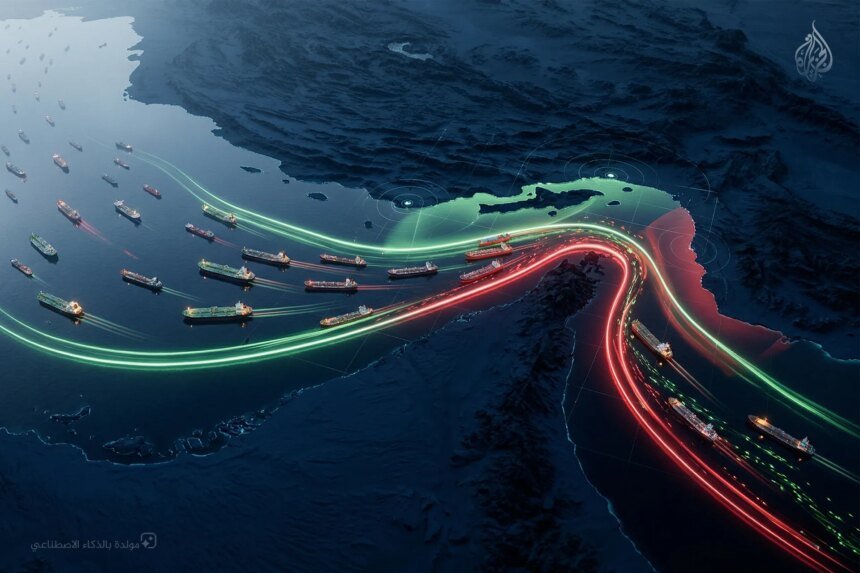
Abdul Wahed details the “Goal Bank” according to the perpetrator. Israel is focusing on its missile capabilities, factories, and underground warehouses, and Washington is targeting Iran’s entire naval capabilities (coastal missile platforms, radars, and naval command centers) to paralyze the Revolutionary Guard’s ability to control the Strait of Hormuz.
On the other hand – according to the water security expert – Iranian goals remain the same: missiles towards Israel and American bases, with the possibility of threatening gas and oil platforms in the Gulf states or mining the strait to raise oil prices, even if the Gulf air defenses have become more capable of intercepting them.
Ali Al-Dhahab draws a broader geographical map that includes the new Iranian targets, which are distributed over a “winding coastal arc” from Ahvaz in the north to the port of Chabahar in the south, and are given priority due to their proximity to American naval vessels, the fact that they are a source of direct threat to navigation, and the weakness of their defensive capacity, which does not exceed 20% after accumulated attrition.
This area includes nuclear facilities, most notably the Bushehr station, and ports that represent the artery of export and import, making it a “lung” for Iran. If it is disrupted, Tehran will lose its steadfastness. The facts of the past days confirm this reading, as the strikes included Bandar Abbas, Bushehr, Chabahar, and Abu Musa, and the Tehran-Mashhad railway line was stopped, according to statements by the researcher specializing in military and strategic affairs to Al Jazeera Net.

Attrition or quality blows?
Among those who see the current strikes as calculated surgical operations aimed at breaking the will of the regime, not just exhausting it, and those who open the door to the possibility of everyone sliding into open-ended exhaustion, the question remains about the nature of the upcoming confrontation, dependent on a complex equation of political and military calculations on both sides.
Here, Al-Jaber resolves the debate from his perspective: What is happening is not classic attrition, but rather “specific devastating strikes” aimed at breaking the vital joints of the regime so that continuing escalation becomes more costly than retreating from it.
Abdul Wahed opens the door to a different possibility, indicating that some study centers suggest a prolonged attrition that will raise the cost for everyone, especially with the possibility of the entry of actors such as China and Russia in rejection of complete American control over the strait, although he concludes that the closest American goal remains quick and effective strikes and not open-ended attrition.
Al-Ghailani links the continuation of the current escalation to three factors:
- A shift in the internal American mood led by a democratic movement pressing to end the war.
- A fundamental shift in NATO’s position towards protecting navigation, for which there are no serious indications.
- A Gulf axis has crystallized, leading independent mediation.
In the absence of these factors combined, the Omani researcher concludes that the medium term does not indicate that the war will stop, but it also does not indicate an era of high-intensity clashes, as both parties are exhausted.

NATO and the axis of resistance
On the sidelines of the direct confrontation between Washington and Tehran, a question arises about the extent to which other actors are willing to change the balance of war. NATO announces careful insurance for international navigation, while Iran’s regional arms remain linked more to internal calculations than to its desire to engage.
In this context, Abdul Wahed and Al-Dhahab rule out any direct Atlantic involvement in the fighting, suggesting that it will be limited to logistical and intelligence support, “undeclared” ammunition, and mine-sweeping missions similar to what happened against the Houthis in the Red Sea.
Al-Dhahab points out that the geographical peculiarity of Hormuz, as it is a narrow corridor open on one side only, makes any direct NATO engagement more complex and more expensive, and it is likely that support will be limited to securing the southern corridor near Oman.
Al-Ghailani links this hesitation to the essence of his equation: NATO’s position has changed as one of the three conditions for breaking the stalemate, but there are no serious indicators so far that indicate this, which keeps the European presence at the limits of “caution” and not “decisiveness.”
Regarding Iran’s agents, the Director-General of the Middle East Council for International Affairs believes that the expansion of the confrontation will push the militias allied with Tehran to move in more than one arena to relieve pressure on it (Houthi escalation, Iraqi movements, and possible Lebanese tension), warning that this option is “risky” because it may give Iran’s opponents a justification to expand their operations against its networks.
The political affairs and maritime security expert believes that these arms will likely be greatly weakened if a comprehensive war breaks out. While the researcher specializing in military and strategic affairs links Hezbollah’s involvement in the navigation issues and the ongoing Israeli strikes despite the memorandum of understanding, ruling out a major role for it as it is “in a self-defense phase,” and it is likely that the Houthis’ decision will remain dependent on Iran’s ability to push them to engage publicly more than on their own desire, especially in light of the path of calm currently taking place between them and Riyadh.
And the bottom line.. Between strikes described as “attacks” to avoid political repercussions, a bank of targets extending from the barracks to the arteries of the economy, and varying readings of the form of the confrontation (a decisive strike that returns everyone to the memorandum of understanding, or fragmented, prolonged zero-sum clashes), the Strait of Hormuz remains the scene of an undeclared negotiation whose chapters are managed by fire.