

Published On 9/7/2026
|
Last update: 15:18 (Mecca time)
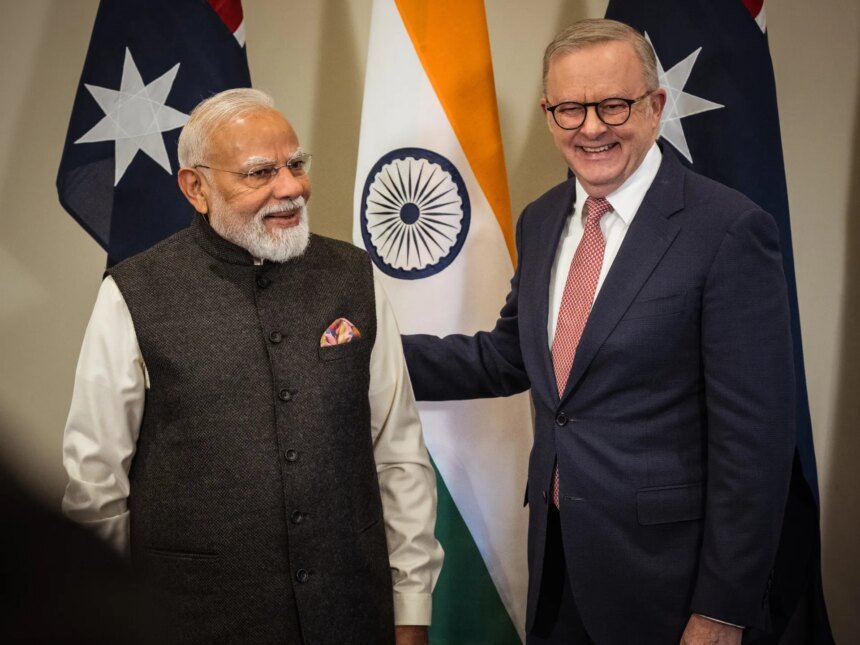
Australia decided to resume the sale of uranium to India for peaceful purposes after Australian Prime Minister Anthony Albanese and his Indian counterpart Narendra Modi signed an executive agreement today, Thursday, in Melbourne, activating the uranium export agreement that had been stalled for years due to fears of its use in weapons, but they did not disclose details of the amount of uranium that will be sold or when.
Modi said after talks with his Australian counterpart Anthony Albanese: “Today we signed an important agreement on nuclear energy. This will pave the way for the supply of uranium from Australia to India, and will give our goals in the field of clean energy new impetus. The agreement allows the long-term export of uranium exclusively for peaceful purposes.”
Exports will be subject to controls set by the International Atomic Energy Agency. “This arrangement facilitates the export of Australian uranium to India, to contribute to increasing the share of renewable energy,” Albanese told reporters.
According to a joint statement, the two countries will build a “temporary space tracking station” in Australia’s Cocos Keeling Islands in the Indian Ocean, to support Indian spaceflight projects.
The largest reserve
Australian uranium exports to India stopped after the 2014 agreement, due to concerns that the uranium could be used to make weapons.
Australia has the largest known reserves of uranium in the world – about 28% of global uranium reserves – but it does not use nuclear energy or nuclear weapons, and all of its uranium is exported.
India, with a population of 1.4 billion people and a growing middle class, seeks to establish nuclear power plants with a capacity of 100 gigawatts by 2047, enough to supply about 60 million Indian homes with electricity annually. However, obtaining uranium was not easy.
India has doubled the amount of nuclear power installed in the country over the past decade, but it still represents only 3% of its total electricity production.
Whose nuclear?
India is not a signatory to the Treaty on the Non-Proliferation of Nuclear Weapons, which only recognizes the United States, China, Britain, France and Russia as nuclear powers. As for Australia, which is a signatory, it refuses to sell uranium to non-signatory countries.
India says the treaty is discriminatory because it only recognizes legitimate nuclear states that conducted nuclear tests before January 1967, which would permanently deprive it of possessing nuclear weapons.
India was imposed with international technology sanctions and a ban on uranium trade after it conducted nuclear tests in 1998. But in 2008, the Nuclear Suppliers Group, which includes the United States, granted India an exemption allowing it to purchase uranium from its members, and since then, Delhi has sought to conclude bilateral agreements that would allow the sale of this material. It signed a similar agreement with Canada in March.
Historically, Australia’s leaders ruled out doing the same until Delhi signed the treaty. However, Canberra’s position softened, and it agreed to allow exports in 2014, provided that it adhered to International Atomic Energy Agency (IAEA) safeguards and “separated India’s civilian and military nuclear programs,” according to a government website.
The administrative agreement reached on Thursday was expected to remove obstacles to activating the previous agreement.
Letters to China
Modi is visiting Australia to attend the annual summit of leaders of the two countries. In their joint statement, Modi and Albanese pledged to strengthen defense and security cooperation in the Indo-Pacific region, “reflecting a qualitative shift in the depth and ambition” of the relationship, according to the text of the statement.
The pledge to strengthen cooperation on regional security came days after Australia criticized China for test-firing a long-range ballistic missile from one of its nuclear submarines in the South Pacific Ocean, an area protected under an anti-nuclear treaty.
The two leaders did not mention China by name when they announced the strengthening of strategic relations, and did not answer reporters’ questions after their statements on Thursday. Thousands of people gathered in Melbourne in the hope of meeting the Indian Prime Minister during his visit.
Relations between India and Australia have strengthened significantly in recent years, driven in part by a shared desire to rein in Beijing’s military ambitions, while working to develop trade partnerships outside China.
India is Australia’s fifth-largest trading partner, with the volume of trade exchange between them in goods and services reaching US$37.7 billion in the fiscal year 2024-2025, according to Australian government figures.
The number of members of the Indian community in Australia has grown significantly in recent years, giving Modi a wide fan base in the country.
For the first time in history, the largest group of overseas-born Australian residents are of Indian origin, according to last year’s statistics released in June.
Modi visited Indonesia earlier this week, and tomorrow, Friday, he will head to New Zealand on his first visit to the country. India and New Zealand signed a free trade agreement last April.