


Published On 7/7/2026
|
Last update: 18:09 (Mecca time)
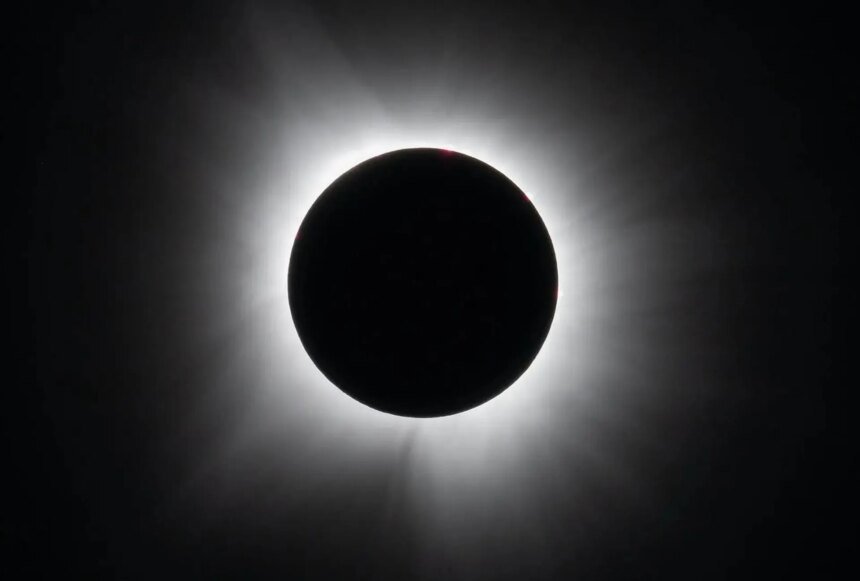
Since solar physicists began studying the Sun in greater detail during the twentieth century, one question has baffled them: Why is the temperature of the solar corona millions of degrees, while the temperature of the Sun’s visible surface is only about 5,500 degrees Celsius?
This seems counterintuitive, as the temperature is supposed to decrease the farther away from its source. For decades, theories have focused on the role of plasma, magnetic fields, and charged particles in energy transfer, but a new study presented an element that had not received much attention before, which is solar dust.
Read also
list of 2 itemsend of list
The study relied on data collected by NASA’s Parker Solar Probe, which came closer to the sun than any spacecraft in history, giving scientists an unprecedented opportunity to study the environment of the solar corona from a very close distance.

The probe approached the solar corona to a distance of approximately 6.1 million kilometers, but it did not carry a device dedicated to monitoring dust, because scientists believed that the high temperatures in that region would evaporate any dust grains before they affected the surrounding environment.
However, antennas and devices measuring magnetic fields and radio signals recorded sudden increases in electrical voltage. After analyzing the data, the research team concluded that these signals are produced when very fine dust grains collide with the probe at tremendous speeds, generating clouds of charged particles that can be monitored electronically.
Lead researcher Sayed Ayaz from the University of Alabama – Huntsville explained that the study adds a new element to understanding the mechanisms of energy transfer in the sun’s atmosphere, after previous studies focused on electrons, ions and plasma only.
How does dust contribute to raising the temperature of the corona?
The study indicates that dust grains acquire an electrical charge in the environment near the sun, and then interact with the magnetic field carried by the solar wind, affecting “Alfvén waves,” which are transverse waves that spread through the plasma along magnetic field lines, and transfer a large portion of the energy within the sun’s atmosphere.
Scientists have believed for years that these waves play a major role in heating the solar corona and accelerating the solar wind, but the new study suggests that dust may be an influential element in this process.
According to the researchers, dust grains may add inertia to the plasma, allowing energy to travel to greater distances within the corona, or their electrical charge enhances interactions between particles and the magnetic field, transforming energy into heat in a more concentrated manner.

Syed Ayaz said: “If the dust mass is the dominant factor, the energy of Alfvén waves may be transmitted to greater distances within the corona, but if the effect of the electric charge prevails, the energy may be transformed locally into heating of the particles.”
He added: “The most interesting question is: Is the dust just passing near the Sun, or does it actually contribute to converting electromagnetic energy into heat and movement of the solar wind? Results that may change the design of future solar missions.”
The results may change the design of future SOLAR missions
Researchers believe that these results may prompt space agencies to rethink the design of future missions to study the Sun, by providing them with specialized devices to monitor dust and its properties near the star.
The importance of these results is not limited to understanding the cause of the increase in the temperature of the solar corona, but also extends to improving models of the formation of the solar wind, which directly affects space weather, satellites, and communications and navigation systems on Earth.
This discovery proves that scientific progress does not always depend on discovering new objects, but sometimes on reconsidering elements that were long thought to be unimportant. The dust, which was thought to evaporate quickly near the sun, may lead to an explanation of a mystery that has puzzled scientists for decades.

With the continuation of space missions and the development of observational tools, our ability to understand the star on which life on Earth depends expands, stressing that investing in scientific research is the way to uncover the secrets of the universe and harness them to serve humanity.
The results of this study were published on July 1, 2026 in The Astrophysical Journal, opening a new door to solar physics research, and perhaps reshaping one of astronomy’s most intractable mysteries.